
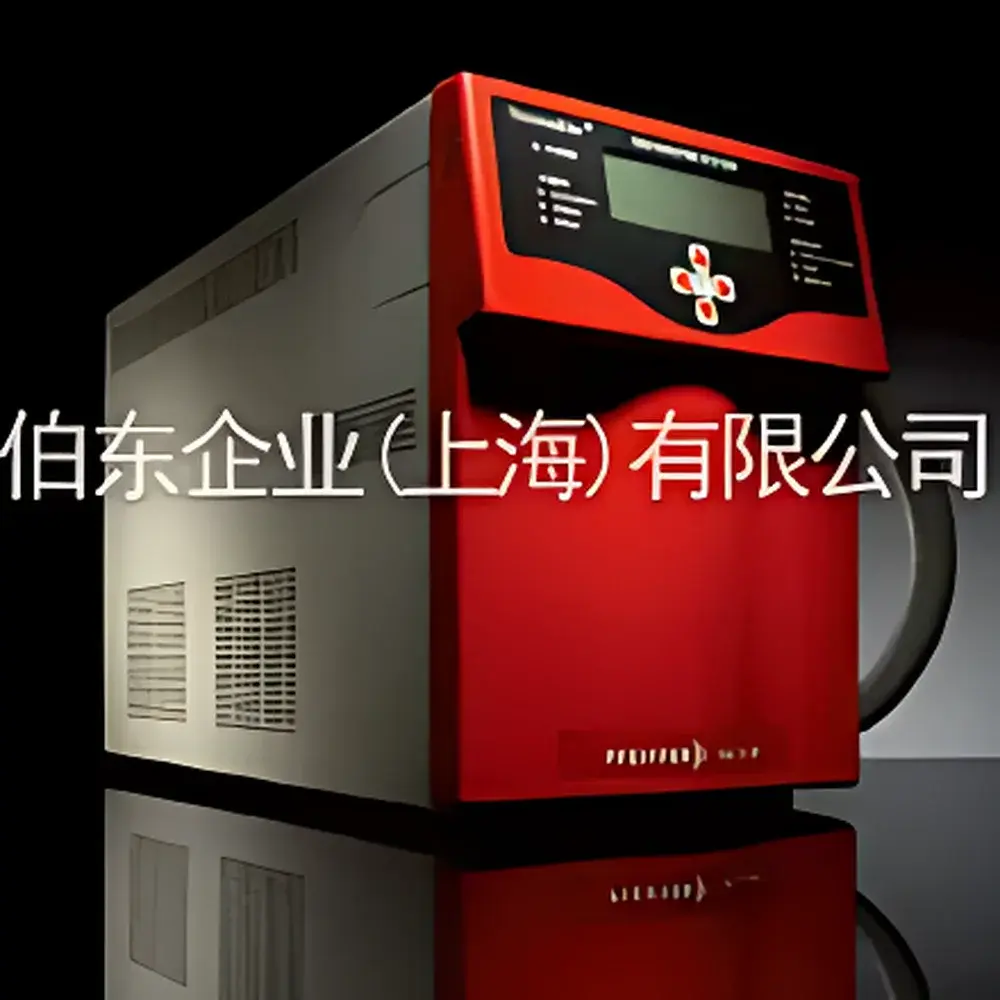
Pfeiffer OmniStar Online Mass Spectrometer for TPD-MS Coupling with Chemisorption Analyzers
| Brand | Pfeiffer Vacuum |
|---|---|
| Origin | Germany |
| Model | OmniStar GSD320 |
| Detection Range | 1–100 u (optional up to 300 u) |
| Ion Source | Hot Cathode Quadrupole |
| Mass Resolution | Unit Mass Resolution (M/ΔM ≥ 150) |
| Detection Limit | < 1 ppm (typical, N₂ background) |
| Interface Temperature | Up to 200 °C |
| Data Acquisition Rate | Up to 100 spectra/s |
| Vacuum Requirement | ≤ 1 × 10⁻⁵ mbar (at analyzer inlet) |
| Pumping System Compatibility | Hicube 300 turbomolecular pump station (integrated or external) |
| Compliance | CE, RoHS, ISO 9001 manufacturing environment |
Overview
The Pfeiffer OmniStar Online Mass Spectrometer is an engineered solution for real-time, high-sensitivity gas-phase analysis in dynamic thermal desorption experiments. Designed explicitly for coupling with chemisorption analyzers—such as those from Quantachrome, Micromeritics, and BEL Japan—the OmniStar enables true TPD-MS (Temperature-Programmed Desorption Mass Spectrometry), TPO-MS, TPR-MS, and TPSR-MS workflows. Its quadrupole mass filter operates with hot cathode ionization, delivering stable, reproducible ion currents across the 1–100 u mass range (extendable to 300 u), with unit mass resolution (M/ΔM ≥ 150) sufficient to resolve key catalytic effluents including H₂ (2 u), CO (28 u), CO₂ (44 u), H₂O (18 u), NH₃ (17 u), O₂ (32 u), and CH₄ (16 u). The system integrates directly into ultra-high vacuum-compatible gas handling lines via a heated capillary interface (up to 200 °C), minimizing condensation and ensuring quantitative transfer of thermally labile species from the reactor zone to the mass spectrometer.
Key Features
- Hot cathode electron ionization source with long-term emission stability and low background noise
- Compact, modular design optimized for integration with commercial chemisorption analyzers and custom-built TPD reactors
- Heated capillary inlet (0–200 °C) with adjustable flow restriction for pressure matching between adsorption chamber (10⁻³–10⁻¹ mbar) and mass spec analyzer (<1 × 10⁻⁵ mbar)
- Real-time spectral acquisition at up to 100 full-scan spectra per second, enabling kinetic deconvolution of overlapping desorption peaks
- Integrated digital signal processing with embedded peak tracking algorithms for automated identification of m/z traces versus temperature/time
- Compatible with Pfeiffer’s HiCube 300 turbomolecular pumping station, providing clean, hydrocarbon-free vacuum without oil backstreaming
- RS-232, Ethernet, and analog voltage output interfaces for synchronization with temperature ramps, gas dosing, and data logging systems
Sample Compatibility & Compliance
The OmniStar is routinely deployed in catalyst characterization laboratories where sample integrity, measurement traceability, and regulatory alignment are critical. It supports solid heterogeneous catalysts—including supported transition metals (Pt, Pd, Ni, Co), metal oxides (CeO₂, TiO₂, Al₂O₃), zeolites, and MOFs—under controlled gas atmospheres (H₂, O₂, CO, NH₃, NO, SO₂, H₂O vapor). All hardware and firmware comply with CE marking requirements and RoHS directives. Manufacturing adheres to ISO 9001 quality management standards. While the instrument itself is not FDA-cleared, its data acquisition architecture supports GLP/GMP-aligned workflows when paired with validated software: raw spectral files (ASCII .dat or .csv) retain full timestamping, detector voltage, filament current, and calibration metadata—enabling audit-ready reconstruction of analytical sequences per 21 CFR Part 11 principles when used with compliant LIMS or ELN platforms.
Software & Data Management
The OmniStar operates with Pfeiffer’s proprietary TPQMS (Thermal Programmed Quadrupole Mass Spectrometry) software suite, which provides synchronized control of temperature ramp profiles (imported from external TPD controllers), gas flow switching, and mass spectral acquisition. Key capabilities include: multi-ion monitoring (MIM) for simultaneous quantification of up to 32 m/z channels; background subtraction using reference scans; real-time calibration against known gas standards (e.g., air, Ar, CO₂ mixtures); and export of time-resolved ion intensity vs. temperature plots compatible with OriginLab, MATLAB, and Python-based kinetic modeling tools (e.g., PyKinetic, CATKIN). Raw data files preserve full spectral fidelity and are structured for interoperability with third-party chemometrics packages supporting PCA, MCR-ALS, and reaction mechanism elucidation.
Applications
- Quantitative determination of active metal dispersion and surface area via H₂ or CO chemisorption coupled with desorption stoichiometry
- Identification and kinetic profiling of surface intermediates during CO oxidation, NOx reduction, ammonia synthesis, and Fischer–Tropsch reactions
- Decoupling of overlapping desorption events in mixed-gas TPD (e.g., distinguishing NH₃ from H₂O fragments at m/z = 17 and 18)
- Stability assessment of catalysts under cyclic redox conditions (TPO/TPR cycling) through repeated mass spectral fingerprinting
- In-situ monitoring of hydrothermal aging effects on zeolite acidity by tracking Brønsted vs. Lewis site decomposition via NH₃-TPD-MS
- Surface science studies of thin-film catalysts and model catalysts under near-ambient pressure conditions using differential pumping configurations
FAQ
Can the OmniStar be integrated with non-Pfeiffer vacuum systems?
Yes—the OmniStar features standardized CF-35 and DN25 flanges, analog/digital I/O, and protocol documentation for integration with vacuum controllers from Agilent, MKS, INFICON, and VAT.
What is the typical detection limit for CO₂ in a TPD experiment?
Under optimal conditions (stable filament emission, 1 s dwell time per m/z, no matrix suppression), the limit of detection for CO₂ is approximately 0.3 ppm in He carrier gas, referenced to NIST-traceable calibration standards.
Does the system support isotopic labeling studies (e.g., ¹⁸O₂, D₂)?
Yes—the unit mass resolution allows clear separation of ¹⁶O₂ (32 u), ¹⁸O₂ (36 u), and ¹⁶O¹⁸O (34 u); deuterium (2 u) is fully resolvable from H₂ (2 u) only with high-resolution TOF-MS, but D₂/H₂ ratio quantification remains robust via peak height ratios at m/z = 2 and 4.
Is software validation support available for regulated environments?
Pfeiffer provides IQ/OQ documentation templates and calibration certificates traceable to national metrology institutes; full 21 CFR Part 11 compliance requires customer-specific configuration of electronic signatures and audit trails within their validated IT infrastructure.
How is sensitivity maintained during extended TPD runs (>24 h)?
Filament lifetime exceeds 6,000 hours under continuous operation; auto-emission stabilization routines adjust electron energy and lens voltages in real time to compensate for minor source drift, preserving relative ion abundance accuracy across multi-step temperature programs.





