
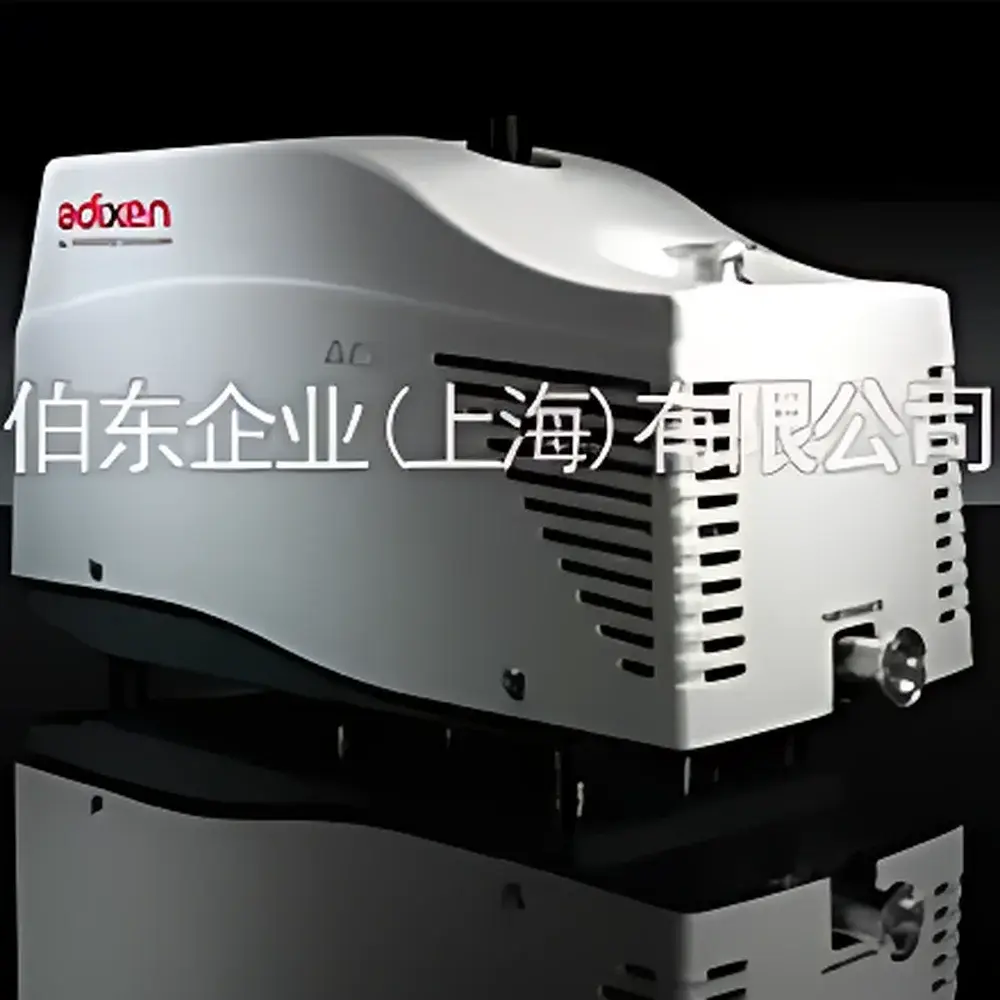
Pfeiffer Vacuum ACP 15/28/40 Adixen Series Dry Scroll Vacuum Pumps
| Brand | Pfeiffer Vacuum |
|---|---|
| Origin | France |
| Pump Type | Oil-Free Dry Scroll |
| Ultimate Vacuum | 1 × 10⁻² mbar |
| Pumping Speed | 15–40 m³/h (ACP 15: 14 m³/h, ACP 28: 27 m³/h, ACP 40: 37 m³/h) |
| Maximum Inlet Pressure | 1000 mbar (abs) |
| Base Weight | 23–32 kg |
| Motor Supply | Single- or Three-Phase |
| Certifications | CE, UL/CSA, SEMI S2 |
| Gas Ballast Option | Standard (SD), Corrosion-Resistant (G), Water-Vapor-Tolerant (CV) |
| Maintenance Interval | 20,000–22,000 hours (full overhaul) |
Overview
The Pfeiffer Vacuum ACP 15/28/40 Adixen Series represents a mature generation of oil-free dry scroll vacuum pumps engineered for high-reliability roughing and medium-vacuum applications in research laboratories, analytical instrumentation, and semiconductor-adjacent processes. Based on multi-stage roots-type architecture with non-contacting, dynamically balanced scroll elements, the ACP series operates without internal lubrication—eliminating hydrocarbon backstreaming, oil vapor contamination, and maintenance associated with traditional rotary vane pumps. Its gas-cooled thermal management system ensures stable performance across extended duty cycles while minimizing energy consumption relative to air-cooled alternatives. Designed and manufactured in France under Pfeiffer Vacuum’s stringent quality control protocols, the ACP platform delivers ultimate pressures down to 1 × 10⁻² mbar and pumping speeds ranging from 14 m³/h (ACP 15) to 37 m³/h (ACP 40), making it suitable as a primary roughing pump for turbomolecular, cryogenic, and ion getter pump systems.
Key Features
- True dry operation: No oil, no lubricants, no hydrocarbon contamination—ideal for UHV-adjacent and ultra-clean process environments.
- Non-contacting scroll technology: Zero wear in the gas path; no particulate generation or degradation in pumping performance over time.
- Three configurable variants: SD (Standard), G (Corrosion-Resistant), and CV (Water-Vapor-Tolerant), each optimized for specific process chemistries and environmental conditions.
- Integrated gas ballast (standard on SD models): Adjustable valve enables efficient removal of condensable vapors (e.g., water, solvents) during operation.
- Extended service life: Full overhaul intervals rated at 20,000 hours (ACP 15) and 22,000 hours (ACP 28/40), significantly reducing total cost of ownership.
- Digital control readiness: Optional RS-485 interface, dry-contact I/O, and Profibus support enable integration into automated vacuum control systems and SCADA architectures.
- Energy-efficient variable-speed operation: Integrated frequency converter allows dynamic speed adjustment to match load requirements—reducing acoustic noise and power draw during partial-load conditions.
- Compliance-ready design: Certified to CE, UL/CSA, and SEMI S2 safety standards; compatible with GLP/GMP audit requirements when deployed with appropriate data logging and access controls.
Sample Compatibility & Compliance
The ACP series is validated for use with a broad spectrum of process gases and vapors—including inert, reactive, and mildly corrosive species—provided appropriate configuration is selected. The G-series variant incorporates dedicated purge gas inlets (R 1/4″ NPT) and chemically resistant internal coatings, enabling safe handling of halogenated compounds, acidic vapors, and trace HF/Cl₂ encountered in plasma etch or thin-film deposition tool maintenance. The CV-series features enhanced condensate management, including external muffler with drain plug and lip-seal protection at the exhaust port, supporting continuous operation with up to 1000 g/h of water vapor load at 100 mbar inlet pressure and 30 °C ambient temperature. All models comply with ISO 8573-1 Class 0 (oil-free air) and meet the vacuum integrity requirements of ASTM F2438 (for leak detection systems) and ISO 20483 (for electron microscopy vacuum chambers). Electrical safety conforms to IEC 61000-6-2/6-4 and EN 61000-3-2.
Software & Data Management
While the ACP series operates as a standalone analog-controlled pump, its optional digital interfaces support seamless integration into laboratory and production vacuum networks. When paired with Pfeiffer’s TPG300 or VACUU·BRAKE® controllers—or third-party PLCs—the pump provides real-time status feedback (motor current, temperature, runtime, fault codes) and accepts remote start/stop, speed setpoint, and gas ballast activation commands. Audit-trail-capable data logging is achievable via external DAQ systems compliant with FDA 21 CFR Part 11 when configured with electronic signature and user-access controls. Firmware updates are performed via standard USB or serial connection using Pfeiffer’s certified VACUU®TOOLS software suite, ensuring traceable revision history and version-controlled deployment across multi-pump installations.
Applications
- Analytical instrumentation: Roughing for mass spectrometers (GC-MS, LC-MS), optical emission spectrometers (OES), and X-ray fluorescence (XRF) systems.
- Electron microscopy: Primary vacuum stage for SEM, TEM, and FIB-SEM columns requiring hydrocarbon-free base pressure stability.
- Surface science: Sample preparation chambers, sputter coaters, and RGA-equipped UHV systems where residual oil contamination must be avoided.
- Semiconductor manufacturing support: Load-lock evacuation, chamber pump-down prior to plasma processing, and cryopump regeneration.
- Research & development: High-throughput vacuum testing rigs, accelerator beamline fore-vacuum stages, and low-temperature physics experiments.
- Industrial processes: Vacuum drying ovens, plasma cleaning systems, lamp envelope evacuation, and thin-film coating lines (PVD, CVD).
FAQ
What distinguishes the SD, G, and CV variants?
The SD (Standard) model is optimized for clean, non-corrosive, low-moisture environments. The G (Corrosion-Resistant) variant adds chemically inert internal surfaces and dedicated purge gas ports for applications involving halogens or acidic byproducts. The CV (Condensable-Vapor) model integrates enhanced condensate drainage, thermal management, and sealing to sustain operation under high water vapor loads.
Can the ACP series serve as a direct replacement for oil-lubricated rotary vane pumps?
Yes—when inlet pressure and gas composition fall within specified operating envelopes. It eliminates oil changes, filter replacements, and hydrocarbon cleanup procedures, but requires verification of compatibility with existing foreline traps and process gas chemistry.
Is the ACP series suitable for continuous 24/7 operation?
Absolutely. Its robust mechanical design, thermally stable gas-cooling system, and extended maintenance intervals make it well-suited for unattended, long-duration operation in mission-critical vacuum infrastructure.
Does Pfeiffer provide factory calibration documentation and conformity certificates?
Yes—each unit ships with EU Declaration of Conformity, test reports per EN 61000-6-2/6-4, and individual performance verification data (pumping speed vs. pressure curve, ultimate pressure measurement, leak rate < 5 × 10⁻⁷ mbar·L/s).
Are spare parts and technical support available globally?
Pfeiffer Vacuum maintains an authorized service network across EMEA, North America, and Asia-Pacific. Original spare kits—including scroll sets, bearings, seals, and control boards—are stocked and distributed through certified partners, with full technical documentation accessible via Pfeiffer’s secure customer portal.



