
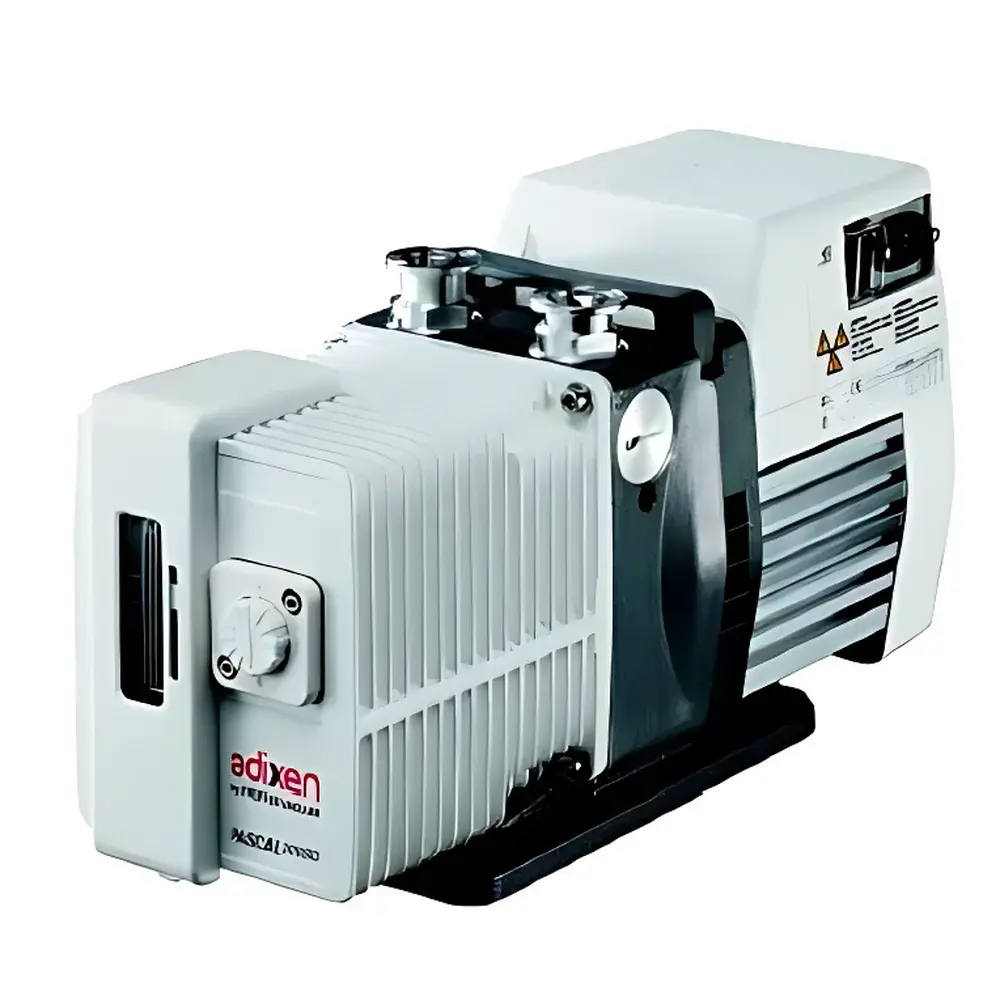
Pfeiffer Vacuum Adixen Pascal SD Series Single-Stage Rotary Vane Pump
| Brand | Pfeiffer Vacuum |
|---|---|
| Origin | Germany |
| Manufacturer Type | Authorized Distributor |
| Product Category | Imported |
| Model | Adixen Pascal SD (1005 SD & 1015 SD) |
| Pump Type | Oil-Lubricated Rotary Vane Pump |
| Pumping Speed | 6 m³/h (1005 SD, 50 Hz) / 16.5 m³/h (1015 SD, 60 Hz) |
| Ultimate Pressure | 5 × 10⁻² hPa (with gas ballast) |
| Motor Power | 0.45 kW |
| Weight | 21 kg (1005 SD) / 24.5 kg (1015 SD) |
| Inlet/Outlet Flange | DN 25 ISO-KF |
| Gas Ballast Valve | Standard |
| Lubrication | Integrated mineral oil reservoir (supplied with pump) |
Overview
The Pfeiffer Vacuum Adixen Pascal SD Series is a robust, single-stage rotary vane vacuum pump engineered for reliable rough vacuum generation in laboratory and light industrial applications. Based on proven Couette-flow rotor-stator geometry and precision-machined vanes, the Pascal SD operates via positive displacement—rotating vanes trap and compress gas between the stator housing and eccentrically mounted rotor, expelling it through the exhaust port. Its design prioritizes stable base pressure performance under variable load conditions, including intermittent water vapor loads typical in drying, degassing, and vacuum filtration workflows. The integrated gas ballast system enables continuous operation in humid environments by introducing controlled air flow to prevent condensate formation inside the oil sump—critical for maintaining long-term oil integrity and minimizing maintenance intervals. As a fully oil-lubricated system, the Pascal SD delivers high volumetric efficiency and mechanical stability without requiring external cooling or complex control interfaces.
Key Features
- Single-stage rotary vane architecture optimized for rapid pump-down to 5 × 10⁻² hPa ultimate pressure (with gas ballast enabled)
- Two standard models: Pascal 1005 SD (6 m³/h at 50 Hz) and Pascal 1015 SD (16.5 m³/h at 60 Hz), both compliant with IEC 60034 motor standards
- Integrated mineral oil lubrication system with sight glass and fill level indicator; factory-supplied with Pfeiffer FVP 100 synthetic-mineral blend oil
- Gas ballast valve as standard equipment—enabling safe handling of water vapor up to saturation point without oil emulsification
- DN 25 ISO-KF inlet and outlet flanges for quick, leak-tight connection using standardized vacuum components
- Low backstreaming rate (< 1 × 10⁻⁶ g/s hydrocarbons) ensures minimal contamination risk for downstream sensitive instrumentation (e.g., mass spectrometers, residual gas analyzers)
- Compact footprint and low-vibration mounting design suitable for benchtop integration or stacked vacuum system configurations
Sample Compatibility & Compliance
The Pascal SD series is intended for non-corrosive, non-reactive, and non-particulate gas streams—including ambient air, nitrogen, argon, and water vapor—making it suitable for vacuum ovens, freeze dryers, vacuum impregnation units, and pre-evacuation stages of high-vacuum systems. It is not rated for halogenated solvents, acidic vapors (e.g., HCl, HF), or oxidizing gases (e.g., O₃, NO₂). The pump complies with CE marking requirements per EU Machinery Directive 2006/42/EC and Electromagnetic Compatibility Directive 2014/30/EU. All models meet ISO 8573-1 Class 4 particulate and Class 3 oil aerosol purity specifications when operated within specified ambient temperature (15–35 °C) and humidity (< 70 % RH, non-condensing) limits. Documentation includes full Declaration of Conformity and RoHS-compliant material declarations.
Software & Data Management
The Pascal SD operates as a standalone mechanical device with no embedded electronics or digital interface. However, its consistent performance profile supports integration into automated vacuum systems via external pressure controllers (e.g., Pfeiffer TPG300 series gauges) and programmable logic controllers (PLCs). When deployed as the backing pump for helium leak detectors such as the ASM 340, the Pascal 1015 SD provides stable foreline pressure regulation essential for repeatable mass spectrometer sensitivity. Maintenance logs—including oil change cycles, gas ballast usage frequency, and operational hours—can be tracked manually or imported into laboratory information management systems (LIMS) compliant with ISO/IEC 17025 and FDA 21 CFR Part 11 audit-trail requirements.
Applications
- Rough vacuum generation for vacuum furnaces, coating systems, and electron microscopy sample preparation chambers
- Backing pump for turbomolecular pumps (e.g., HiPace series), cryopumps, and diffusion pumps in multi-stage vacuum architectures
- Pre-evacuation stage for helium mass spectrometer leak detection systems (e.g., ASM 340, ASM 182)
- Vacuum-assisted filtration, solvent removal, and lyophilization in pharmaceutical and biotech R&D labs
- Environmental simulation chambers requiring stable 10⁻¹–10⁻² hPa operating range
- Calibration laboratories supporting vacuum gauge verification per ASTM E1952 and ISO 20483
FAQ
What oil type is recommended for the Pascal SD series?
Pfeiffer FVP 100 synthetic-mineral hybrid oil is factory-filled and specified for all operating conditions. Substitutions must meet DIN 51506 VDL specifications and exhibit identical vapor pressure and oxidation resistance characteristics.
Can the Pascal SD operate continuously with gas ballast engaged?
Yes—gas ballast may remain open during extended operation in high-humidity environments; however, ultimate pressure degrades to ~7 hPa, and oil change intervals reduce by approximately 30 %.
Is the Pascal SD compatible with three-phase power supply?
Both 1005 SD and 1015 SD models are available with either single-phase (230 V, 50/60 Hz) or three-phase (400 V, 50/60 Hz) motor options—selected at time of order.
Does the pump include an exhaust filter or noise enclosure?
No exhaust silencer or acoustic enclosure is supplied standard; however, Pfeiffer offers optional mufflers (Part No. 203-100) and vibration-damping mounts (Part No. 204-001) for compliance with workplace noise regulations (ISO 4871).
What is the expected service life under typical lab use?
With scheduled oil changes every 1,000 operating hours and annual inspection of vanes and bearings, mean time between overhauls exceeds 6,000 hours per ISO 281 life calculation methodology.



