
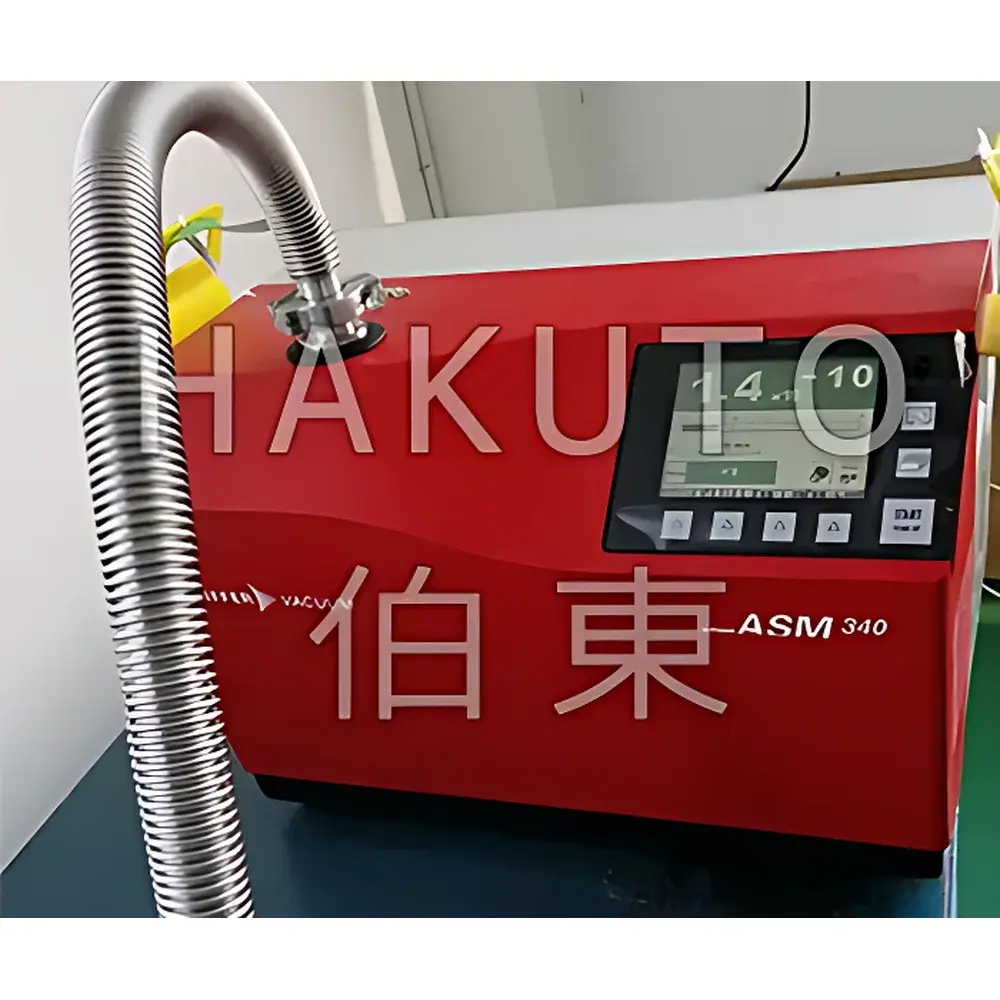
Pfeiffer Vacuum ASM 340 / ASM 390 Helium Mass Spectrometer Leak Detector for Welded Bellows Testing
| Brand | Pfeiffer Vacuum |
|---|---|
| Origin | France |
| Model | ASM 340, ASM 390 |
| Detection Sensitivity | ≤5×10⁻¹² mbar·L/s (He) |
| Operating Mode | Vacuum Mode / Sniffing Mode / Accumulation Mode |
| Mass Filter | Quadrupole Mass Spectrometer |
| Pumping System | Integrated Turbo-Molecular Pump + Backing Pump |
| Helium-Specific Detection | Yes |
| Compliance | CE, RoHS, ISO 9001 certified manufacturing |
| Interface | RS232, Ethernet, Digital I/O for PLC integration |
| Software | VACUSAFE™ with audit trail, user management, and test report generation (PDF/CSV) |
Overview
The Pfeiffer Vacuum ASM 340 and ASM 390 Helium Mass Spectrometer Leak Detectors are engineered for high-sensitivity, quantitative leak detection in critical vacuum and pressure components—specifically optimized for welded bellows used in aerospace, semiconductor, energy, and precision instrumentation applications. These instruments operate on the principle of quadrupole mass spectrometry, selectively ionizing and separating helium atoms (mass-to-charge ratio m/z = 4) from background gases with exceptional specificity. Unlike pressure decay or bubble testing, helium mass spectrometry provides trace-level sensitivity (down to 5×10⁻¹² mbar·L/s), enabling reliable detection of micro-leaks at weld seams, laser-bonded flanges, and hermetic seals—where visual inspection is insufficient and destructive testing is prohibited. The ASM series integrates a compact turbo-molecular pumping system and a robust cold-cathode ion source, ensuring stable operation under variable process conditions and long-term measurement reproducibility.
Key Features
- High-resolution quadrupole mass filter tuned exclusively for helium (m/z = 4), minimizing cross-sensitivity to hydrogen, water vapor, or hydrocarbons
- Dual-mode operation: vacuum mode (for internal cavity testing) and sniffing mode (for localized external leak localization)
- Integrated high-vacuum pumping architecture: turbomolecular pump backed by a dry scroll pump—eliminating oil contamination risks and ensuring compatibility with ultra-clean environments
- Real-time leak rate quantification with automatic unit conversion (mbar·L/s, Pa·m³/s, std cm³/year)
- Programmable test sequences with up to 10 user-defined test steps, including pre-evacuation, helium injection timing, and dwell-based accumulation
- Rugged industrial enclosure (IP54 rated) with EMI-shielded electronics, suitable for factory-floor deployment near welding stations or cleanroom peripheries
- Compliant with ISO 20486:2017 (leak detection—terminology and methodology) and aligned with ASTM E493/E1574 practices for helium-based leak testing
Sample Compatibility & Compliance
The ASM 340/390 supports non-destructive evaluation of welded metallic bellows across diameters from 6 mm to 1,200 mm and lengths up to 6 m—accommodated via custom fixtures, vacuum chambers, or accumulation hoods. It meets functional requirements for GMP-compliant manufacturing environments: full 21 CFR Part 11 readiness (with optional VACUSAFE™ software license), electronic signature support, and immutable audit trails for all calibration events, test logs, and operator actions. All helium handling protocols adhere to ISO 8573-1 Class 1 compressed gas purity standards. The system is validated for use with stainless steel (304/316L), Inconel, titanium, and Hastelloy bellows—materials commonly employed in high-cycle fatigue and extreme thermal cycling applications where leak integrity directly impacts service life and safety certification.
Software & Data Management
VACUSAFE™ control software provides deterministic test execution, configurable pass/fail thresholds, and automated reporting compliant with ISO/IEC 17025 documentation requirements. Each test record includes timestamped vacuum curves, helium response profiles, ambient temperature/pressure metadata, and operator ID. Data export supports CSV for statistical process control (SPC) integration and PDF with digital signatures for QA archival. Remote monitoring is enabled via Ethernet or OPC UA—allowing synchronization with MES systems (e.g., Siemens Opcenter, Rockwell FactoryTalk) and centralized leak performance dashboards. Calibration history, sensor diagnostics, and pump health metrics are logged automatically and retained for ≥10 years per GLP retention guidelines.
Applications
- Final acceptance testing of welded bellows for vacuum feedthroughs, expansion joints, and actuator diaphragms
- In-line quality verification post-laser welding—detecting porosity, micro-cracks, or incomplete fusion at seam interfaces
- Batch verification of multi-unit assemblies using accumulation hood methodology (e.g., simultaneous testing of 3–5 bellows under controlled helium partial pressure)
- Leak mapping of complex geometries via helium spray scanning with position-encoded data logging
- Validation of hermeticity for components destined for space-grade qualification (ECSS-Q-ST-70-02C) or nuclear service (ASME III NB-5300)
- Root cause analysis in failure investigations—correlating leak location with metallurgical NDE reports (e.g., X-ray or ultrasonic weld maps)
FAQ
What leak detection sensitivity is achievable with the ASM 340 when testing welded bellows in vacuum mode?
Typical detection limit is ≤5×10⁻¹² mbar·L/s under optimal conditions (base pressure <1×10⁻⁷ mbar, stable thermal environment, calibrated helium reference leak). Sensitivity may vary slightly depending on bellows volume, surface outgassing, and fixture conductance.
Can the ASM 390 be integrated into an automated production line with PLC control?
Yes—digital I/O signals (start, stop, pass/fail, alarm) and Modbus TCP/Ethernet/IP protocols enable seamless integration with Siemens S7, Allen-Bradley ControlLogix, or Beckhoff TwinCAT systems.
Is helium recovery supported to reduce operational cost?
While the ASM platform does not include built-in helium recovery, it is fully compatible with third-party helium recapture systems (e.g., Cryo-Trap + PSA modules) via standard vacuum port interfaces and pressure feedback loops.
Does the system require annual recalibration per ISO/IEC 17025?
Calibration frequency depends on usage intensity and risk assessment; however, Pfeiffer recommends traceable calibration every 12 months using NIST-traceable helium reference leaks, documented per ISO/IEC 17025 Clause 6.5.
How is operator training and method validation supported?
Pfeiffer Vacuum offers application-specific IQ/OQ documentation packages, on-site validation assistance, and certified operator training courses covering ASTM E2653-22 methodology and EU Annex 11-compliant data integrity practices.
Related Products



