
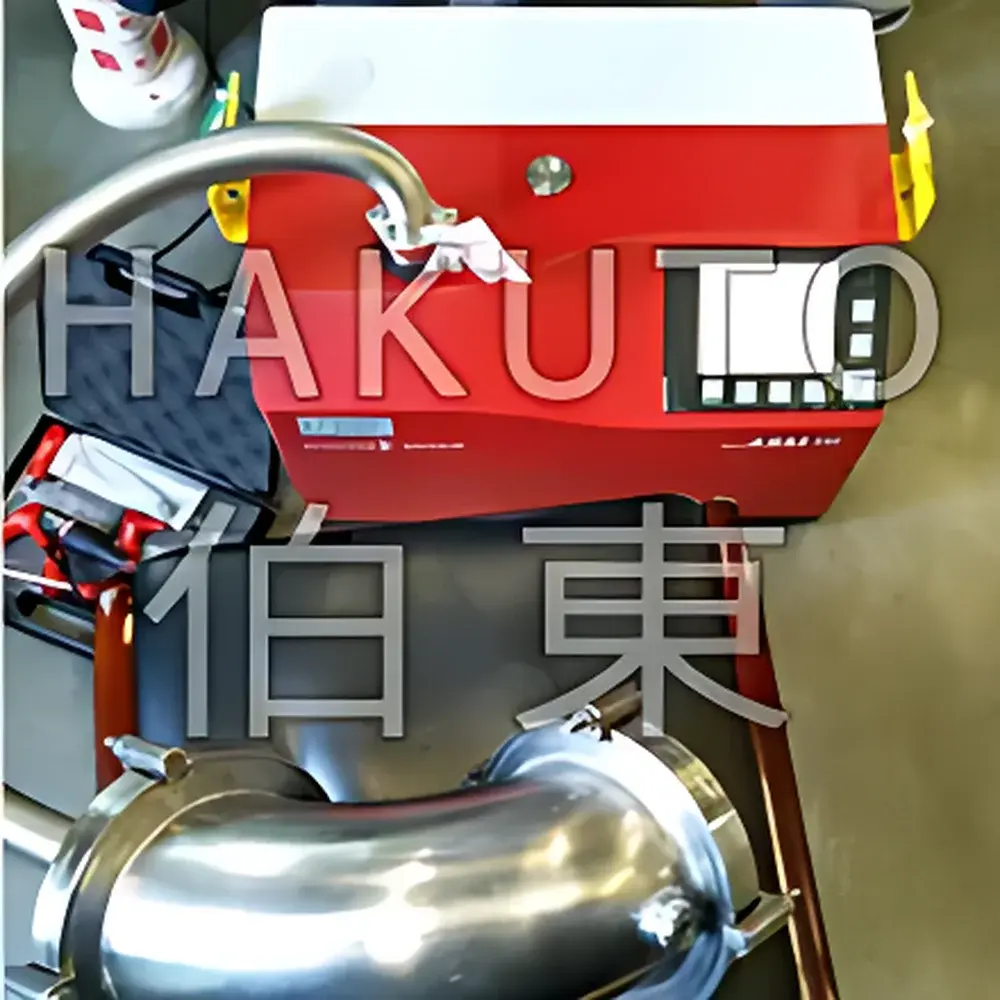
Pfeiffer Vacuum ASM 340 Helium Mass Spectrometer Leak Detector for Welded Container Integrity Testing
| Brand | Pfeiffer Vacuum |
|---|---|
| Origin | France |
| Model | ASM 340 |
| Detection Principle | Quadrupole Mass Spectrometry (He⁺ at m/z = 4) |
| Minimum Detectable Leak Rate (Vacuum Mode) | 5 × 10⁻¹³ Pa·m³/s |
| Operating Pressure Range (Analyzer) | 1 × 10⁻⁷ to 1 × 10⁻³ hPa |
| Mass Resolution | Unit mass resolution (FWHM ≤ 1 amu at m/z = 4) |
| Interface | DN 40 CF vacuum flange |
| Control | Touchscreen GUI with real-time leak rate display and trend logging |
| Compliance | Designed per ISO 20486:2017 (Leak detection — Vocabulary and test methods), compatible with ASTM E499-21 (Standard Test Method for Leak Detection Using Helium Mass Spectrometer) and EU Machinery Directive 2006/42/EC |
Overview
The Pfeiffer Vacuum ASM 340 Helium Mass Spectrometer Leak Detector is an engineered solution for high-sensitivity, quantitative leak assessment of welded pressure vessels, storage tanks, heat exchangers, and other hermetically sealed industrial containers. It operates on the principle of quadrupole mass spectrometry, selectively detecting ionized helium (He⁺, m/z = 4) introduced as a tracer gas into or around the test object. In vacuum-mode operation—where the test piece is evacuated and connected directly to the spectrometer’s analyzer—the ASM 340 achieves a verified minimum detectable leak rate of 5 × 10⁻¹³ Pa·m³/s, enabling identification of sub-micron discontinuities in weld seams that would remain undetectable via conventional pressure-decay or bubble-emission techniques. This performance level aligns with stringent international quality requirements for ASME Section VIII Div. 1 & 2 pressure equipment, nuclear coolant loops, and pharmaceutical process vessels subject to FDA 21 CFR Part 11–compliant validation protocols.
Key Features
- Quadrupole mass filter optimized for helium-specific detection with unit mass resolution (FWHM ≤ 1 amu at m/z = 4), minimizing interference from hydrogen, water vapor, or nitrogen background signals
- Vacuum-integrated architecture featuring integrated turbomolecular pumping stage (base pressure < 1 × 10⁻⁷ hPa) and differential pumping system to maintain stable analyzer operating conditions during dynamic leak scanning
- Real-time graphical user interface with color-coded leak rate visualization, automatic threshold-based alarm triggering, and timestamped event logging
- DN 40 CF vacuum interface for direct coupling to standard industrial vacuum manifolds; optional helium spray probe kit (ASM-Spray-Kit) supports localized sniffer-mode testing for large or non-evacuable assemblies
- No consumables or routine filament replacement required; hot cathode ion source designed for > 10,000 hours operational lifetime under continuous duty
- CE-marked and compliant with electromagnetic compatibility (EMC) standards EN 61326-1 and safety standard EN 61010-1
Sample Compatibility & Compliance
The ASM 340 is validated for use across carbon steel, stainless steel, aluminum, and nickel-alloy welded structures ranging from small instrument housings ( 50 m³). Its vacuum-mode configuration satisfies ISO 20486:2017 Annex A criteria for “high-sensitivity vacuum helium testing” and supports traceable calibration per ASTM E499-21 using certified reference leaks (e.g., VCR-type stainless steel capillary standards traceable to NIST SRM 2189). When deployed in regulated manufacturing environments—including those governed by ISO 13485, GMP Annex 1, or ASME BPVC Section V Article 10—the instrument’s audit trail functionality (including operator ID, test parameters, and raw signal timestamps) facilitates compliance with data integrity expectations under FDA 21 CFR Part 11 and EU Annex 11.
Software & Data Management
The embedded firmware provides native support for CSV export of time-stamped leak rate data (ms resolution), including peak amplitude, integration window, and background-subtracted net signal. Optional PC-based LeakTest Suite software enables automated test sequencing, multi-point mapping of weld joints, statistical process control (SPC) charting of leak distribution across production batches, and generation of PDF-certified test reports with digital signature fields. All data files include embedded metadata (instrument serial number, calibration due date, operator credentials) to satisfy GLP/GMP documentation requirements. Audit logs record every parameter change, calibration action, and alarm event with immutable timestamps—no local editing or deletion permitted without administrative authentication.
Applications
- Final acceptance testing of ASME-coded pressure vessels prior to hydrostatic proof testing
- In-process weld seam verification during fabrication of cryogenic LNG tanks and hydrogen storage modules
- Leak benchmarking of vacuum-jacketed pharmaceutical reactors and sterile transfer systems
- Root cause analysis of field failures in geothermal heat exchanger manifolds
- Qualification of orbital TIG and laser hybrid welds in aerospace fuel system components
- Validation of hermetic seals in medical device implant housings (ISO 11607-1)
FAQ
What vacuum level must the test chamber achieve before initiating a vacuum-mode helium test?
The ASM 340 requires a stabilized base pressure below 1 × 10⁻³ hPa at the analyzer inlet; typical pump-down time for a 10 m³ vessel equipped with a 1,200 L/s turbomolecular pump is approximately 12–18 minutes.
Can the ASM 340 be integrated into an automated production line?
Yes—via RS-232, Ethernet (TCP/IP), or optional Profibus DP interface, enabling PLC-triggered test initiation, pass/fail signal output, and real-time data streaming to MES platforms.
Is helium consumption quantified or monitored during testing?
The instrument does not measure helium flow rate, but its integrated pressure sensor tracks chamber pressure rise during sniffer-mode surveys; users typically employ calibrated mass flow controllers (e.g., Brooks 5850E) upstream of the spray probe for traceable gas dosing.
How often is recalibration required?
Annual verification against certified reference leaks is recommended per ISO/IEC 17025; full factory recalibration is advised every 24 months or after exposure to > 10⁻² hPa hydrocarbon contamination.
Does the ASM 340 support multi-gas detection beyond helium?
No—it is purpose-built for helium (m/z = 4) with fixed quadrupole tuning; alternative tracer gases (e.g., hydrogen, SF₆) require dedicated mass spectrometer configurations not offered in the ASM series.
Related Products






