
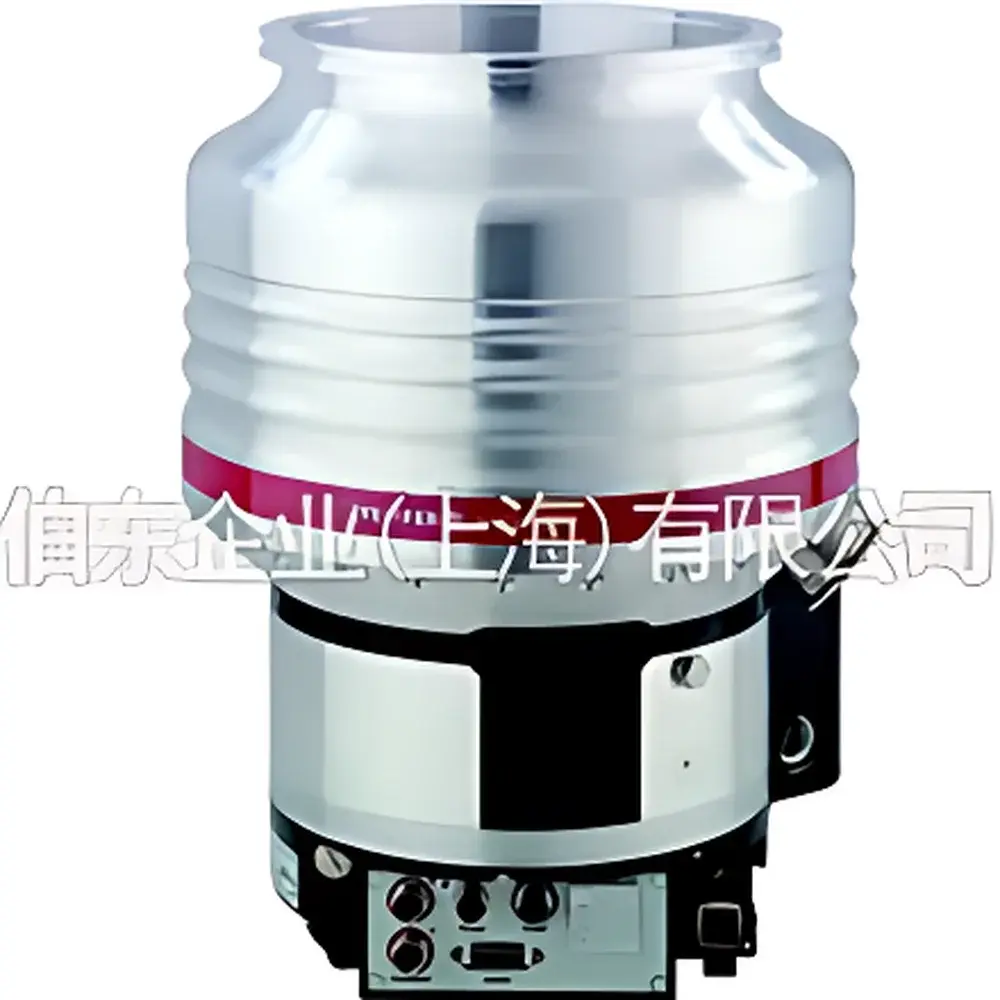
Pfeiffer Vacuum HiPace 1800 Turbo Molecular Pump
| Brand | Pfeiffer Vacuum |
|---|---|
| Origin | Germany |
| Model | HiPace 1800 |
| Pump Type | Oil-free Turbo Molecular Pump |
| Nominal Pumping Speed (N₂) | 1450 L/s |
| Compression Ratio (N₂) | >1×10⁸ |
| Ultimate Pressure (N₂) | <1×10⁻⁷ hPa |
| Max. Starting Pressure (N₂) | 1.8 mbar |
| Gas Seal Valve | Integrated 24 V DC |
| Ingress Protection Rating | IP54 |
| Controller | TC 1200 |
| Communication Interface | RS-485 (Profibus/DeviceNet options available) |
| Flange | DN 200 ISO-K or ISO-F |
| Weight | 33–34 kg |
| Startup Time | ~20 min |
Overview
The Pfeiffer Vacuum HiPace 1800 is a high-performance, oil-free turbo molecular pump engineered for demanding ultra-high vacuum (UHV) and high-vacuum applications in research, industrial process control, and analytical instrumentation. Operating on the principle of momentum transfer via high-speed rotating titanium blades (up to ~90,000 rpm), the HiPace 1800 achieves exceptional pumping speeds across a broad gas spectrum—particularly optimized for nitrogen (1450 L/s), helium (1650 L/s), and hydrogen (1700 L/s). Its robust rotor design, precision-balanced ceramic bearings, and integrated drive electronics ensure stable operation under continuous duty cycles, even in vibration-prone or thermally fluctuating environments. Unlike diffusion or cryogenic pumps, the HiPace 1800 delivers clean, hydrocarbon-free vacuum without consumables or regeneration downtime—making it indispensable for contamination-sensitive processes such as surface science, mass spectrometry, electron microscopy, and thin-film deposition.
Key Features
- Oil-free, high-speed turbomolecular pumping with nominal N₂ speed of 1450 L/s and compression ratio exceeding 1×10⁸ for inert and reactive gases
- Integrated drive electronics housed within the pump body—eliminating external controller cabling and reducing footprint
- IP54-rated enclosure for reliable operation in industrial settings with dust and light water exposure
- Standard 24 V DC gas seal valve for rapid isolation and backstreaming prevention during shutdown or venting
- Modular flange compatibility: DN 200 ISO-K and ISO-F configurations support seamless integration into existing vacuum manifolds
- Multiple configuration variants: Standard (HiPace 1800), U-version (inverted mounting capability), C-version (corrosion-resistant materials for Cl₂, HF, NH₃, and other aggressive process gases), and UC-combination models
- RS-485 digital interface as standard; optional Profibus or DeviceNet protocols enable full integration into PLC-based automation systems and SCADA networks
Sample Compatibility & Compliance
The HiPace 1800 is compatible with a wide range of process and analytical vacuum chambers—including those used in semiconductor etch and PVD/CVD tools, residual gas analyzers (RGAs), time-of-flight mass spectrometers (TOF-MS), and synchrotron beamline end stations. Its corrosion-resistant C-series variant meets stringent requirements for halogenated, acidic, or amine-based chemistries common in plasma processing and atomic layer deposition (ALD). The pump complies with IEC 61000-6-2 (immunity) and IEC 61000-6-4 (emissions) standards. When paired with the TC 1200 controller, it supports audit-ready operation per FDA 21 CFR Part 11 (with optional electronic signature and event logging), and aligns with GLP/GMP documentation practices for regulated R&D and production environments.
Software & Data Management
The TC 1200 controller provides real-time monitoring of rotational speed, bearing temperature, motor current, vibration status, and pumping performance diagnostics. All operational parameters are accessible via front-panel display or remote interface. The Pfeiffer Vacuum Control Software (VACUU·VIEW) enables multi-pump orchestration, trend logging, alarm configuration, and export of timestamped CSV data for traceability. Historical pump run-time, fault codes, and maintenance intervals are stored in non-volatile memory—supporting predictive maintenance planning and ISO 9001-compliant equipment qualification (IQ/OQ/PQ). Firmware updates are performed securely over RS-485, ensuring long-term interoperability and cybersecurity resilience.
Applications
- Analytical instrumentation: High-resolution mass spectrometry (HRMS), secondary ion mass spectrometry (SIMS), and X-ray photoelectron spectroscopy (XPS)
- Semiconductor manufacturing: Vacuum load locks, cluster tool transfer chambers, and ion implantation beamlines
- Thin-film technology: Sputtering, evaporation, and atomic layer deposition (ALD) systems requiring ultra-clean, particle-free vacuum
- Research infrastructure: UHV surface science chambers, accelerator vacuum systems, and quantum computing dilution refrigerator fore-lines
- Industrial vacuum processing: Leak detection systems, vacuum furnaces, and coating lines operating under continuous 24/7 duty cycles
FAQ
What is the maximum allowable inlet pressure for safe startup?
The HiPace 1800 requires a pre-vacuum of ≤1.8 mbar (N₂-equivalent) at the inlet before ramp-up. A two-stage roughing system (e.g., dry scroll or diaphragm pump) must achieve this base pressure prior to turbine activation.
Can the HiPace 1800 operate in inverted orientation?
Yes—the U-series variant is specifically engineered for upside-down mounting, enabling compact vertical integration in space-constrained vacuum systems without performance degradation.
Is the pump suitable for corrosive gas environments?
The C-series and UC-series models feature nickel-plated rotors, ceramic-coated stators, and fluoropolymer-sealed electronics—validated for sustained operation with chlorine, hydrogen fluoride, ammonia, and other chemically aggressive process gases.
Does the pump support regulatory compliance for pharmaceutical or medical device manufacturing?
When operated with TC 1200 and configured with VACUU·VIEW logging, the system supports ALCOA+ data integrity principles and satisfies audit requirements under FDA 21 CFR Part 11 and EU Annex 11 for computerized system validation.
What maintenance intervals are recommended for continuous operation?
Under typical clean-vacuum conditions, routine inspection is advised every 12 months; bearing lifetime exceeds 30,000 hours. Full service—including rotor balancing and bearing replacement—is performed exclusively by Pfeiffer-certified centers using factory-calibrated tooling and traceable spare parts.



