
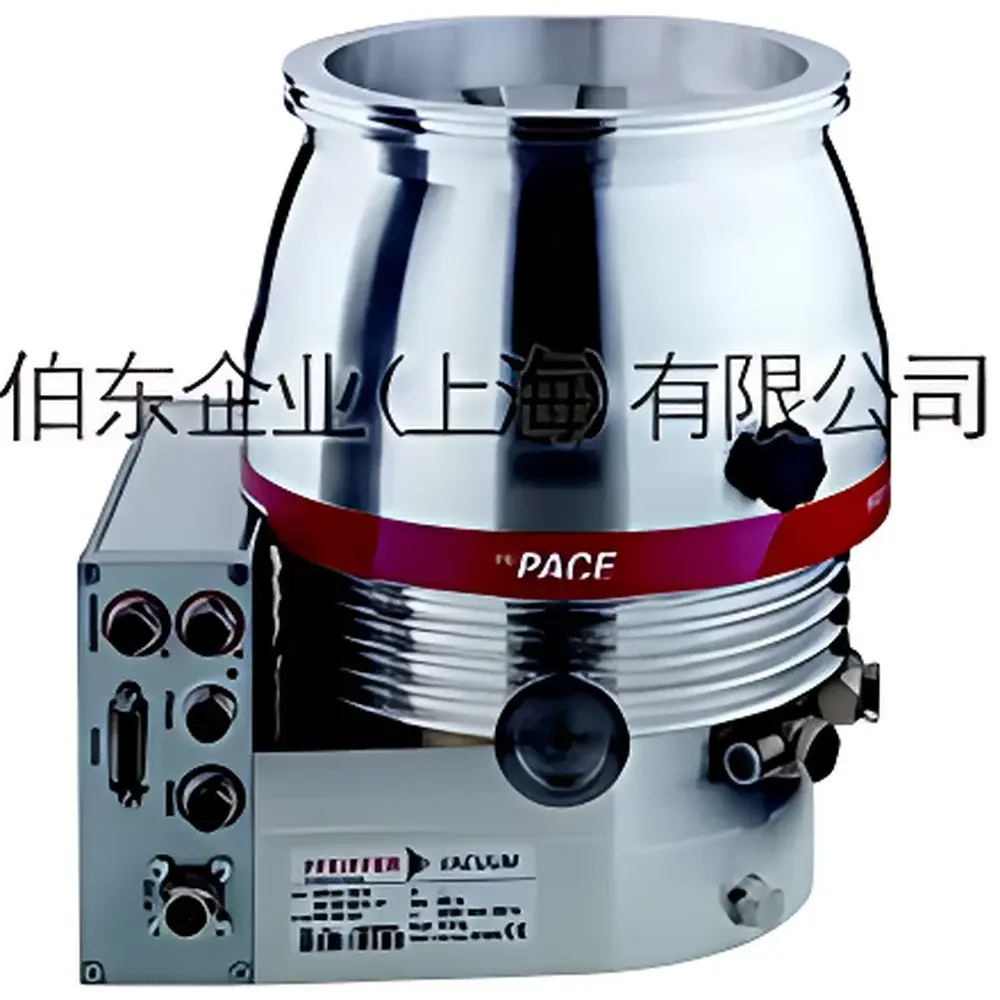
Pfeiffer Vacuum HiPace 700M Full-Magnetic Levitation Turbomolecular Pump
| Brand | Pfeiffer Vacuum |
|---|---|
| Origin | Germany |
| Model | HiPace 700M |
| Pump Type | Oil-Free Turbomolecular Pump |
| Ultimate Pressure (N₂) | < 5 × 10⁻¹⁰ hPa |
| Weight | 20.8 kg |
| Nominal Pumping Speed (N₂) | 685 L/s |
| Inlet Flange | DN 160 ISO-K / CF-F / ISO-F (configurable) |
| Integrated Controller | TM 700 |
| Bearing System | 5-Axis Active Magnetic Bearings |
| Cooling | Integrated Water-Cooling Interface |
| Mounting | Omnidirectional (Any Orientation) |
Overview
The Pfeiffer Vacuum HiPace 700M is a high-performance, oil-free turbomolecular pump engineered for ultra-high vacuum (UHV) and extreme high vacuum (XHV) applications in research laboratories, analytical instrumentation, surface science, and semiconductor process development. Utilizing advanced 5-axis active magnetic bearing technology, the HiPace 700M eliminates mechanical contact between rotor and stator—removing the need for lubricants, wear-prone bearings, or periodic maintenance. Its operational principle relies on high-speed molecular momentum transfer: a multi-stage turbine rotor spinning at up to 90,000 rpm imparts directional kinetic energy to gas molecules, preferentially directing them toward the exhaust stage where they are transferred to a backing pump (typically a dry scroll or diaphragm pump). This design achieves a theoretical ultimate pressure of < 5 × 10⁻¹⁰ hPa with nitrogen—validated under clean, bakeable, and vibration-isolated conditions—and delivers a nominal pumping speed of 685 L/s for N₂ at the DN 160 inlet.
Key Features
- Full magnetic levitation system with real-time position control across five degrees of freedom—ensuring stable, contactless rotation even under thermal transients or dynamic load changes.
- Integrated TM 700 controller with digital I/O, RS-485, and optional fieldbus interfaces (PROFIBUS, DeviceNet) for seamless integration into automated vacuum systems and SCADA environments.
- Water-cooled housing with standardized quick-connect fittings—enabling efficient thermal management during continuous operation at full speed without external chillers.
- Omnidirectional mounting capability: certified for horizontal, vertical (inlet-up/inlet-down), and tilted configurations without performance degradation or bearing stress.
- Ultra-low vibration emission (< 0.5 µm peak-to-peak at 1 m distance) and acoustic noise level ≤ 45 dB(A), critical for electron microscopy, atomic force microscopy (AFM), and interferometric setups.
- Energy-efficient operation: typical power consumption at full speed is < 1.2 kW, including controller and cooling circuit drive.
Sample Compatibility & Compliance
The HiPace 700M is compatible with inert, reactive, and condensable gases—including N₂, He, H₂, Ar, O₂, and common process gases—provided appropriate foreline protection (e.g., cold traps or adsorption filters) is used for vapors. Its all-metal, UHV-bakeable construction (stainless steel body, titanium rotor blades) supports cleaning protocols up to 150 °C. The pump conforms to CE marking requirements per EU Machinery Directive 2006/42/EC and Electromagnetic Compatibility Directive 2014/30/EU. It meets ISO 28580:2018 for turbomolecular pump performance verification and is designed to support GLP-compliant vacuum system qualification when paired with traceable pressure measurement (e.g., Bayard–Alpert gauges or capacitance manometers calibrated per ISO 3567). No internal hydrocarbons or silicone-based materials are present—ensuring compatibility with residual gas analyzers (RGAs) and mass spectrometry coupling.
Software & Data Management
The TM 700 controller provides embedded firmware supporting local operation via front-panel keypad and LCD, as well as remote supervision through ASCII command protocol over RS-485 or Ethernet (via optional gateway). Real-time telemetry includes rotational speed, bearing currents, temperature at three critical zones (motor, bearings, exhaust), vibration spectra (FFT output), and cumulative operating hours. All operational events—including start/stop cycles, fault logs, and parameter changes—are timestamped and stored with non-volatile memory retention (>10 years). Audit trail functionality complies with FDA 21 CFR Part 11 requirements when deployed with validated system-level software (e.g., LabVIEW VI or custom SCADA with electronic signature modules). Firmware updates are performed via secure USB interface with SHA-256 signature verification.
Applications
- Ultra-high vacuum chambers for surface analysis techniques: XPS, AES, LEED, and molecular beam epitaxy (MBE).
- Mass spectrometry systems requiring rapid pump-down and long-term base pressure stability—especially time-of-flight (TOF-MS) and Orbitrap platforms.
- Electron optics infrastructure: transmission electron microscopes (TEM), scanning electron microscopes (SEM), and electron beam lithography tools.
- Quantum technology testbeds: cold atom traps, superconducting qubit dilution refrigerators, and cryogenic vacuum insulation systems.
- Accelerator physics beamlines and synchrotron radiation end-stations demanding low outgassing and minimal magnetic interference.
FAQ
What backing pump is required for the HiPace 700M?
A dry backing pump with a minimum forepump speed of 12 m³/h and ultimate pressure ≤ 1 × 10⁻² hPa is recommended—such as the Pfeiffer DuoLine series or Edwards nXR dry pumps.
Can the HiPace 700M be operated without water cooling?
No. Continuous operation at rated speed requires active water cooling; the integrated interface accepts standard 6 mm OD tubing with flow rate ≥ 2.5 L/min and inlet temperature 10–25 °C.
Is the pump suitable for corrosive gas environments?
Standard configuration is rated for clean, dry inert and reactive gases. For Cl₂, NF₃, or plasma effluents, optional corrosion-resistant coatings (e.g., AlTiN on rotor stages) and enhanced sealing must be specified at time of order.
Does the TM 700 controller support analog setpoint input?
Yes—0–10 VDC or 4–20 mA analog inputs are available via optional expansion module (TM 700-AI), enabling closed-loop pressure control when paired with a capacitance manometer.
What is the mean time between failures (MTBF) under typical lab usage?
Based on Pfeiffer’s field reliability database, MTBF exceeds 45,000 operating hours for systems maintained per manufacturer guidelines and operated within specified ambient and cooling parameters.



