
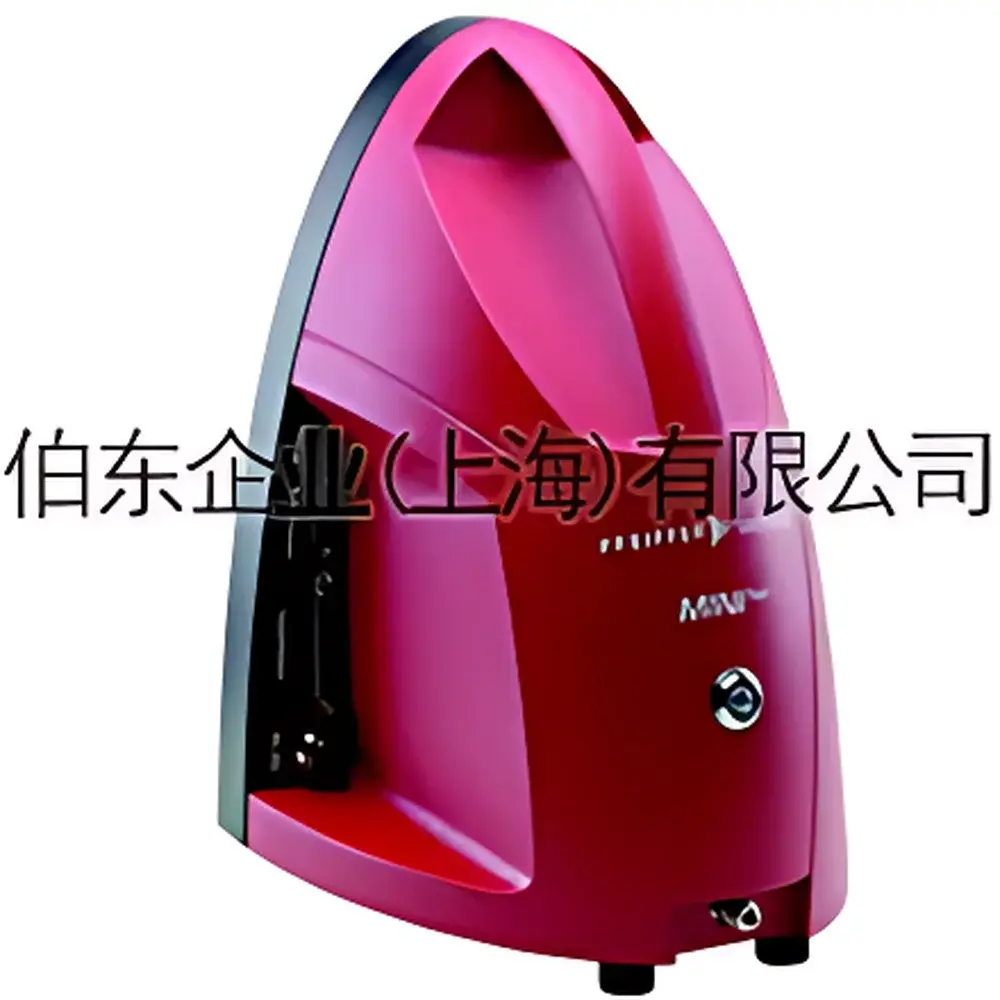
Pfeiffer Vacuum MiniTest 300 Portable Helium Mass Spectrometer Leak Detector
| Brand | Pfeiffer Vacuum |
|---|---|
| Origin | Germany |
| Model | MiniTest 300 |
| Weight | 5 kg |
| Minimum Detectable Leak Rate | 5 × 10⁻⁸ Pa·m³/s |
| Maximum Inlet Pressure | 200 hPa (abs.) |
| Operating Temperature | +10 °C to +35 °C |
| Storage Temperature | +10 °C to +55 °C |
| Acoustic Noise Level | < 70 dB(A) |
| Power Supply | 100–240 V, 50/60 Hz |
| Interface Options | RS-485, RJ-25, Gauge, I/O D-sub 9, Remote Control D-sub 9 |
| Wireless Remote Range | up to 100 m (RC 500 optional) |
| Sensor Technology | Quartz Window Mass Filter |
| Warm-up Time to Ready State | ≤ 30 min |
| Display | 3.5-inch LCD |
Overview
The Pfeiffer Vacuum MiniTest 300 is a fully integrated, portable helium mass spectrometer leak detector engineered for high-reliability field diagnostics in demanding industrial and scientific vacuum environments. Unlike conventional benchtop or fixed-installation leak detectors, the MiniTest 300 employs a compact quadrupole mass filter with a proprietary quartz window sensor — the first of its kind commercially deployed in a handheld-class instrument. This design enables stable ion transmission under variable inlet conditions while maintaining long-term calibration integrity. The device operates on the principle of selective helium ion detection via magnetic sector-free mass separation at unit mass resolution (m/z = 4), followed by Faraday cup or secondary electron multiplier amplification. Its ability to function continuously at inlet pressures up to 200 hPa (absolute) eliminates the need for external pre-pumping in coarse-leak screening scenarios, significantly accelerating diagnostic workflows in large-volume systems such as power plant condensers, vacuum furnaces, and pharmaceutical lyophilizers.
Key Features
- Quartz window sensor architecture: Provides enhanced thermal stability and reduced sensitivity drift during extended operation, particularly under fluctuating ambient humidity.
- True portability: Weighing only 5 kg with integrated battery-compatible power management, the MiniTest 300 supports single-operator deployment across multi-story facilities or remote outdoor installations.
- High-pressure tolerance: Rated for continuous operation at up to 200 hPa absolute inlet pressure, enabling rapid gross-leak identification without auxiliary roughing pumps.
- Water vapor resilience: Optimized ion source geometry and differential pumping stages minimize signal suppression from ambient moisture, ensuring consistent performance in non-climate-controlled environments.
- Wireless remote control (RC 500): Full functional parity with wired interface; supports real-time parameter adjustment, alarm acknowledgment, and data logging initiation within 100 m line-of-sight range.
- Robust mechanical design: IP54-rated enclosure with shock-absorbing housing and reinforced KF25 vacuum interface compliant with ISO-KF standards.
- Low-maintenance architecture: No consumable filaments or replaceable turbomolecular pump oils; mean time between failures (MTBF) exceeds 15,000 hours per IEC 61508 reliability modeling.
Sample Compatibility & Compliance
The MiniTest 300 is validated for use with standard helium tracer gas (≥ 99.999% purity) and compatible with all common vacuum system materials including stainless steel (AISI 304/316), aluminum alloys, glass, and elastomeric seals (FKM, EPDM, Viton®). It meets electromagnetic compatibility requirements per EN 61326-1:2013 and safety standards per EN 61010-1:2010. While not certified for intrinsically safe (ATEX/IECEx) zones, its low-power electronics and sealed sensor chamber permit deployment in Class 1 Div 2 / Zone 2 classified areas when installed per NEC Article 500 guidelines. Data acquisition protocols support audit-trail generation aligned with FDA 21 CFR Part 11 Annex 11 principles for regulated pharmaceutical and medical device manufacturing environments.
Software & Data Management
Instrument control and data handling are managed via embedded firmware with dual-mode operation: standalone mode using the 3.5-inch high-contrast LCD touchscreen, and PC-connected mode via RS-485 or optional USB-to-RS485 adapter. All measurement sessions — including timestamped leak rate values, pressure transients, and operator ID entries — are stored internally on non-volatile flash memory (≥ 10,000 records capacity). Export is supported in CSV format via microSD card slot or direct serial transfer. Optional Pfeiffer Vacuum LeakTest Suite v3.x software provides advanced trending analysis, multi-channel synchronization for distributed leak surveys, and automated report generation compliant with ISO 10893-8 and ASTM E499-20 test documentation requirements.
Applications
- Vacuum furnace integrity verification in heat-treatment and sintering facilities
- In-situ leak mapping of large-scale power generation condenser shells and steam turbine casings
- Pharmaceutical freeze-dryer chamber validation and GMP-compliant requalification
- Leak quantification in vacuum-insulated panels (VIPs) and cryogenic distribution lines
- Quality assurance testing of hermetic packaging for MEMS sensors and optoelectronic modules
- Routine maintenance of semiconductor process chambers, including PVD/CVD tools and ion implanters
- Field commissioning of HVAC refrigeration circuits operating below atmospheric pressure
FAQ
What is the minimum detectable leak rate under standard operating conditions?
The specified minimum detectable leak rate is 5 × 10⁻⁸ Pa·m³/s when using helium at 1 atm partial pressure and following ISO 20484:2017 test methodology.
Can the MiniTest 300 be used in high-humidity environments without performance degradation?
Yes — its quartz window sensor and optimized ion optics reduce water cluster interference, allowing stable operation even at relative humidity levels exceeding 85% RH.
Is calibration traceable to national metrology institutes?
Factory calibration is performed against NIST-traceable helium permeation standards (NIST SRM 2184), with certificate of calibration included with each unit.
Does the instrument support integration into automated test systems?
Yes — full SCPI command set and Modbus RTU protocol support enable seamless integration with PLC-based vacuum monitoring platforms and MES-level data historians.
What maintenance intervals are recommended for routine operation?
No scheduled maintenance is required within the first 24 months; annual verification of sensitivity and background noise level is advised per ISO 9001 internal audit procedures.




