
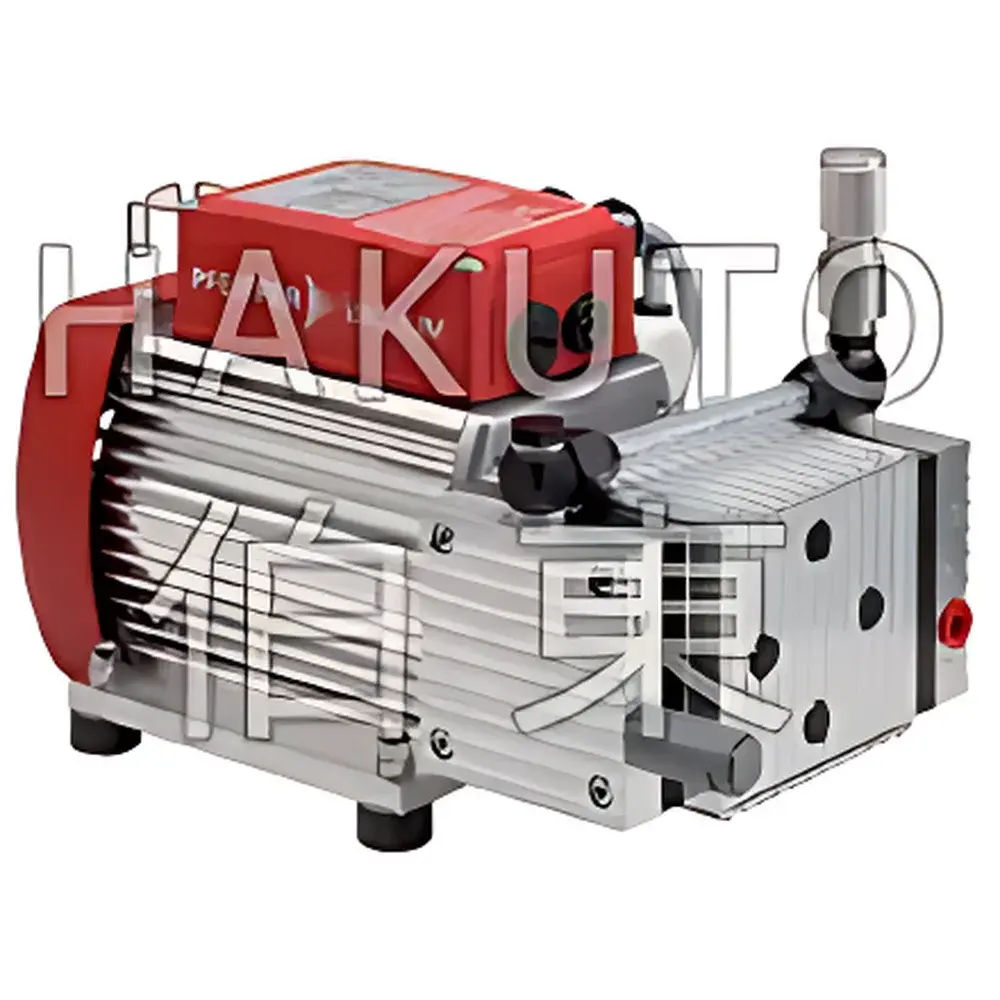
Pfeiffer Vacuum MVP 015 Diaphragm Vacuum Pump
| Brand | Pfeiffer Vacuum |
|---|---|
| Origin | Germany |
| Product Type | Oil-Free Diaphragm Pump |
| Model | MVP 015 |
| Pumping Speed | 1.5 m³/h |
| Ultimate Vacuum | ≤ 4.5 mbar (abs) |
| Noise Level | ≤ 45 dB(A) |
| Weight | 2.7 kg |
| Motor Power | 1.5 W |
| Dimensions (L×W×H) | 180 × 120 × 160 mm |
| Voltage Options | AC 100–240 V / DC 24 V |
| Stages | 2-stage |
| Corrosion-Resistant Option | Available (MVP 015-2 DC / MVP 015-4 DC) |
| Inlet Port | G 1/8" or DN6 ISO-KF |
Overview
The Pfeiffer Vacuum MVP 015 is a compact, oil-free diaphragm vacuum pump engineered for precision laboratory and analytical applications requiring clean, dry, and contamination-free vacuum generation. Based on positive displacement via elastomeric diaphragm oscillation, the MVP 015 operates without lubricants—eliminating hydrocarbon backstreaming, oil vapor contamination, or condensable residue in sensitive vacuum environments. Its two-stage configuration enables enhanced ultimate vacuum performance compared to single-stage equivalents, achieving ≤ 4.5 mbar (abs) while maintaining stable flow across variable inlet pressures. Designed for integration into modular vacuum systems—including as a forepump for Pfeiffer turbomolecular pumps—the MVP 015 delivers consistent performance in R&D labs, surface science instrumentation (e.g., BET surface area analyzers), residual gas analysis, leak detection, and controlled-atmosphere synthesis setups.
Key Features
- Oil-free operation ensures absolute hydrocarbon-free vacuum—critical for mass spectrometry coupling, thin-film deposition, and UHV-compatible pre-pumping stages.
- Two-stage diaphragm architecture improves ultimate vacuum capability and enhances pumping efficiency at low inlet pressures.
- Low-noise design (≤ 45 dB(A)) and minimal mechanical vibration support use in noise-sensitive environments such as analytical laboratories adjacent to open-plan workspaces or metrology suites.
- Modular port configurations: Standard G 1/8″ thread or DN6 ISO-KF flange options enable direct compatibility with common vacuum tubing, valves, and instrumentation interfaces.
- Dual-voltage motor (AC 100–240 V / DC 24 V) facilitates global deployment—including battery-powered or embedded system integration in portable analyzers and OEM equipment.
- Corrosion-resistant variants (MVP 015-2 DC, MVP 015-4 DC) feature chemically inert wetted materials (e.g., EPDM diaphragms, PTFE-coated valves) for handling mildly aggressive vapors encountered in chemical synthesis or solvent degassing.
- Tool-free diaphragm and valve replacement reduces maintenance downtime and supports GLP-compliant service logging.
Sample Compatibility & Compliance
The MVP 015 is compatible with non-condensable gases and low-vapor-pressure solvents (e.g., water, ethanol, acetone below saturation limits). It is not intended for continuous pumping of high-humidity, corrosive (e.g., HCl, Cl₂, NH₃), or polymerizing vapors without optional chemical protection kits. The pump complies with IEC 61000-6-3 (EMC emission standards) and IEC 61000-6-2 (immunity), and meets CE marking requirements under the EU Machinery Directive 2006/42/EC. For regulated environments, its predictable service intervals and documented maintenance procedures align with GLP audit expectations; however, it does not include built-in electronic audit trails required for full FDA 21 CFR Part 11 compliance—integration with external data acquisition systems is recommended for traceable vacuum log recording.
Software & Data Management
The MVP 015 operates as a standalone analog device without onboard digital control or communication interfaces (e.g., RS-232, USB, or Ethernet). Its operational status is monitored via mechanical pressure gauges or external vacuum sensors connected to host instrumentation. For automated systems, analog voltage outputs (0–10 V) or digital I/O signals (optional on DC variants) can be interfaced with PLCs or LabVIEW-based control platforms. Pfeiffer provides comprehensive technical documentation—including English-language operating manuals, dimensional drawings, and RoHS/REACH declarations—in PDF format for download from the official support portal. Firmware updates are not applicable; hardware revisions follow Pfeiffer’s formal EC-type examination certification process.
Applications
- Forevacuum supply for Pfeiffer HiPace and TurboVac turbomolecular pumps in UHV and HV systems.
- Vacuum source for Micromeritics ASAP, TriStar, and BELSORP surface area and porosity analyzers.
- Sample preparation vacuum for TGA-MS coupling, headspace GC sampling, and vacuum desiccation of hygroscopic compounds.
- Process vacuum in small-scale CVD/PVD precursor delivery lines where oil-free integrity is mandatory.
- Mobile or field-deployable vacuum modules in environmental monitoring stations and portable gas analyzers.
- Routine vacuum filtration, rotary evaporation (low-boiling solvents), and vacuum drying in synthetic chemistry labs.
FAQ
What is the maximum allowable inlet pressure for continuous operation?
Continuous operation is rated up to atmospheric pressure (1013 mbar); intermittent exposure to brief overpressure events (< 1.2 bar) is tolerated but not recommended for extended durations.
Can the MVP 015 be used with aggressive gases like chlorine or hydrogen sulfide?
Standard units are unsuitable. Only corrosion-resistant models (e.g., MVP 015-4 DC with FKM diaphragms and Hastelloy components) may be considered after detailed chemical compatibility review with Pfeiffer’s Material Compatibility Guide.
Is the pump suitable for vacuum oven applications?
Yes—provided chamber outgassing rates remain within the 1.5 m³/h pumping capacity and process temperatures do not exceed 40 °C ambient near the pump housing.
How often should the diaphragm be replaced under typical lab usage?
Under continuous operation at ≤ 50% duty cycle and clean gas conditions, diaphragm service life exceeds 10,000 hours; annual inspection is advised per GLP maintenance schedules.
Does the MVP 015 require a backing trap or cold trap?
Not inherently—but for solvent-laden streams or high-moisture applications, an inline adsorption trap (e.g., molecular sieve or activated carbon) is strongly recommended to prevent diaphragm swelling and valve clogging.



