
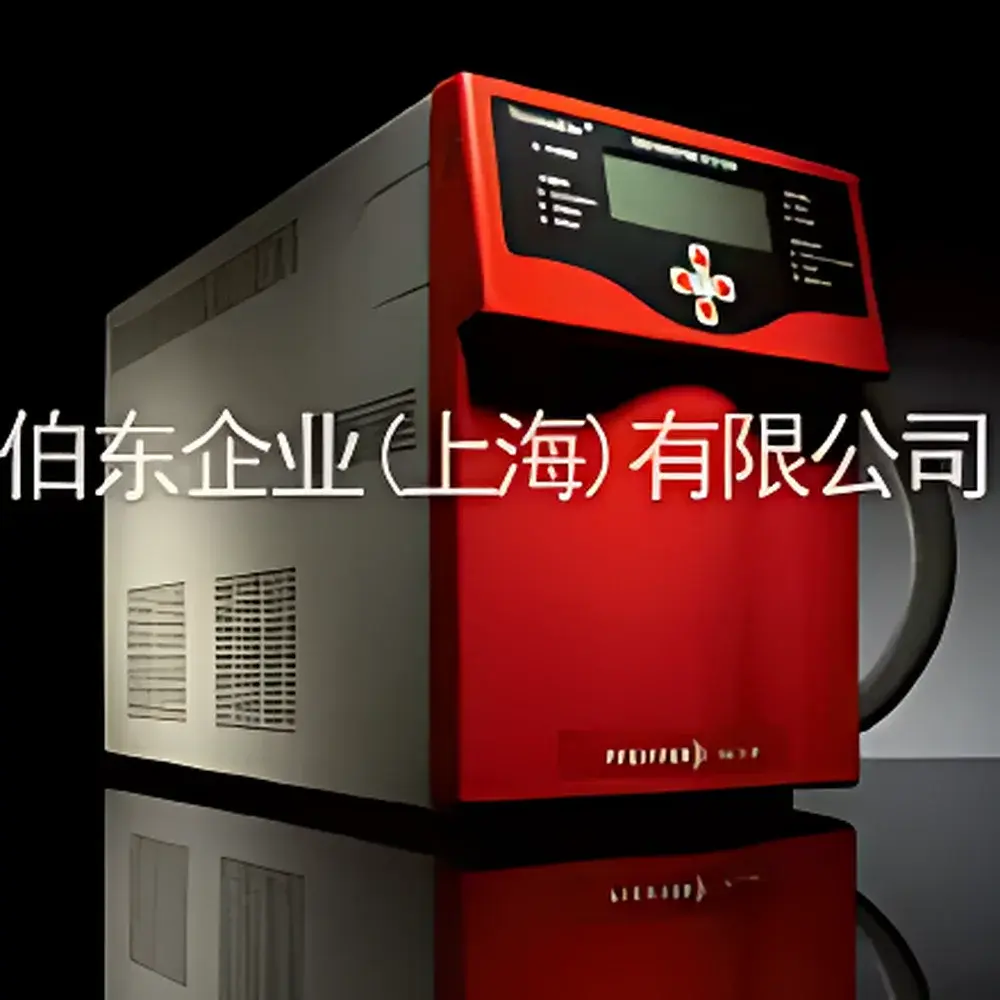
Pfeiffer Vacuum ThermoStar Online Mass Spectrometer for Simultaneous Coupling with FTIR and Thermogravimetric Analysis (TGA)
| Brand | Pfeiffer Vacuum |
|---|---|
| Origin | Germany |
| Model | ThermoStar GSD301 |
| Detection Principle | Quadrupole Mass Spectrometry (QMS) |
| Mass Range | 1–300 u (standard), upgradable to 500 u |
| Detection Limit | <10⁻¹⁴ mbar (partial pressure, typical) |
| Ion Source | Gas-tight dual-filament design |
| Inlet System | Integrated Pt-capillary inlet, max. temp. 350 °C, vacuum-rated to 5×10⁻³ mbar |
| Pumping System | Dual-stage turbomolecular pumping (HiPace 80 + backing pump) |
| Software | QuadStar™ v4.x (supports ASTM E2554, ISO 11348, GLP-compliant audit trail, 21 CFR Part 11 optional modules) |
| Interface Compatibility | Fully compatible with TA Instruments, Mettler Toledo, NETZSCH, SETARAM, PerkinElmer, LINSEIS, Seiko, Micromeritics, Quantachrome TGA/DTA/DSC/adsorption systems |
Overview
The Pfeiffer Vacuum ThermoStar GSD301 is a high-stability quadrupole mass spectrometer engineered specifically for real-time, simultaneous hyphenated analysis with Fourier-transform infrared (FTIR) spectroscopy and thermogravimetric analyzers (TGA). Operating on the principle of electron ionization (EI) coupled with mass-filtered ion detection, the ThermoStar enables quantitative and qualitative identification of volatile and semi-volatile species evolved during thermal decomposition, desorption, or reaction processes. Unlike standalone gas analysis tools, this system integrates directly into the effluent stream of a TGA furnace via a heated capillary transfer line (up to 350 °C), ensuring minimal condensation and molecular fragmentation. The simultaneous acquisition of mass spectral data (m/z 1–300 u) and FTIR absorption spectra provides orthogonal analytical dimensions—mass-to-charge ratio resolution from QMS and functional-group specificity from IR—thereby eliminating ambiguity in complex mixture characterization. Designed for laboratory-based method development and industrial process R&D, the ThermoStar meets core requirements for materials science, catalysis, polymer degradation studies, pharmaceutical stability testing, and clean energy research.
Key Features
- Gas-tight, dual-filament ion source architecture ensures long-term operational stability and minimizes oxidation-related filament failure during continuous operation with reactive or corrosive gases.
- Integrated Pt/Ir microcapillary inlet system rated to 350 °C and 5×10⁻³ mbar, enabling direct coupling with high-temperature TGA furnaces without cold traps or intermediate gas conditioning.
- Dual-stage high-vacuum pumping configuration: HiPace 80 turbomolecular pump backed by a dry scroll pump delivers stable base pressure <5×10⁻⁹ mbar, essential for high signal-to-noise ratio in trace gas detection.
- Modular mechanical design allows field-replaceable components—including ion optics, detector assembly, and inlet tubing—reducing mean time to repair (MTTR) and supporting ISO/IEC 17025-compliant maintenance protocols.
- QuadStar™ software platform supports synchronized data acquisition across TGA, FTIR, and MS channels with timestamp-aligned export (CSV, ASCII, .qdt), batch processing, peak deconvolution, and isotopic pattern fitting for unknown compound identification.
Sample Compatibility & Compliance
The ThermoStar GSD301 accommodates solid, powder, and thin-film samples placed directly in standard TGA crucibles (Pt, Al₂O₃, or ceramic). It detects evolved gases including H₂O, CO, CO₂, CH₄, NH₃, NOₓ, SO₂, hydrocarbons, siloxanes, and halogenated organics—provided they remain thermally stable under EI conditions. The system complies with ASTM E1131 (standard test method for compositional analysis of evolved gases), ISO 11348 (toxicity assessment via luminescent bacteria), and supports GLP/GMP workflows through configurable user access levels, electronic signatures, and full audit-trail logging (21 CFR Part 11 optional). All vacuum components meet PED 2014/68/EU and RoHS 2011/65/EU directives.
Software & Data Management
QuadStar™ v4.x serves as the central control and analysis interface. It provides real-time spectral visualization, background subtraction, library search against NIST/EPA/FFW databases, and calibration-free semi-quantitative analysis using relative sensitivity factors (RSFs). Raw data files are stored in vendor-neutral formats compliant with FAIR principles (Findable, Accessible, Interoperable, Reusable). Integration with third-party TGA software (e.g., NETZSCH Proteus®, TA Universal Analysis™) is achieved via TCP/IP or RS-232 hardware triggers, enabling fully automated start/stop synchronization and event-driven sampling. Data export supports LIMS interoperability via ASTM E1384-compliant XML schemas.
Applications
- Residual solvent quantification in pharmaceutical APIs per ICH Q3C guidelines.
- Decomposition pathway mapping of battery cathode materials (e.g., NMC, LFP) under inert and oxidative atmospheres.
- In-situ monitoring of catalyst deactivation mechanisms during Fischer–Tropsch synthesis or methanol-to-olefins (MTO) reactions.
- Identification of pyrolysis products from biomass feedstocks to optimize bio-oil composition.
- Outgassing profiling of space-grade polymers and composites under thermal cycling per ECSS-Q-ST-70-02C.
FAQ
Can the ThermoStar be retrofitted to an existing TGA system from another manufacturer?
Yes—the ThermoStar features universal flange interfaces (CF35/CF50) and programmable analog/digital I/O for seamless integration with TA Instruments, METTLER TOLEDO, NETZSCH, SETARAM, and other major TGA platforms.
What is the minimum detectable concentration for CO₂ in a nitrogen matrix?
At 100 °C inlet temperature and 1 s dwell time per mass channel, the typical limit of detection (LOD) is 10 ppmv (v/v) with a signal-to-noise ratio ≥3:1.
Is remote diagnostics supported?
Yes—via secure SSH tunneling and optional Pfeiffer Remote Service Module (RSM), enabling firmware updates, spectral calibration verification, and pump health monitoring without on-site intervention.
Does the system support isotope ratio monitoring (IRM)?
The standard GSD301 does not include high-resolution magnetic sector optics; however, isotopic patterns (e.g., ¹²CO vs. ¹³CO) are resolvable at unit mass resolution, sufficient for kinetic isotope effect (KIE) studies in thermal decomposition kinetics.
Are service contracts and spare parts available globally?
Pfeiffer Vacuum maintains certified service centers in Shanghai, Taipei, Bangkok, and Tokyo, with 98% spare part availability from regional depots and 72-hour critical component dispatch guarantee under Platinum Support agreements.
Related Products





