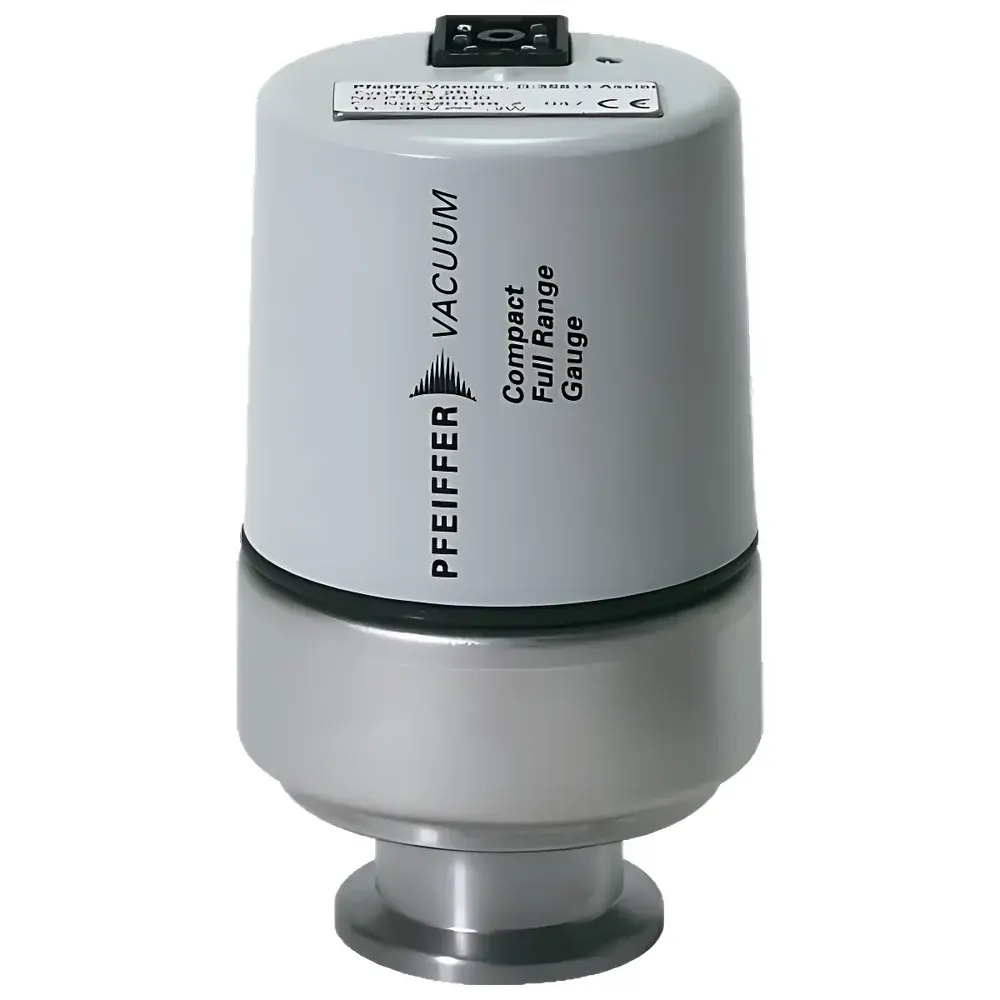
Pfeiffer Vacuum TPR 280/281 Pirani Vacuum Gauge
| Brand | Pfeiffer Vacuum |
|---|---|
| Origin | Germany |
| Model | TPR 280 / TPR 281 |
| Measurement Range | 1.0 × 10³ hPa to 5.0 × 10⁻⁴ hPa |
| Operating Temperature | 80 °C (standard) / 250 °C (high-temp version) |
| Accuracy | ±15 % of reading |
| Burst Pressure | 1000 kPa |
| Weight | 80 g (TPR 280, standard) / 130 g (TPR 280, high-temp) / 80 g (TPR 281, corrosion-resistant) |
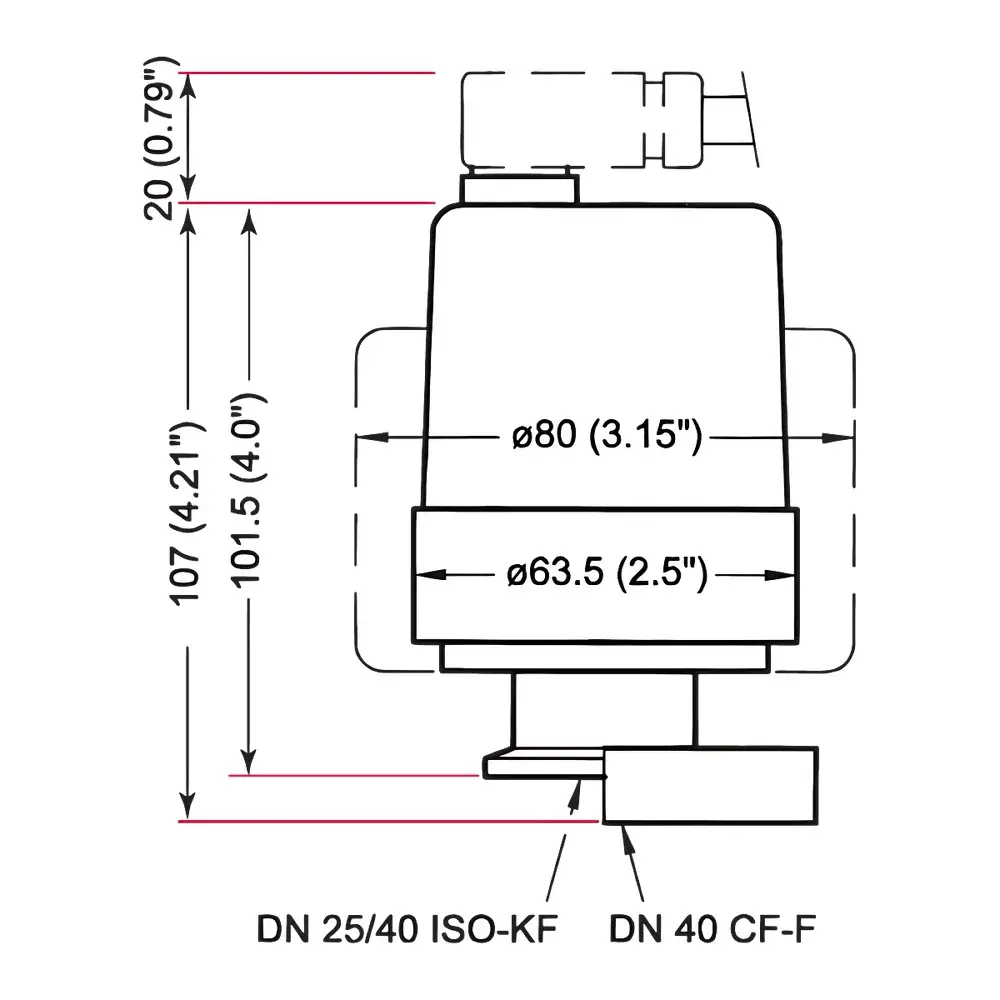
| Flange Options | DN 16 ISO-KF, DN 16 CF, 1/8" NPT, 8 VCR |
Overview
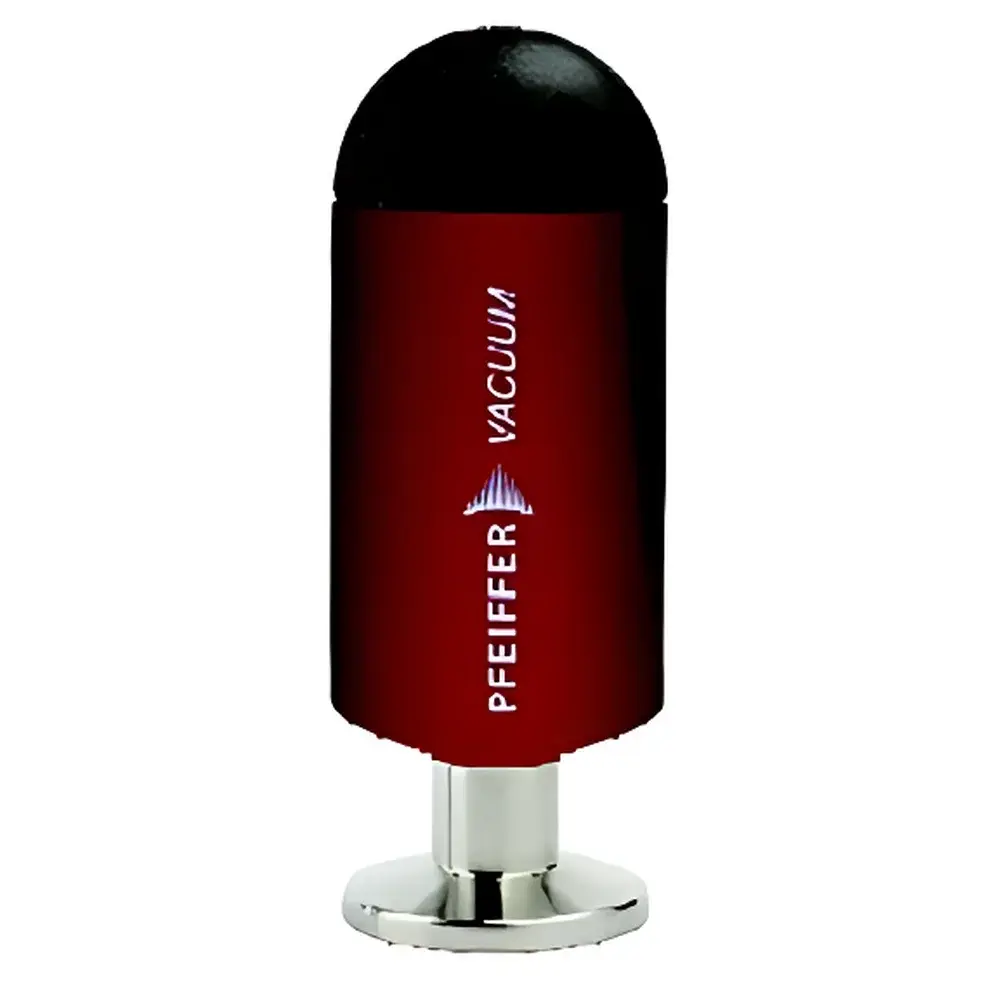
The Pfeiffer Vacuum TPR 280 and TPR 281 are compact, robust Pirani vacuum gauges engineered for reliable total pressure measurement in low- and medium-vacuum ranges. Based on thermal conductivity principles, these gauges operate by monitoring the heat loss from a heated filament immersed in the gas phase — a method standardized under ISO 20487 and widely accepted for routine vacuum process monitoring in industrial, R&D, and OEM applications. With a continuous measurement range spanning from atmospheric pressure (1000 hPa) down to 5 × 10⁻⁴ hPa (0.5 mTorr), the TPR series bridges the gap between mechanical gauges and more complex capacitance or cold cathode instruments. Its solid-state design eliminates moving parts, ensuring long-term stability and minimal drift over time. The gauge head integrates seamlessly into vacuum systems via multiple standardized flange interfaces — including DN 16 ISO-KF, DN 16 CF, 1/8″ NPT, and 8 VCR — enabling flexible integration across diverse vacuum architectures.
Key Features
- Thermally compensated Pirani sensor with stable calibration traceable to national metrology institutes
- Two operating temperature variants: standard version rated up to 80 °C ambient; high-temperature version rated to 250 °C for bake-out compatible environments
- Corrosion-resistant TPR 281 variant features chemically inert sensor housing and filament protection for use with aggressive gases (e.g., Cl₂, NH₃, HF)
- Low power consumption (<1.5 W typical), suitable for embedded OEM control systems and portable vacuum instrumentation
- Fast response time (<1 s for 90% step change), supporting real-time process feedback in dynamic vacuum cycles
- Compact footprint (≤ Ø35 mm × 60 mm) and lightweight construction (80–130 g), minimizing thermal load and mechanical stress on vacuum chambers
Sample Compatibility & Compliance
The TPR series is compatible with all common process gases including N₂, O₂, Ar, He, H₂, CO₂, and air. While calibration is performed in nitrogen, correction factors are provided per ISO 20487 Annex B for common gases to ensure accurate total pressure estimation across mixed-gas environments. The TPR 281 variant extends compatibility to corrosive media through its fluoropolymer-sealed electronics and passivated stainless-steel sensor housing. All models comply with CE marking requirements under the EU Electromagnetic Compatibility Directive (2014/30/EU) and Low Voltage Directive (2014/35/EU). They are designed to support GLP and GMP-aligned vacuum system qualification when paired with documented calibration certificates (available upon request) and integrated into systems compliant with FDA 21 CFR Part 11 data integrity guidelines.
Software & Data Management
The TPR gauge operates as a standalone analog/digital transducer and does not require proprietary software for basic operation. It outputs a linear 0–10 V or 4–20 mA signal proportional to logarithmic pressure, enabling direct integration with PLCs, DAQ systems, and SCADA platforms. Optional digital interface modules (e.g., Pfeiffer’s SmartView controller or third-party RS485/Modbus gateways) allow for remote configuration, multi-point calibration storage, and audit-trail-enabled logging — essential for regulated environments requiring electronic record retention per ALCOA+ principles. Firmware updates and configuration backups are supported via standard USB or Ethernet connections using Pfeiffer’s Vacuum Control Suite (VCS), which meets IEC 62443-3-3 cybersecurity baseline requirements for industrial instrumentation.
Applications
- Monitoring roughing and pre-evacuation stages in semiconductor thin-film deposition systems (PECVD, sputtering, evaporation)
- Process pressure control in vacuum drying ovens, freeze dryers, and degassing chambers
- OEM integration into analytical instrumentation such as residual gas analyzers (RGAs) and mass spectrometers requiring auxiliary vacuum stage monitoring
- Leak detection system support — providing coarse-stage pressure feedback prior to helium mass spectrometer operation
- Education and training labs where durability, ease of use, and wide dynamic range are prioritized over ultra-high resolution
- Vacuum packaging lines, coating equipment, and vacuum furnaces requiring repeatable, maintenance-free pressure indication
FAQ
What is the recommended calibration interval for the TPR series?
Annual calibration is recommended for critical applications; however, field verification against a reference gauge every 6 months is sufficient for non-regulated processes.
Can the TPR 280 be used in oxygen-rich or hydrogen atmospheres?
Yes — but only with appropriate gas-specific calibration factors applied. Hydrogen requires a correction factor of ~0.15× (due to higher thermal conductivity); oxygen requires ~1.1× relative to nitrogen.
Is the TPR series compatible with vacuum bake-out procedures?
The TPR 280 (250 °C version) and TPR 281 are explicitly rated for bake-out up to 250 °C; standard TPR 280 units must be removed prior to heating above 80 °C.
Does the TPR output support digital communication protocols?
Not natively — it provides analog voltage/current output. Digital functionality requires an external interface module supporting Modbus RTU, Profibus DP, or EtherCAT.
How does the TPR compare to capacitance manometers in terms of accuracy and gas dependence?
Capacitance manometers offer higher absolute accuracy (±0.25 %) and gas independence but are significantly more expensive and limited to ≤1000 hPa. The TPR trades some accuracy (±15 %) for broader range, lower cost, and superior reliability in dirty or condensable vapor environments.