
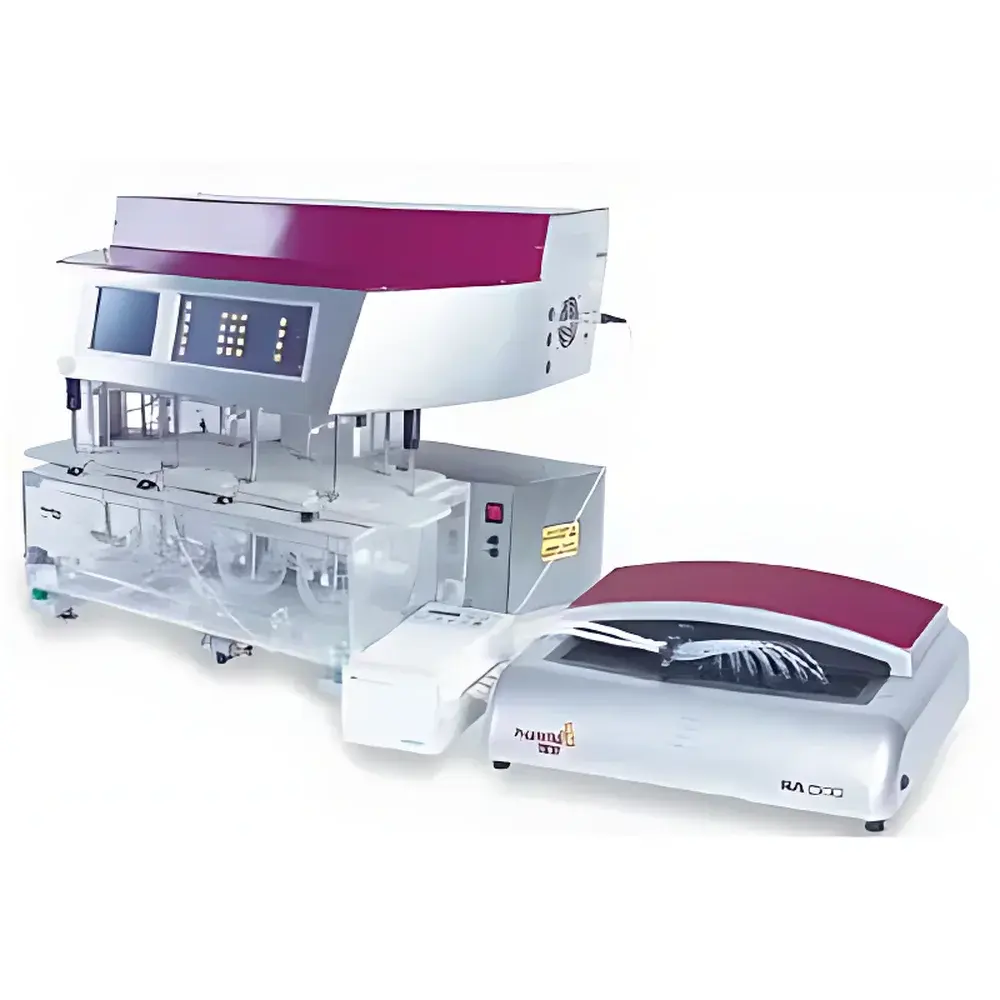
Pharma-test DFC1220 12-Position Automated Sampling Dissolution System
| Brand | Pharma-test |
|---|---|
| Origin | Germany |
| Model | ADS |
| Instrument Type | Offline Dissolution Tester |
| Dissolution Vessels | 6, 8, or 7 (configurable) |
| Temperature Range | 10–50 °C |
| Temperature Accuracy | ±0.1 °C |
| Rotation Speed Range | 15–150 rpm |
| Paddle Wobble Amplitude | ≤1 mm |
| Basket Wobble Amplitude | ≤1 mm |
| Water Bath Temperature Control Range | Ambient to 45 °C |
| Water Bath Temperature Resolution | 0.1 °C |
| Water Bath Volume | 12 L |
Overview
The Pharma-test DFC1220 12-Position Automated Sampling Dissolution System is a fully integrated, offline dissolution testing platform engineered for compliance with global pharmacopeial standards—including USP , EP 2.9.3, and JP 17. Designed around the hydrodynamic principles of paddle and basket dissolution methods, the system delivers high reproducibility in drug release profiling by maintaining precise control over critical physicochemical parameters: temperature uniformity, rotational stability, vessel geometry alignment, and timed sampling integrity. Unlike semi-automated or manual systems, the DFC1220 ADS architecture decouples sample collection from analytical detection—enabling flexible integration with third-party UV-Vis spectrophotometers while retaining full traceability and audit readiness under regulated environments.
Key Features
- Modular 12-position automated sampling station compatible with all Pharma-test dissolution test units (e.g., PT-DT series), supporting seamless retrofitting without hardware modification.
- High-precision peristaltic pump module (IPC8/IPC16) delivering consistent flow rates and minimal carryover between samples; pump tubing is chemically resistant to common dissolution media (e.g., HCl, phosphate buffers, surfactant solutions).
- Dual-stage temperature management: independent vessel heating via calibrated immersion heaters (10–50 °C, ±0.1 °C accuracy) and auxiliary water bath regulation (ambient to 45 °C, 0.1 °C resolution) ensuring thermal equilibrium across all 12 vessels.
- Mechanical compliance verified per USP : paddle and basket wobble amplitudes rigorously maintained at ≤1 mm; shaft concentricity and vertical alignment conform to ISO 17025-accredited calibration protocols.
- Robust mechanical design with stainless-steel frame, corrosion-resistant fluid pathways, and IP54-rated electronics for long-term operation in QC laboratories.
Sample Compatibility & Compliance
The DFC1220 ADS accommodates standard USP Apparatus 1 (basket) and Apparatus 2 (paddle) configurations, with optional support for Apparatus 3 (reciprocating cylinder) and Apparatus 4 (flow-through cell) via accessory kits. Vessel capacity is configurable for 6-, 7-, or 8-position setups depending on lab workflow requirements. All wetted materials meet USP Class VI biocompatibility standards. The system is validated for use with aggressive dissolution media—including 0.1 N HCl, pH 4.5 acetate buffer, pH 6.8 phosphate buffer, and SDS-containing formulations—without degradation of pump tubing or sampling manifolds. Full 21 CFR Part 11 compliance is achieved through Win DISS 32 software, including electronic signatures, role-based access control, immutable audit trails, and automated backup of raw acquisition data.
Software & Data Management
Win DISS 32 serves as the central control and data governance layer for the DFC1220 ADS. It supports method-driven operation: users define dissolution protocols—including sampling timepoints, filtration parameters, dilution factors, and media replacement schedules—via intuitive graphical workflows. Raw absorbance data from connected UV-Vis instruments (including Shimadzu, Agilent, Thermo Fisher, and PerkinElmer models) is imported directly into Win DISS 32 for real-time concentration calculation using preloaded calibration curves or user-defined algorithms. All calculations adhere to ICH Q5C linearity and accuracy expectations. Reports are exportable in PDF/A-1b and CSV formats, with metadata embedded per ALCOA+ principles (Attributable, Legible, Contemporaneous, Original, Accurate, Complete, Consistent, Enduring, Available).
Applications
- Comparative dissolution profiling of generic and innovator products in bioequivalence studies.
- Stability-indicating release testing during accelerated and long-term stability programs (ICH Q1A–Q1E).
- Formulation development support: evaluating the impact of excipient composition, particle size distribution, and coating thickness on release kinetics.
- Quality control release testing for solid oral dosage forms (tablets, capsules, orally disintegrating tablets) in GMP-compliant manufacturing environments.
- Investigational analysis of extended-release and modified-release dosage forms requiring multi-phase dissolution modeling (e.g., Weibull, Higuchi, Korsmeyer-Peppas).
FAQ
Can the DFC1220 ADS be upgraded from an existing Pharma-test dissolution tester?
Yes—the ADS sampling module is retrofittable to any current-generation Pharma-test dissolution instrument (PT-DT 700, PT-DT 800, or PT-DT 900 series) without replacing the host unit.
Does the system support sequential or simultaneous sampling across all 12 positions?
Sampling is performed sequentially per protocol-defined intervals; however, the IPC16 pump enables parallel delivery of up to 16 fractions to a multi-cell UV cuvette holder, minimizing total assay cycle time.
Is validation documentation provided with the system?
Pharma-test supplies IQ/OQ documentation templates aligned with ASTM E2503 and USP , along with factory calibration certificates traceable to NIST standards.
What UV-Vis spectrophotometers are certified for integration?
Win DISS 32 includes native drivers for >20 models across major vendors; custom API integration is available for legacy or proprietary instruments upon request.
How is carryover mitigated during automated sampling?
The IPC8/IPC16 pump employs programmable rinse cycles with adjustable volume and dwell time; all fluid paths are purged with fresh dissolution medium prior to each sampling event.
Related Products






