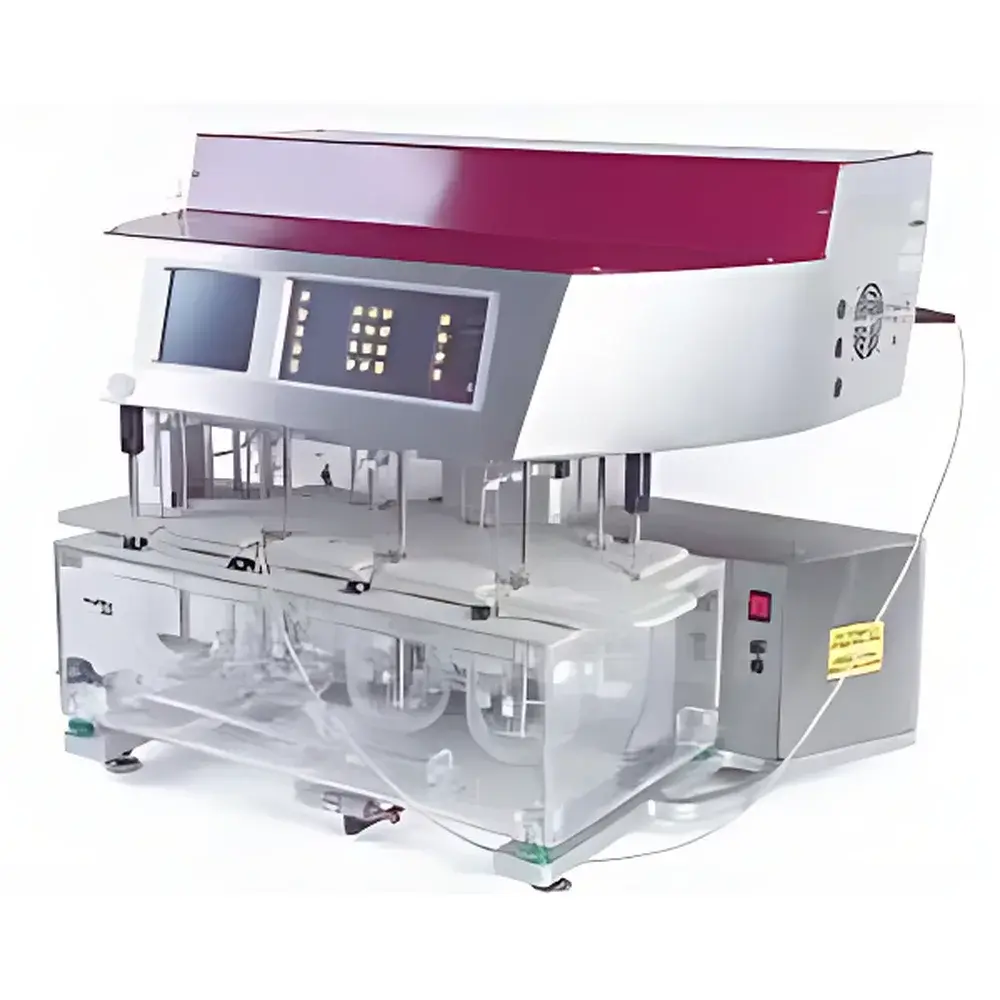
Pharma-test PT-DT 8-Position Automated Sampling Dissolution Tester
| Brand | Pharma-test |
|---|---|
| Origin | Germany |
| Model | PT-DT Series |
| Instrument Type | Offline Dissolution Tester |
| Sample Positions | 8 |
| Dissolution Vessel Options | 250 mL, 1 L, 2 L, 4 L |
| Temperature Range | 25–45 °C |
| Temperature Accuracy | ±0.2 °C |
| Rotational Speed Range | 25–250 rpm |
| Speed Accuracy | ±1 rpm |
| Water Bath Volume | 35 L |
| Construction | Stainless Steel (GLP-compliant) |
| Modular Architecture | Supports upgrade to semi-automated (offline) and fully automated (online) configurations |
| Validation Support | IQ/OQ/PQ documentation and execution available |
| Regulatory Compliance | Designed to meet USP <711>, EP 2.9.3, JP XVII, and ChP (Chinese Pharmacopoeia) General Chapter 0931 requirements |
Overview
The Pharma-test PT-DT 8-Position Automated Sampling Dissolution Tester is a precision-engineered offline dissolution system designed for pharmaceutical quality control laboratories requiring strict adherence to international pharmacopoeial standards. Based on the rotating basket (USP Apparatus 1) and paddle (USP Apparatus 2) principles, the system enables quantitative measurement of drug substance release from solid oral dosage forms—including immediate-release and modified-release tablets, capsules, and pellets—into a defined dissolution medium under controlled hydrodynamic, thermal, and mechanical conditions. Its core architecture integrates a thermostatically regulated water bath, independently driven stirring shafts, and a programmable sampling module capable of timed, sequential withdrawal of samples across all eight positions without manual intervention. Engineered in Germany and compliant with ISO 9001-certified manufacturing protocols, the PT-DT platform delivers high reproducibility in dissolution profile generation—critical for formulation development, batch release testing, and stability studies.
Key Features
- Eight independent dissolution stations with synchronized or individually programmable operation
- Stainless steel mainframe construction meeting GLP infrastructure requirements and corrosion resistance for long-term use in regulated environments
- Precise temperature control via digital PID-regulated water bath (25–45 °C, ±0.2 °C accuracy) with integrated circulation pump and level sensor
- Motor-driven shafts supporting both USP Apparatus 1 (rotating basket) and Apparatus 2 (paddle), with speed range 25–250 rpm and ±1 rpm repeatability
- Modular design allowing future expansion to semi-automated sampling (offline filtration/injection) or full online integration with HPLC/UHPLC systems
- Optional motorized lift mechanism for automatic vessel head positioning—reducing operator variability and improving ergonomic safety
- Configurable dissolution vessel capacity: 250 mL, 1 L, 2 L, and 4 L—supporting compendial flexibility and extended kinetic profiling
Sample Compatibility & Compliance
The PT-DT accommodates standard USP-compliant dissolution vessels and accessories, including baskets (mesh sizes 20–40), paddles, sinkers, and flow-through cells (with optional adapter kits). It supports routine testing of coated tablets, gelatin capsules, osmotic pumps, and multiparticulate systems. All operational parameters—including temperature setpoint, agitation speed, sampling timepoints, and vessel volume—are fully configurable to satisfy method-specific requirements outlined in USP , European Pharmacopoeia 2.9.3, Japanese Pharmacopoeia XVII, and Chinese Pharmacopoeia General Chapter 0931. The system is validated per ICH Q5C and ASTM E2503 guidelines, and IQ/OQ/PQ protocols—including installation verification, operational boundary testing, and performance qualification using certified reference standards—are available upon request.
Software & Data Management
The PT-DT operates via Pharma-test’s proprietary PC-based control software, which provides intuitive graphical interface for method creation, real-time monitoring of temperature and rotation status, and automated logging of sampling events. All data—including timestamps, vessel ID, temperature readings, speed values, and user actions—are recorded with audit trail functionality compliant with FDA 21 CFR Part 11 requirements. Export options include CSV, PDF, and XML formats compatible with LIMS and electronic lab notebook (ELN) platforms. Optional 21 CFR Part 11 add-on modules support electronic signatures, role-based access control, and immutable record retention—ensuring alignment with GMP and GLP data integrity expectations.
Applications
- Comparative dissolution profiling for generic product development and bioequivalence assessment
- Stability-indicating release testing during accelerated and long-term storage studies
- In-process control of coating uniformity and film integrity in tablet manufacturing
- Excipient interaction screening during preformulation research
- Regulatory submission support—including ANDA, NDA, and MAA dossiers requiring dissolution data traceability
- Method transfer between R&D, QC, and contract testing laboratories
FAQ
Does the PT-DT support both Apparatus 1 and Apparatus 2 configurations?
Yes—the system is mechanically and software-configurable for either rotating basket or paddle assemblies, with tool-free interchangeability and pre-calibrated alignment fixtures.
Can the system be upgraded to fully automated online dissolution-HPLC coupling?
Yes—Pharma-test offers dedicated interface modules and validation packages for seamless integration with major HPLC/UHPLC vendors, enabling real-time quantification without manual sample handling.
Is IQ/OQ/PQ documentation included with the instrument?
Standard delivery includes factory-verified IQ/OQ templates; PQ execution and site-specific validation support are available as optional professional services.
What is the maximum allowable deviation for temperature and rotational speed during qualification?
Per USP , the system maintains ≤±0.2 °C temperature deviation and ≤±1 rpm speed deviation across all eight positions under loaded conditions—verified during factory OQ.
How is data integrity ensured during multi-day dissolution runs?
All parameter changes, sampling events, and system alarms are timestamped and logged in an encrypted database with write-once-read-many (WORM) archiving capability, satisfying ALCOA+ principles.