
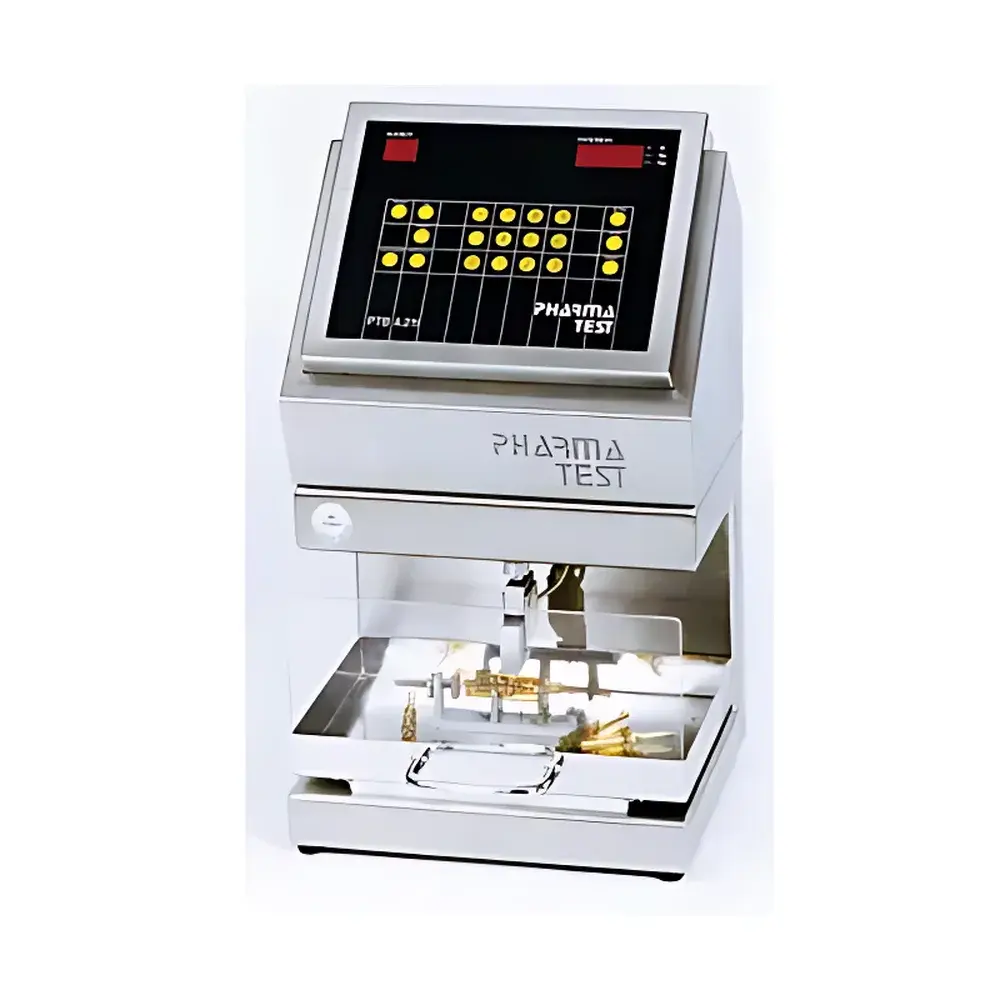
Pharma-test PTB 211E Ampoule Hardness Tester
| Brand | Pharma-test |
|---|---|
| Origin | Germany |
| Model | PTB 211E |
| Measurement Principle | Constant-Speed and Constant-Force Methods |
| Force Range | 2–330 N |
| Resolution | 1 N |
| Optional Units | N, kp, Sc |
| Interface | RS-232, Parallel Printer Port |
| Compliance Option | 21 CFR Part 11–compliant Software Available |
| Sample Capacity | 1–30 mL Ampoules |
Overview
The Pharma-test PTB 211E Ampoule Hardness Tester is a precision-engineered mechanical testing instrument designed specifically for the quantitative evaluation of break resistance in glass pharmaceutical ampoules. Unlike tablet hardness testers—which rely on axial compression of solid dosage forms—the PTB 211E applies controlled, unidirectional force to the neck or body of sealed ampoules using a calibrated piston-driven actuator. It operates on two validated mechanical test modes: constant-speed mode (where the plunger advances at a defined linear velocity until fracture) and constant-force mode (where load is incrementally increased until the predefined breaking threshold is reached). This dual-mode architecture ensures method flexibility across pharmacopoeial requirements and internal quality control protocols. The device complies with core mechanical integrity assessment principles referenced in Ph. Eur. 3.2.1 (Glass Containers) and USP (Containers—Glass), supporting objective, operator-independent determination of ampoule robustness prior to sterilization, labeling, and distribution.
Key Features
- High-precision electromechanical actuation system with ±1 N force resolution and reproducible loading profiles across the full 2–330 N range
- Dual-test methodology: selectable constant-speed (mm/s) or constant-force (N/s) control for alignment with internal SOPs or regulatory expectations
- Integrated LED illumination at the test station enables real-time visual confirmation of fracture initiation and crack propagation during testing
- Onboard statistical engine calculates mean, standard deviation, coefficient of variation, min/max, and histogram distribution for up to 999 test results per batch
- RS-232 serial interface supports bidirectional communication with LIMS or custom QA databases; parallel printer port enables direct hardcopy output of test reports
- Modular unit design facilitates GMP-aligned calibration verification using traceable NIST-certified force standards
Sample Compatibility & Compliance
The PTB 211E accommodates standard 1 mL to 30 mL Type I and Type II borosilicate glass ampoules—including those with flanged, threaded, or snap-off neck geometries—without requiring fixture reconfiguration. Its adjustable support cradle and vertically aligned plunger ensure consistent point-of-load application at the ampoule’s weakest structural zone (typically the neck seal or shoulder junction). While not a pharmacopoeial instrument per se, its measurement methodology aligns with the mechanical stress evaluation principles embedded in ISO 8536-1 (Infusion containers) and ASTM E2473 (Standard Guide for Mechanical Testing of Parenteral Packaging Systems). Optional 21 CFR Part 11–compliant software provides electronic signature capability, audit trail logging, user access levels, and data immutability—enabling deployment in FDA-regulated environments under GLP or cGMP conditions.
Software & Data Management
The optional Pharma-test Control Software (v3.x) transforms the PTB 211E into a fully auditable digital testing node. It enforces role-based authentication (administrator, analyst, reviewer), captures timestamped metadata (operator ID, sample ID, environmental temperature/humidity if integrated), and generates PDF or CSV reports compliant with ALCOA+ data integrity criteria. All raw force–displacement curves are stored with full traceability, and report templates can be customized to reflect site-specific QA formats. Audit trails record every parameter change, result deletion, or calibration event—retained for minimum 15 years per default configuration. Data export supports automated ingestion into enterprise systems via HL7 or ASTM E1384-compliant messaging frameworks.
Applications
- Pre-release evaluation of ampoule mechanical integrity following lyophilization or terminal sterilization cycles
- Comparative analysis of glass composition batches (e.g., low-borosilicate vs. high-borosilicate variants)
- Stability study endpoint assessment for container-closure system performance over shelf life
- Root cause investigation of breakage incidents during secondary packaging or logistics handling
- Validation of new ampoule supplier qualification protocols against historical reference data
- Supporting regulatory submissions requiring evidence of container robustness per ICH Q5C and Q5D guidelines
FAQ
Does the PTB 211E meet ISO/IEC 17025 calibration requirements?
Yes—when used with certified reference force standards and documented calibration procedures, it satisfies clause 6.5.2 of ISO/IEC 17025:2017 for mechanical testing equipment.
Can test parameters be locked to prevent unauthorized modification?
Yes—via the optional 21 CFR Part 11 software, parameter lockout is enforced per user privilege level and requires dual authorization for critical changes.
Is third-party validation support available for IQ/OQ/PQ documentation?
Pharma-test provides template protocols and witnessed factory acceptance testing (FAT); site-specific OQ execution requires local metrology partner involvement.
What maintenance intervals are recommended for sustained accuracy?
Plunger alignment verification and load cell zero-check every 200 tests; full recalibration annually or after any impact event or mechanical service.
How does the PTB 211E differentiate between brittle fracture and plastic deformation in non-glass ampoules?
It does not interpret material failure mode—it records peak force and displacement. Interpretation of fracture type must be supported by complementary microscopy or SEM analysis.







