
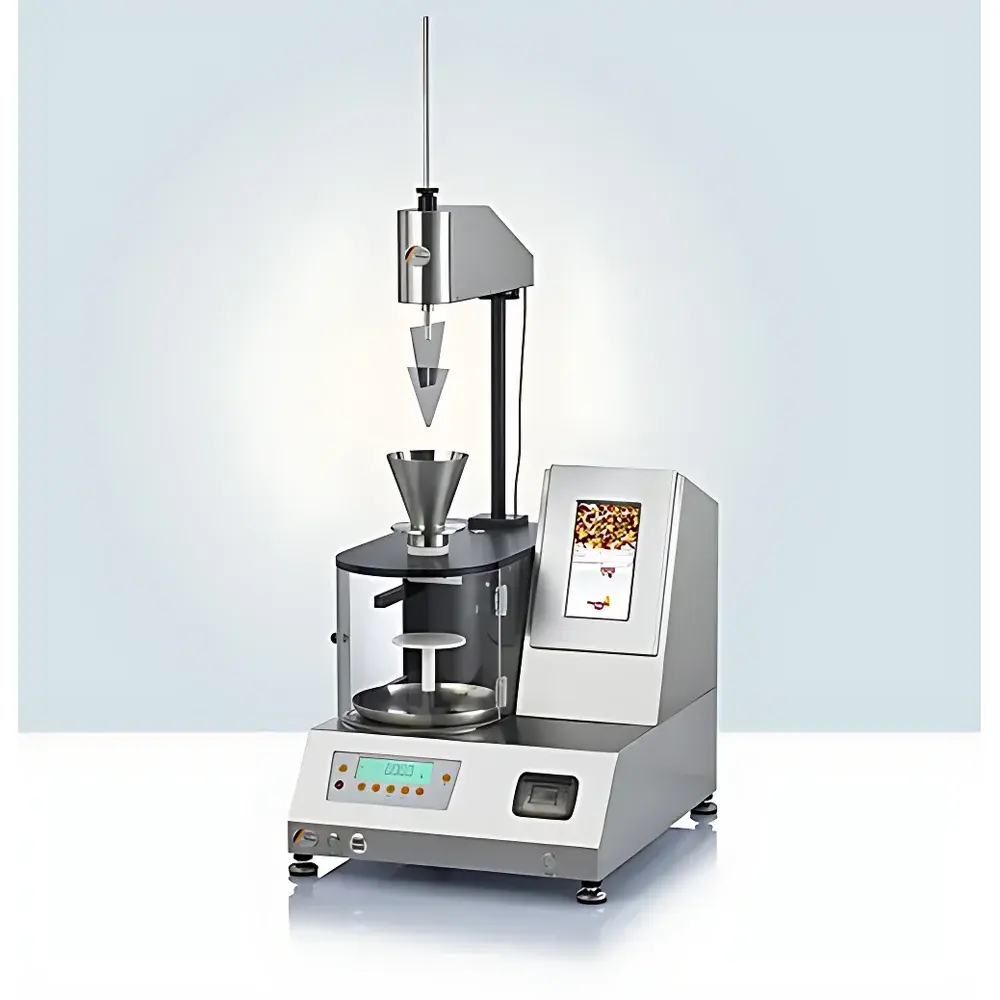
Pharma Test PTG-S5 Automated Powder Flowability Analyzer
| Brand | Pharma Test |
|---|---|
| Origin | Germany |
| Model | PTG-S5 |
| Instrument Type | Fully Automated Powder Flowability Analyzer |
| Standards Compliance | USP <1174>, EP <2.9.36>, EP <2.9.16>, ISO 4324 (1983) |
| Funnel Volume | 450 mL |
| Heap Angle Range | 1–65° |
| Heap Volume Range | 0.1–275 mL |
| Bulk Density Range | 0–6.0 g/mL |
| Sample Mass Range | 1 mg–325 g |
| Flow Time Range | 0.1–999 s |
| Nozzle Orifices | 6, 8, 10, 15, 25 mm |
| Display | 7-inch color touchscreen |
| Dimensions (L×W×H) | 50 × 55 × 90 cm |
| Construction | Electropolished stainless steel housing |
| Software | 21 CFR Part 11 compliant with audit trail, electronic signatures, and secure data storage |
Overview
The Pharma Test PTG-S5 Automated Powder Flowability Analyzer is an engineered solution for standardized, operator-independent assessment of powder flow behavior in pharmaceutical development, quality control, and regulatory submission environments. Based on the principle of gravitational powder discharge through calibrated orifices under controlled conditioning, the PTG-S5 implements the core methodologies defined in major pharmacopoeial standards—including USP , European Pharmacopoeia monographs EP (Angle of Repose) and EP (Flow Through an Orifice), as well as ISO 4324 (1983) for bulk density and flow time determination. The system quantifies critical functional properties including flow time (for 100 g sample), heap angle (angle of repose), heap volume, heap mass, and derived bulk density—parameters directly linked to tablet compression performance, content uniformity, and blend homogeneity. Its fully automated sequence eliminates inter-operator variability, ensuring high reproducibility across laboratories and production sites.
Key Features
- Fully automated measurement cycle—from powder conditioning via integrated PTG-ER stirrer to orifice flow, heap formation, and gravimetric analysis—executed without manual intervention.
- Electropolished stainless steel construction with sealed, electrostatic-dissipative dust enclosure; includes vacuum interface for real-time particulate capture during testing.
- Integrated high-precision Sartorius analytical balance (0.1 mg readability) co-located within the instrument chamber for direct mass acquisition during heap and flow measurements.
- 7-inch full-color capacitive touchscreen interface with intuitive workflow navigation, multilingual support (EN/DE/FR/ES), and on-device result visualization including real-time flow curves.
- Modular nozzle system with five interchangeable orifices (6, 8, 10, 15, 25 mm diameter) enabling method flexibility across powder categories—from fine APIs to granules and excipients.
- Built-in thermal printer delivers immediate hardcopy output of test reports, including timestamp, operator ID, method parameters, raw data, and calculated results.
Sample Compatibility & Compliance
The PTG-S5 supports dry, free-flowing to marginally cohesive powders typical of pharmaceutical solid dosage forms, including active pharmaceutical ingredients (APIs), excipients (e.g., microcrystalline cellulose, lactose monohydrate), and blended formulations. It is not intended for wet, sticky, fibrous, or highly aerated materials requiring shear cell or dynamic powder rheometry. All operational protocols adhere strictly to pharmacopoeial requirements: flow time is measured for exactly 100 g of powder discharged through a specified orifice; heap angle is determined optically from the apex of a conical pile formed under standardized funnel geometry; bulk density is calculated as mass divided by heap volume. The instrument’s mechanical design, calibration traceability, and software architecture meet GLP principles and are validated per ICH Q5A and Annex 15 guidelines. Stainless steel surfaces comply with FDA-recommended cleanability standards for multi-product facilities.
Software & Data Management
The embedded firmware supports 21 CFR Part 11 compliance through role-based user authentication, electronic signatures, immutable audit trails, and encrypted local database storage. Each test record contains metadata (date/time, operator, method version, environmental conditions if logged externally), raw sensor outputs (mass vs. time, image coordinates for angle calculation), and final derived values. Data export is supported via USB and Ethernet (LAN) to LIMS or ELN systems in CSV, PDF, or XML formats. Preconfigured IQ/OQ documentation packages—aligned with GAMP 5 categories—are supplied with installation, covering installation verification, operational boundary testing, and performance qualification against reference standards. Software updates are delivered via secure firmware update protocol with version rollback capability.
Applications
- Pre-formulation screening of powder flow attributes to guide excipient selection and process design space definition.
- Batch release testing per compendial methods to ensure consistency of powder blends prior to capsule filling or tablet compression.
- Stability-indicating assessment of flow degradation due to moisture uptake, phase transition, or particle agglomeration over time.
- Comparative evaluation of processing effects—e.g., impact of milling, spheronization, or roller compaction—on macroscopic flow behavior.
- Regulatory filing support: generation of auditable, compliant datasets for ANDA, NDA, or MAA submissions requiring demonstration of powder functionality.
FAQ
Does the PTG-S5 require external calibration weights or third-party verification for daily use?
No. The integrated Sartorius balance performs internal calibration at startup and supports user-initiated calibration using certified weights traceable to national standards. Routine verification is performed using a supplied 100 g stainless steel check weight.
Can the instrument be integrated into a networked QC laboratory environment?
Yes. Via Ethernet (LAN), the PTG-S5 supports centralized data archiving, remote monitoring of instrument status, and scheduled firmware updates through a secure corporate intranet.
Is method transfer between PTG-S5 units feasible across global manufacturing sites?
Yes. Method files—including orifice selection, stir speed, dwell time, and reporting templates—are portable and version-controlled. IQ/OQ documentation ensures identical performance baselines across installations.
What maintenance intervals are recommended for long-term reliability?
Daily wipe-down of funnel and enclosure surfaces; monthly inspection of nozzle seating and stirrer coupling; annual full mechanical and software validation using Pharma Test’s service protocol.
Does the system support non-pharmacopoeial custom methods?
Yes. The software allows creation of user-defined protocols with adjustable parameters (e.g., variable sample mass, custom flow duration thresholds, alternative angle calculation algorithms), subject to internal validation per SOP.



