
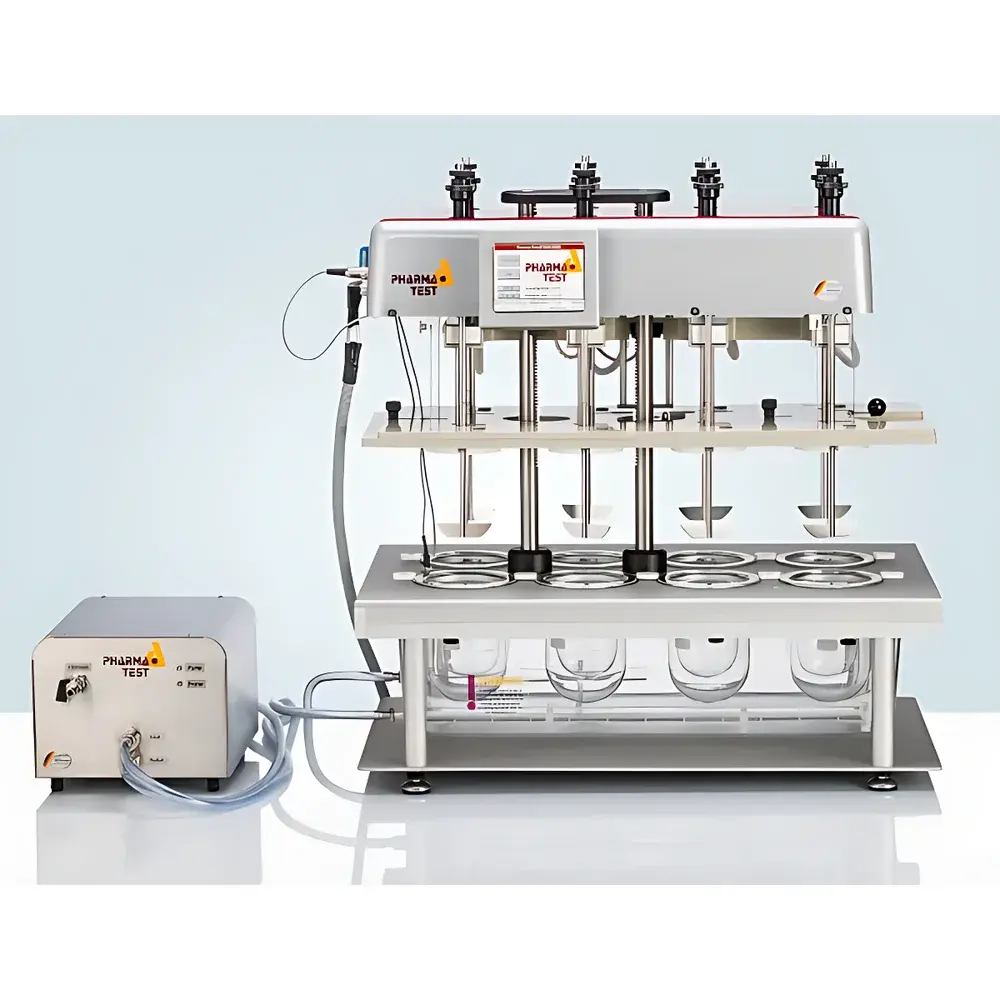
Pharma-test PTWS 820D Semi-Automatic 8-Station Dissolution Sampling System
| Brand | Pharma-test |
|---|---|
| Origin | Germany |
| Model | PTWS 820D |
| Instrument Type | Offline Dissolution Tester |
| Compliance | USP <711>, USP <724>, Ph. Eur. 2.9.3 & 2.9.4, DAB, JP <15>, ChP |
| Sample Positions | 8 (4+4 arrangement) |
| Drive Mechanism | Single motor-driven vertical lift |
| Temperature Monitoring | Real-time auto-check at each sampling point |
| Data Storage | SD card (method storage capacity: >10,000 protocols) |
| User Access Control | Role-based authentication (admin/operator) |
| Status Indication | Tri-color LED traffic-light display (green = ready, yellow = warming/stabilizing, red = error/failure) |
| Calibration Support | Built-in OQ/PQ reminder prompts |
| Cup Sealing | Low-volatility precision-fit lid |
| Bath Accessibility | Tool-free water bath removal for cleaning |
Overview
The Pharma-test PTWS 820D is a semi-automatic, offline 8-station dissolution testing system engineered for regulatory-compliant solid oral dosage form evaluation in pharmaceutical quality control and development laboratories. It operates on the principle of paddle or basket dissolution apparatus per USP and , Ph. Eur. 2.9.3 (paddle) and 2.9.4 (basket), as well as Japanese Pharmacopoeia (JP) Chapter 15 and Chinese Pharmacopoeia (ChP) General Chapter 0931. The system employs a single central drive mechanism to synchronize vertical movement of all eight paddles or baskets, ensuring mechanical consistency across vessels while maintaining individual thermal and hydrodynamic independence. Each dissolution vessel is uniquely encoded to support traceable method assignment and data linkage—critical for audit-ready documentation under FDA 21 CFR Part 11 and EU Annex 11 requirements.
Key Features
- 8-position dissolution assembly arranged in dual 4-cup banks (4+4 configuration), enabling parallel testing with full thermal isolation between vessels
- Motorized vertical lift mechanism with programmable descent speed and dwell time, minimizing mechanical perturbation during sampling initiation
- Real-time temperature verification at every scheduled sampling event—temperature values logged alongside sample timestamps for full environmental correlation
- Low-volatility, precision-machined cup lids reduce solvent evaporation by >92% compared to standard acrylic covers, preserving sink conditions over extended test durations (up to 24 h)
- Tool-free water bath detachment design facilitates rapid descaling, disinfection, and routine maintenance without disassembly of drive or sensor modules
- Tri-color optical status indicator (green/yellow/red) coupled with audible alerts provides immediate visual feedback on system readiness, thermal stabilization, or fault conditions
- Onboard self-diagnostic startup sequence validates motor torque, temperature sensor calibration, and encoder alignment prior to method execution
- Step-start manual mode allows incremental activation of individual stations for troubleshooting, method validation, or operator training
Sample Compatibility & Compliance
The PTWS 820D accommodates standard USP Apparatus 1 (basket) and Apparatus 2 (paddle) configurations with 1000 mL vessels, supporting tablets, capsules, granules, and multiparticulate systems. Vessel geometry conforms to ISO 16578:2015 specifications for dissolution apparatus dimensional tolerances. All firmware and operational logic are validated against pharmacopoeial requirements—including automated timing synchronization with external HPLC autosamplers via TTL trigger output. The system supports GLP/GMP-aligned workflows through role-based user management (admin, analyst, reviewer), electronic signature-capable method locking, and immutable audit trail generation for all parameter changes, sampling events, and calibration actions.
Software & Data Management
Method programming and execution are managed via an integrated 7-inch capacitive touchscreen interface with intuitive icon-driven navigation. Protocols—including rotation speed (25–250 rpm), temperature setpoint (25–45 °C), sampling intervals (1–240 min), and total duration—are stored on removable SD cards with SHA-256 hash verification to prevent unauthorized modification. Export formats include CSV and XML for direct ingestion into LIMS or statistical analysis platforms (e.g., JMP, Minitab). Built-in OQ/PQ checklist prompts guide users through installation qualification, operational qualification, and performance qualification steps—aligning with ASTM E2503-22 and ISPE GAMP 5 guidance for regulated instrument lifecycle management.
Applications
The PTWS 820D serves as a core platform for dissolution profile comparison (f1/f2 analysis), batch release testing, stability-indicating method development, and formulation optimization. It is routinely deployed in QC labs for routine compliance testing against monograph specifications, in R&D for IVIVC modeling, and in regulatory submissions to support bioequivalence justification. When interfaced with UV-Vis spectrophotometers or HPLC systems equipped with fraction collectors, it enables automated generation of multi-point dissolution curves compliant with ICH Q5A(R2) and Q4B Annex 5 guidelines.
FAQ
Does the PTWS 820D support Apparatus 3 (reciprocating cylinder) or Apparatus 4 (flow-through cell)?
No—the system is configured exclusively for USP Apparatus 1 and 2. Additional apparatus types require separate hardware platforms.
Can sampling be triggered externally via TTL or Ethernet?
Yes—TTL pulse output is provided for synchronized triggering of third-party autosamplers or analytical instruments.
Is 21 CFR Part 11 compliance fully implemented out-of-the-box?
The system provides foundational controls (user roles, audit trail, electronic signatures), but full Part 11 compliance requires site-specific validation and documented SOPs per your organization’s quality system.
What is the maximum allowable deviation in vessel temperature uniformity across all 8 positions?
Per Ph. Eur. 2.9.3, the system maintains ±0.2 °C uniformity at 37.0 °C when operated within specified ambient conditions (20–25 °C, <60% RH).
How frequently must the OQ/PQ reminders be acknowledged?
Reminders appear at user-defined intervals (e.g., quarterly, per 100 runs) and can be deferred only with supervisor-level override and mandatory comment logging.





