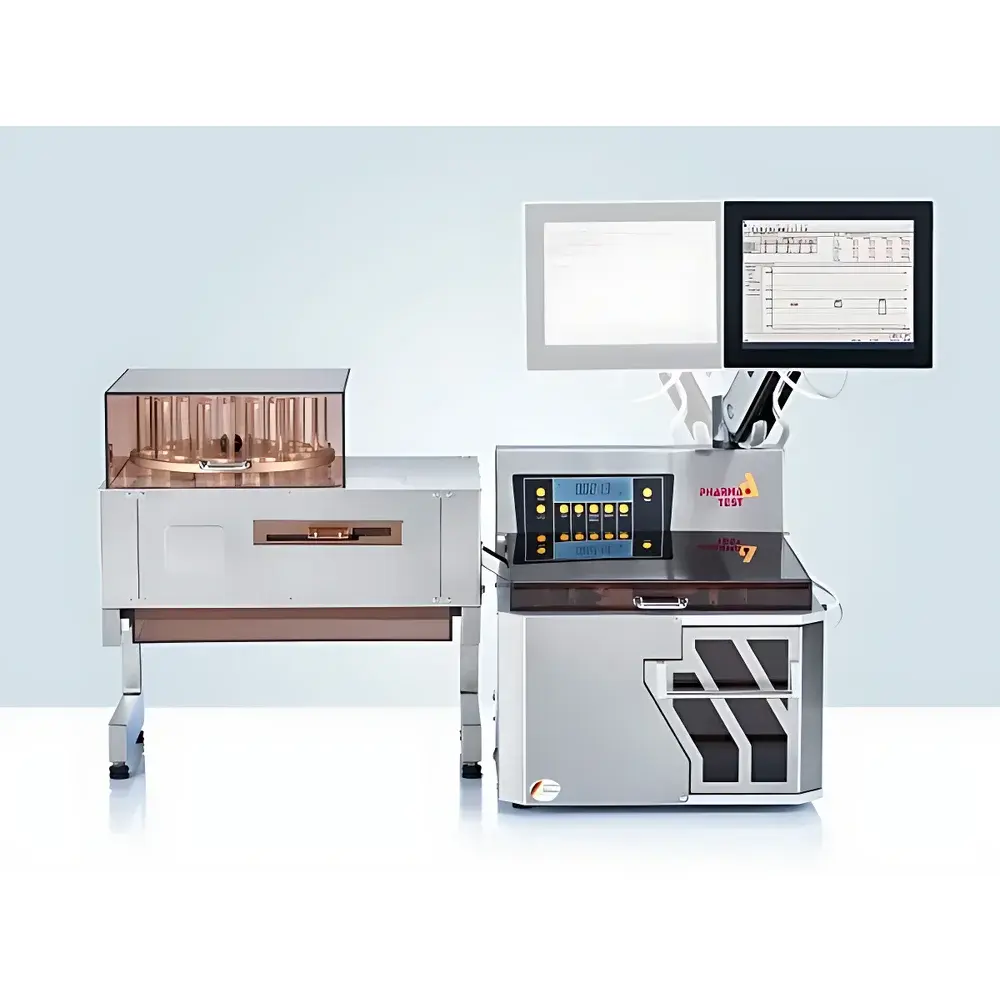
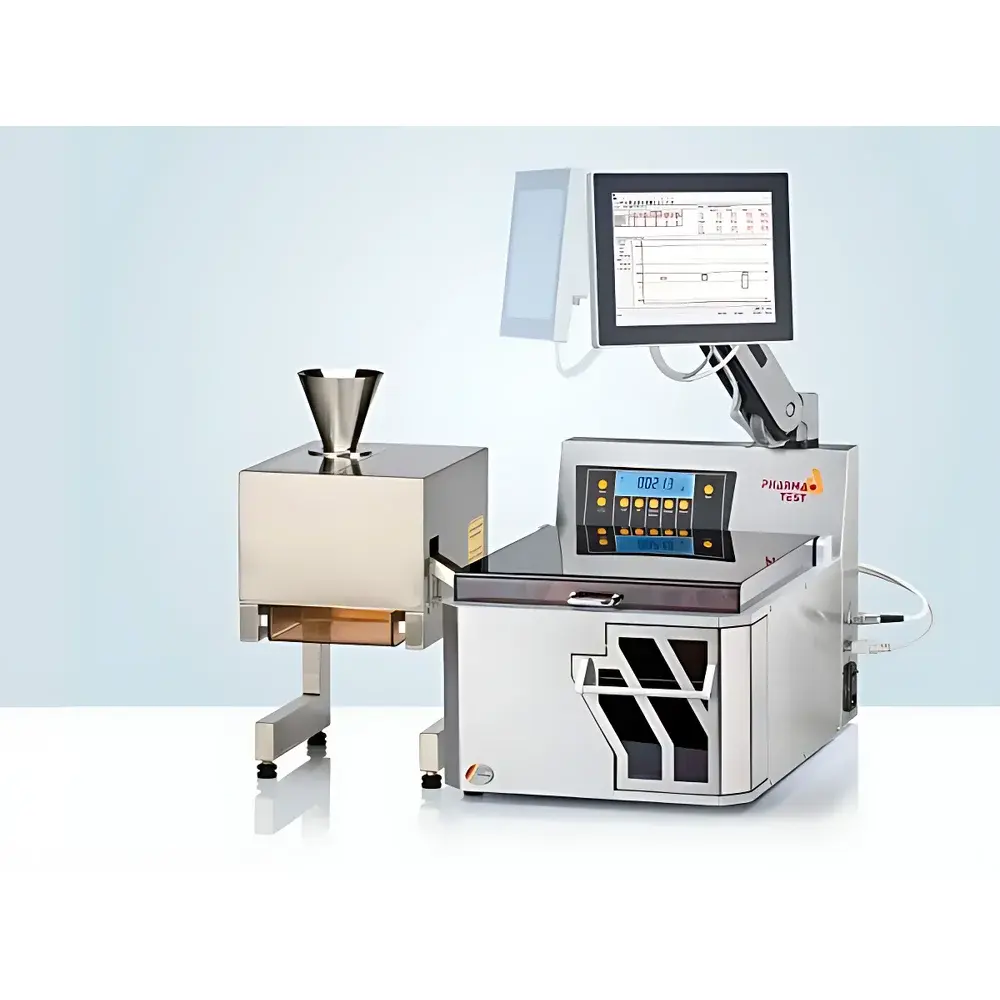
Pharma-test WHT 4ME Fully Automated Tablet Tester
| Brand | Pharma-test |
|---|---|
| Origin | Germany |
| Model | WHT 4ME |
| Compliance | EP <2.9.8>, USP <1217> |
| Testing Parameters | Hardness (constant-speed or constant-force mode), Weight, Thickness/Height, Diameter/Length |
| Sample Capacity | 20-position auto-feeder, up to 250 tablets per run |
| Throughput Modes | Single-batch or multi-batch (up to 10 distinct tablet types/batches) |
| Software | WHT 32 compliant with FDA 21 CFR Part 11 (audit trail, electronic signatures, configurable data storage paths) |
| User Interface | Integrated high-resolution touchscreen PC |
| Sample Handling | Tool-free adaptation for round, oblong, rectangular, and irregularly shaped tablets |
| Mechanical Design | Patented tapping mechanism ensures precise tablet centering prior to hardness and diameter measurement |
| Regulatory Alignment | Designed for GLP/GMP environments |
Overview
The Pharma-test WHT 4ME Fully Automated Tablet Tester is an integrated metrological platform engineered for comprehensive physical characterization of solid oral dosage forms in regulated pharmaceutical development, QC, and manufacturing environments. Based on precision mechanical actuation and calibrated force transduction, the system performs concurrent, sequential, or independent measurements of tablet hardness (crushing strength), weight, thickness (or height), and diameter (or length) — all in strict accordance with pharmacopoeial requirements defined in European Pharmacopoeia monograph and United States Pharmacopeia chapter . Unlike semi-automated or single-parameter testers, the WHT 4ME implements a unified sample handling architecture that eliminates manual repositioning, operator-induced variability, and inter-test setup delays. Its core measurement principle relies on load cell–based compression under programmable velocity profiles (constant-speed mode) or controlled force ramping (constant-force mode), enabling reproducible quantification of mechanical integrity across diverse tablet geometries and formulations.
Key Features
- Pharmacopoeia-compliant hardness testing aligned with EP and USP , including mandatory calibration verification and system suitability checks.
- Tool-free adaptability for round, oblong, capsule-shaped, rectangular, and irregular tablets — no mechanical fixture changes required between sample types.
- Patented tapping mechanism automatically centers each tablet within the test zone prior to hardness and dimensional measurements, ensuring repeatable probe contact geometry and minimizing edge-effect errors.
- Integrated 20-position auto-feeder with programmable batch sequencing, supporting both single-batch runs and multi-batch protocols (up to 10 distinct tablet identities per session).
- Dual-mode hardness testing: selectable constant-speed (mm/min) or constant-force (N/s) compression profiles, facilitating comparative studies across formulation variants or stability timepoints.
- Embedded high-resolution industrial touchscreen PC enables local method configuration, real-time monitoring, and immediate result review without external computing hardware.
- Modular integration capability with upstream/downstream equipment (e.g., tablet counters, blister line interfaces) via standard digital I/O and Ethernet-based communication protocols.
Sample Compatibility & Compliance
The WHT 4ME accommodates tablets ranging from 3 mm to 25 mm in diameter (or longest dimension), with thicknesses from 1.5 mm to 12 mm and weights between 20 mg and 2 g. It maintains measurement integrity across coated, uncoated, scored, bi-layer, and extended-release formulations. All dimensional sensors are traceably calibrated against NIST-traceable standards, and hardness force transducers undergo annual verification per ISO/IEC 17025–accredited procedures. The system’s mechanical design conforms to IEC 61000-6-2 (immunity) and IEC 61000-6-4 (emission) standards. Full documentation packages support IQ/OQ/PQ execution, and hardware/software configurations meet EU Annex 11 and FDA 21 CFR Part 11 requirements when operated with validated WHT 32 software.
Software & Data Management
The optional WHT 32 software suite provides a 21 CFR Part 11–compliant environment for method development, instrument control, data acquisition, and long-term archival. It features role-based user access control, electronic signature workflows, immutable audit trails recording all parameter modifications and test executions, and configurable data export formats (CSV, PDF, XML). Data storage paths are fully user-definable, supporting networked drives, NAS systems, or LIMS-integrated repositories. Built-in reporting templates align with ICH M4 Q5 and WHO TRS 986 Annex 5 expectations for physical testing documentation. Software validation documentation (URS, FRS, DQ/IQ/OQ/PQ protocols) is available upon request.
Applications
- QC release testing of commercial batches per compendial specifications.
- Formulation development studies assessing excipient impact on tablet mechanical properties.
- Stability program monitoring of hardness drift over accelerated and real-time conditions.
- Process validation support for direct compression, wet granulation, and roller compaction unit operations.
- Investigations into capping, lamination, or chipping root causes using correlated hardness–thickness–weight trends.
- Regulatory submission dossier preparation requiring raw data traceability, metadata annotation, and electronic record retention.
FAQ
Does the WHT 4ME require recalibration when switching between tablet shapes?
No — its adaptive jaw geometry and centering tap mechanism eliminate the need for tooling changes or recalibration between round, oblong, or irregular tablets.
Can hardness data be exported directly to our LIMS?
Yes — WHT 32 supports configurable CSV/XML exports and optional OPC UA or HL7 interface modules for seamless LIMS integration.
Is the system suitable for use in Grade A cleanroom environments?
The WHT 4ME is rated IP42 and designed for ambient laboratory use; for cleanroom deployment, it must be installed within a Class C or lower background environment with appropriate environmental controls.
What validation documentation is provided with the instrument?
A complete validation package including URS, FAT/SAT reports, calibration certificates, and IQ/OQ protocols is supplied; PQ support materials are available upon request.
How does the system ensure compliance with data integrity principles (ALCOA+)?
Through enforced electronic signatures, time-stamped audit trails, prevention of data deletion or overwriting, and immutable storage of raw sensor values alongside processed results.