
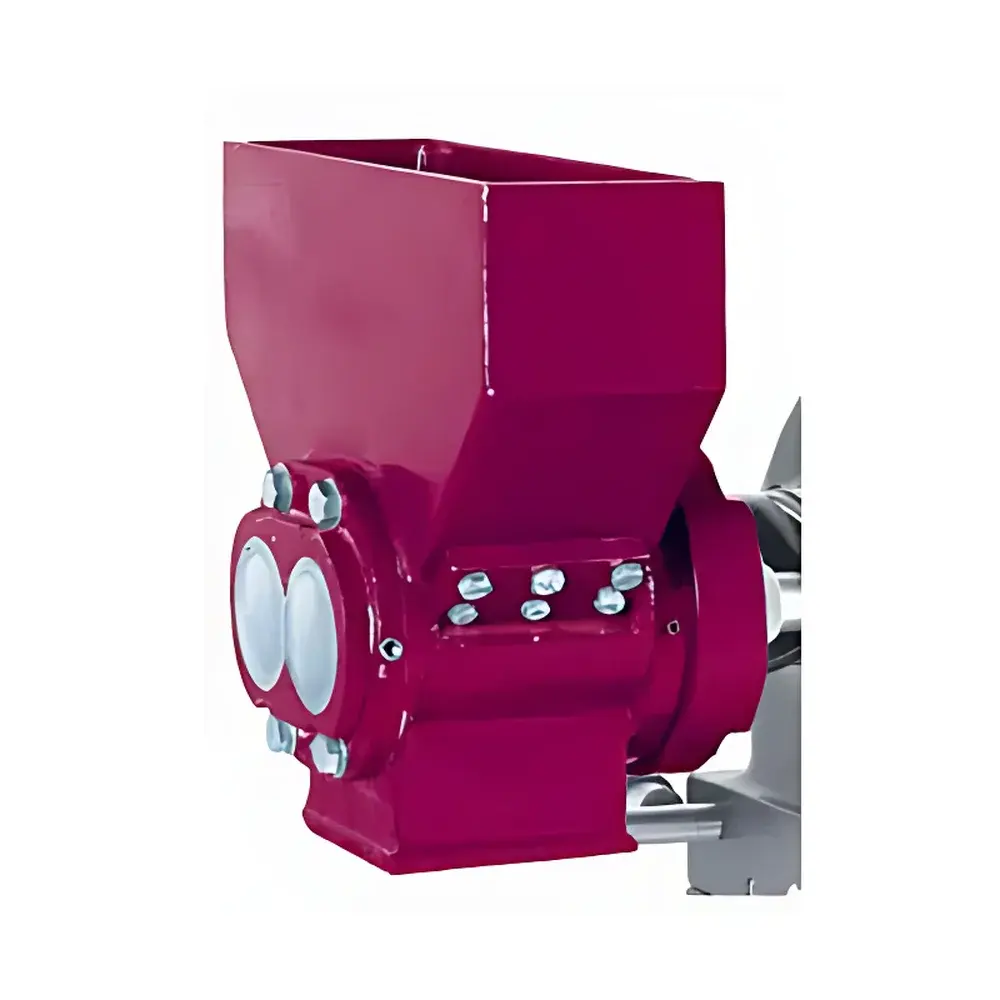
Pharmag DGM-Series Desktop Dry Granulation Machine
| Brand | Pharmag |
|---|---|
| Origin | Germany |
| Manufacturer Type | Authorized Distributor |
| Origin Category | Imported |
| Model | DGM-Series |
| Throughput | 20 kg/h |
| Dimensions | 360 × 270 × 600 mm |
| Construction Material | 316 Stainless Steel Rollers with Helical Grooves |
| Control Interface | LCD Touch Panel |
| Roller Speed | Adjustable (0–25 rpm) |
| Compliance | Designed to Support GMP-Aligned Manufacturing Environments |
Overview
The Pharmag DGM-Series Desktop Dry Granulation Machine is an engineered solution for continuous, solvent-free particle densification in pharmaceutical development and small-batch manufacturing. Based on the principle of roll compaction—where powder is fed between two counter-rotating, hydraulically loaded rollers to form a compacted ribbon—the system enables deterministic control over granule density, porosity, and mechanical strength without thermal or solvent-based processing. This eliminates drying steps, reduces process variability, and supports regulatory requirements for residual solvent control (ICH Q3C). Designed specifically for R&D labs, pilot-scale formulation units, and contract development organizations (CDMOs), the DGM-Series integrates seamlessly into quality-by-design (QbD) workflows and supports early-phase process characterization per ICH Q5A and Q8(R2).
Key Features
- Compact desktop footprint (360 × 270 × 600 mm) optimized for limited lab space while maintaining full functional integrity
- Pair of precision-machined 316 stainless steel rollers featuring helical groove patterns to enhance powder feeding uniformity and ribbon discharge consistency
- Variable-speed roller drive (0–25 rpm) with closed-loop torque monitoring, enabling systematic evaluation of compression force vs. throughput across diverse API-excipient blends
- Integrated LCD touch interface with intuitive parameter setting, real-time status display, and password-protected user access levels
- GMP-aligned construction: fully accessible surfaces, minimal crevices, tool-free disassembly of feed hopper and roller housing for cleaning validation
- Modular architecture supporting future integration of optional upstream (high-shear mixer) or downstream (oscillating granulator, fluid bed dryer) modules
Sample Compatibility & Compliance
The DGM-Series accommodates free-flowing to marginally cohesive powders typical of direct compression formulations—including microcrystalline cellulose (MCC), lactose monohydrate, mannitol, and low-dose APIs blended with high-carrier excipients. It is compatible with both batch and semi-continuous operation modes. From a compliance standpoint, the machine’s design aligns with core elements of EU Annex 1 (sterile and non-sterile manufacturing), USP on dry granulation, and FDA Process Validation Guidance (Stage 1: Process Design). Its operational logs, parameter settings, and user actions can be captured via external SCADA or LIMS interfaces to support 21 CFR Part 11-compliant data governance when integrated into validated systems.
Software & Data Management
While the DGM-Series operates via embedded firmware with local LCD control, it provides analog and digital I/O ports (4–20 mA, RS-485 Modbus RTU) for integration into centralized process monitoring platforms. All critical process parameters—including roller speed, hydraulic pressure setpoint, feed screw rotation rate, and motor current draw—are timestamped and exportable as CSV files. Audit trail functionality (user login, parameter changes, start/stop events) is enabled upon connection to a compliant electronic record system. The firmware supports configurable alarm thresholds and automatic shutdown on deviation detection (e.g., torque overload, feed blockage), ensuring consistent output quality and equipment protection.
Applications
- Pre-formulation screening of compaction behavior and ribbon tensile strength
- Development of robust dry granulation processes for heat- or moisture-sensitive APIs
- Generation of clinical trial material under GMP-like conditions (non-sterile)
- Scale-down modeling for tech transfer to commercial roll compactors (e.g., Alexanderwerk WP120, Gerteis Minicell)
- Teaching and training in pharmaceutical engineering curricula on unit operations and solid dosage form design
- Supporting Quality Risk Management (QRM) activities per ICH Q9 through controlled variation of input parameters
FAQ
What is the maximum allowable feed rate for consistent ribbon formation?
The validated throughput range is 5–20 kg/h, dependent on powder bulk density, flowability, and target ribbon thickness. Optimal performance is achieved within 10–18 kg/h for most standard excipient blends.
Can the machine be qualified under GMP for use in regulated environments?
Yes—the DGM-Series supports IQ/OQ protocols. Its 316 stainless steel contact parts, cleanable geometry, and traceable parameter logging enable qualification when deployed within a documented quality management system.
Is roller gap adjustment manual or automated?
Roller gap is manually set using calibrated micrometer dials prior to operation; fine-tuning during run is not supported, ensuring reproducibility across batches.
Does Pharmag provide documentation for regulatory submissions?
Pharmag supplies technical specifications, material certifications (EN 10204 3.1), electrical safety reports (IEC 61000-6-2/4), and a basic risk assessment (FMEA summary) upon request for inclusion in regulatory filings.
How often does preventive maintenance require roller recalibration?
Roller alignment and load cell calibration are recommended annually or after 500 operational hours—whichever occurs first—using Pharmag-certified service engineers.





