
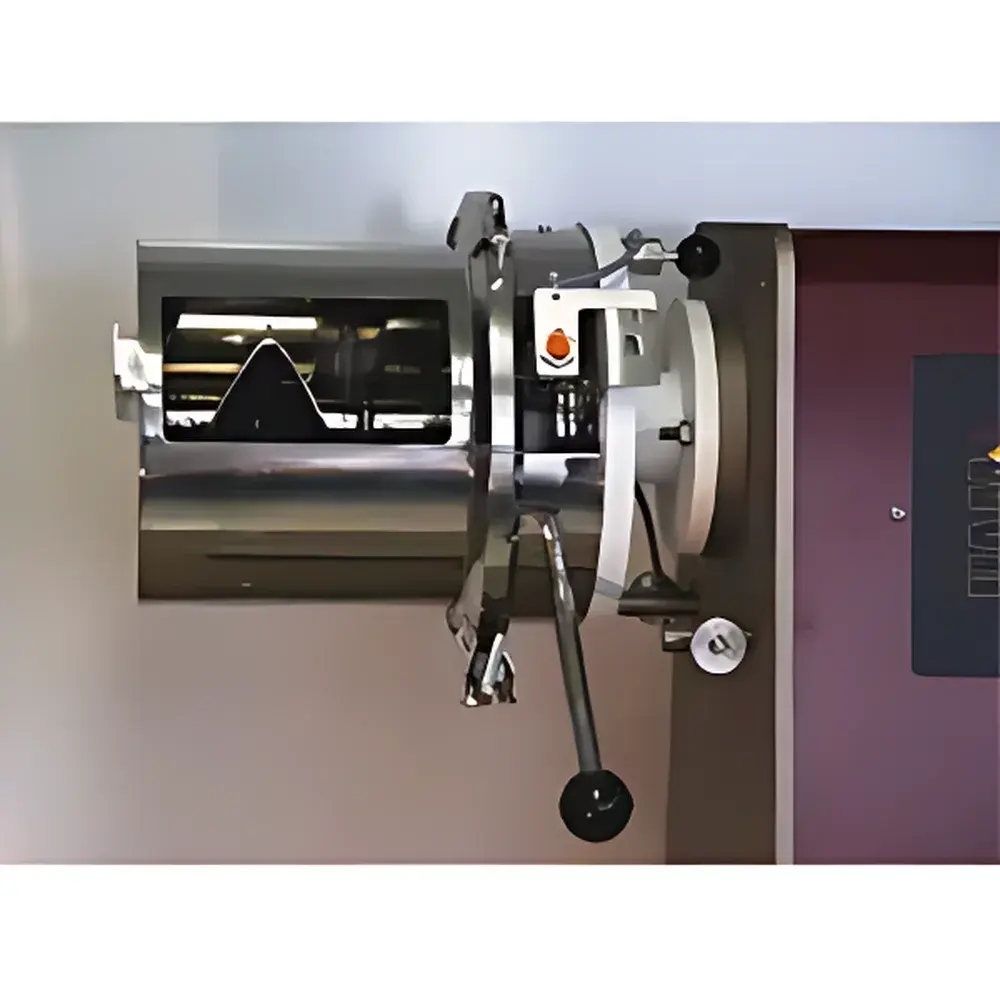
Pharmag High-Speed Mixer
| Brand | Pharmag |
|---|---|
| Origin | Germany |
| Model | High-Speed Mixer |
| Capacity | 5 L (3–4 L operational) |
| Construction | Electropolished stainless steel drum, blades, and cam coupling |
| Safety | Electromagnetic lid interlock with automatic motor shutdown |
| Drive | UAM motor with tension-ring coupling |
| Mixing Principle | Asymmetric pear-shaped tumbling motion |
Overview
The Pharmag High-Speed Mixer is a precision-engineered laboratory-scale powder blending system designed for reproducible, scalable, and GMP-aligned solid dosage form development in pharmaceutical, nutraceutical, and advanced biomaterial research. Unlike conventional orbital or vortex shakers, this instrument employs an asymmetric pear-shaped tumbling motion—generated by a precisely balanced, single-sided mounted rotating drum coupled via a tension-ring mechanism to a high-torque UAM motor. This kinematic design induces controlled convective and diffusive particle movement across multiple axes, enabling rapid homogenization of disparate solid phases without segregation, attrition, or heat buildup. The system is not a generic shaker but a purpose-built solid-state mixer optimized for low-shear, high-fidelity blending of cohesive powders, granules, microcrystalline cellulose, excipients, API blends, and fibrous botanical materials—making it especially relevant for formulation scientists working under ICH Q5, Q8, and Q9 frameworks.
Key Features
- Asymmetric pear-shaped tumbling geometry ensures three-dimensional particle trajectory, minimizing dead zones and promoting uniform radial and axial dispersion.
- Electropolished 316L stainless steel drum, impeller blades, and cam coupling—fully compliant with ASME BPE surface finish standards (Ra ≤ 0.4 µm) and resistant to corrosion from organic solvents and aqueous-based excipients.
- Single-sided cantilevered drum mounting enables precise tilt-angle adjustment (0–15°), allowing optimization of fill level dynamics and shear profile per batch size.
- Integrated electromagnetic lid interlock system meets IEC 61508 SIL-2 functional safety requirements: motor halts within <100 ms upon lid displacement, eliminating operator exposure during operation.
- Tension-ring drive coupling decouples mechanical vibration from the motor housing, ensuring stable rotational integrity at speeds up to 120 rpm and extending bearing service life beyond 20,000 hours.
- No internal seals or lubricated gearboxes—reducing cleaning validation burden and supporting dry-run compatibility for solvent-free blending protocols.
Sample Compatibility & Compliance
The Pharmag High-Speed Mixer accommodates batch sizes from 3 L to 4 L (of a 5 L total drum volume), supporting mass ratios up to 1:100,000 (e.g., trace API in large excipient volumes) with coefficient of variation (CV) <3% across ≥10 sampling points per batch—validated per USP and ASTM D6938-22. It is routinely deployed in pre-formulation screening, blend uniformity studies per FDA Guidance for Industry (2019), and continuous manufacturing feed preparation workflows. All wetted surfaces conform to ISO 13485:2016 and EU Annex 1 (2022) requirements for sterile product equipment qualification. Documentation packages include Factory Acceptance Test (FAT) reports, material certifications (EN 10204 3.1), and IQ/OQ templates aligned with GAMP 5 v2.5.
Software & Data Management
While the base model operates via analog speed control and mechanical timer, optional digital retrofit kits provide RS-485 Modbus RTU interface for integration into SCADA or MES platforms (e.g., Siemens Desigo, Rockwell FactoryTalk). Audit-trail-enabled firmware logs runtime, speed setpoint, lid status, and thermal events—supporting compliance with FDA 21 CFR Part 11 and EU Annex 11 when paired with validated electronic record systems. Data export formats include CSV and XML, compatible with JMP, Minitab, and Python-based statistical process control (SPC) pipelines.
Applications
- Homogenization of low-dose potent compounds (e.g., oncology APIs) with lactose monohydrate or mannitol carriers.
- Blending of moisture-sensitive formulations requiring nitrogen-purged operation (lid port configurable for inert gas inlet).
- Preparation of placebo batches for dissolution method development and stability-indicating assay validation.
- Combining hygroscopic excipients (e.g., PVP K30) with hydrophobic actives without agglomeration.
- Scale-down modeling of industrial tumble blenders (e.g., V-blenders, bin blenders) for QbD-driven process characterization.
FAQ
What is the maximum recommended fill level for optimal mixing performance?
Optimal performance is achieved at 60–80% drum volume—i.e., 3–4 L for the standard 5 L drum. Overfilling reduces tumbling amplitude and increases segregation risk.
Can the mixer be validated for GMP production use?
Yes. The unit supports full qualification (IQ/OQ/PQ) with documented calibration of rotational speed (±0.5 rpm), torque consistency, and lid interlock response time (<100 ms). Validation templates are provided upon request.
Is cleaning verification supported for multi-product facilities?
The fully drainable, crevice-free electropolished interior and tool-free lid removal enable rapid CIP/SIP readiness. Swab recovery studies per PDA TR29 demonstrate >95% residue removal after standardized cleaning cycles.
Does the system support inert atmosphere operation?
A dedicated lid port (M12 × 1.0 thread) allows connection to nitrogen or argon supply lines; pressure retention up to 0.5 bar gauge is verified per EN 13445.
What maintenance intervals are recommended?
Motor brush inspection every 5,000 hours; tension-ring coupling torque verification annually; full visual inspection of drum weld integrity per ISO 5817 Class B prior to each new product campaign.






