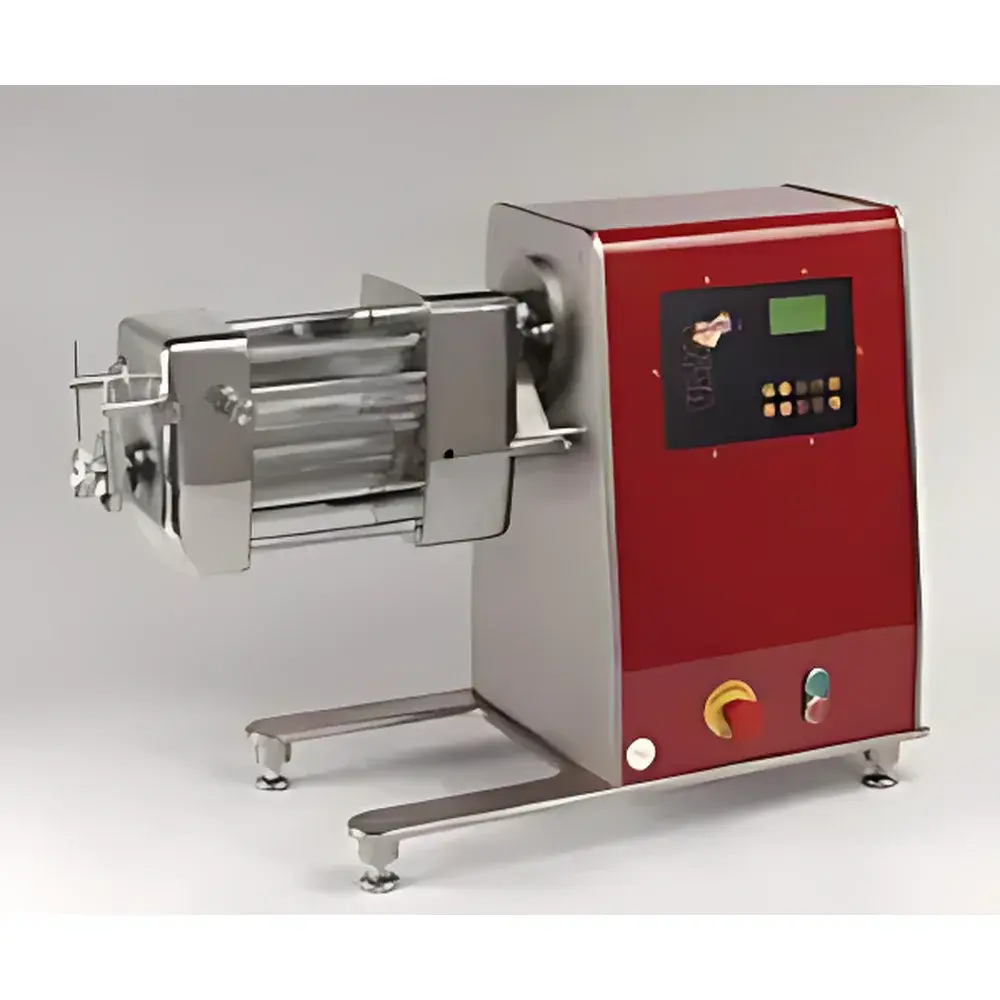
Pharmag WGL Series Wet Granulator
| Brand | Pharmag |
|---|---|
| Origin | Germany |
| Manufacturer Type | Authorized Distributor |
| Origin Category | Imported |
| Model | WGL-Series |
| Output Capacity | 25–30 kg/h |
| Rotor Configuration | 6-piece high-strength stainless steel rotors |
| Oscillation Angle | 90° |
| Standard Sieve Mesh Sizes | 1.0 mm and 1.6 mm |
| Optional Sieve Mesh Sizes | 0.315 mm, 0.355 mm, 0.63 mm, 0.8 mm, 1.0 mm, 1.25 mm, 1.6 mm, 2.0 mm, 2.5 mm, 3.15 mm |
Overview
The Pharmag WGL Series Wet Granulator is an engineered solution for high-integrity wet granulation in pharmaceutical solid dosage form development and small-to-medium scale manufacturing. Designed and manufactured in Germany, this unit operates on the principle of high-shear mechanical agitation combined with controlled liquid binder addition to induce nucleation, coalescence, and densification of powder blends. Its robust architecture supports reproducible granule formation under defined process parameters—critical for establishing scalable, QbD-aligned granulation processes. The system is purpose-built for applications requiring strict adherence to GMP-compliant workflows, including formulation screening, clinical batch production, and rework of substandard tablets or oversized agglomerates generated via double-compression methods.
Key Features
- High-shear granulation chamber with six independently mounted, high-strength stainless steel (AISI 316L) rotors—engineered for uniform torque distribution and minimal dead zones during mixing and granulation.
- Precision-controlled oscillation mechanism delivering a consistent 90° swing angle, ensuring predictable material turnover and shear history across batches.
- Dual-standard sieve assembly included (1.0 mm and 1.6 mm mesh), enabling immediate flexibility in granule size distribution profiling without tooling changeover delays.
- Modular sieve cassette design supporting rapid interchange of optional mesh sizes—from ultra-fine 0.315 mm up to coarse 3.15 mm—facilitating systematic DoE studies on particle size influence on downstream compression, drying, and dissolution behavior.
- Process-integrated load monitoring and motor current feedback for real-time detection of granulation endpoint—aligning with established endpoints such as power consumption inflection or torque plateauing per ASTM E2941 and ICH Q5C guidance.
- GMP-ready construction: fully welded AISI 316L contact surfaces, Ra ≤ 0.8 µm surface finish, IP54-rated non-contact drive system, and validation-documented material certifications (EN 10204 3.1).
Sample Compatibility & Compliance
The WGL Series accommodates a broad spectrum of active pharmaceutical ingredients (APIs) and excipients—including hygroscopic, low-density, and cohesive powders—when paired with appropriate binder selection and process parameter tuning. It complies with core regulatory expectations for equipment used in GMP environments: design qualification (DQ) documentation is provided per ISPE GAMP 5, and the unit supports IQ/OQ protocols aligned with Annex 15 and FDA Process Validation Guidance. All wetted parts meet USP Class VI biocompatibility standards; electrical safety conforms to IEC 61000-6-2/6-4 and CE Machinery Directive 2006/42/EC. The system is compatible with clean-in-place (CIP) validation when integrated into modular skids with validated spray ball coverage.
Software & Data Management
While the base WGL model operates via analog/manual control interface, optional digital upgrade kits integrate programmable logic controller (PLC)-based automation with HMI touchscreen interface (Siemens SIMATIC HMI KTP700). Batch records—including rotor speed profile, binder addition timing/volume, oscillation cycle count, and motor load trends—are timestamped and exportable in CSV format. When deployed with compliant data acquisition software, the system supports 21 CFR Part 11 requirements including electronic signatures, audit trails, and user access level management—enabling full traceability for GLP/GMP audits and regulatory submissions.
Applications
- Early-phase formulation development: rapid generation of granules for tablet compressibility assessment and dissolution profiling.
- Clinical trial material production: consistent granule output at 25–30 kg/h for Phase I–III batches under documented process conditions.
- Reprocessing of defective tablets: size reduction and regranulation of oversized or laminated tablets using appropriate mesh sizing and binder re-introduction.
- Excipient functionality testing: evaluation of disintegrant efficiency, binder performance, and flow enhancement across granule size distributions.
- Moisture-sensitive API processing: closed-system operation minimizes ambient humidity exposure during granulation and discharge.
FAQ
What regulatory documentation is supplied with the WGL Series?
Factory-issued DQ documentation, material compliance certificates (EN 10204 3.1), EC Declaration of Conformity, and GAMP 5-aligned verification templates are provided standard.
Can the unit be qualified for use in aseptic manufacturing environments?
The WGL Series is not designed for Grade A/B cleanroom integration; however, it meets ISO 14644-1 Class 8 (Class 100,000) compatibility when installed in controlled non-sterile manufacturing suites.
Is remote monitoring or SCADA integration supported?
Yes—via optional Profibus DP or Modbus TCP communication modules, enabling integration into plant-wide MES or SCADA systems for centralized process oversight.
What maintenance intervals are recommended for rotor assemblies?
Inspection and torque verification of rotor mounting bolts are required every 500 operational hours; full bearing lubrication and wear inspection are scheduled at 2,000-hour intervals per maintenance manual Rev. 3.2.
Does Pharmag provide installation qualification (IQ) support?
Yes—Pharmag-certified field service engineers conduct on-site IQ execution, including utility interface verification, dimensional checks, and alarm/function testing against URS-defined criteria.