
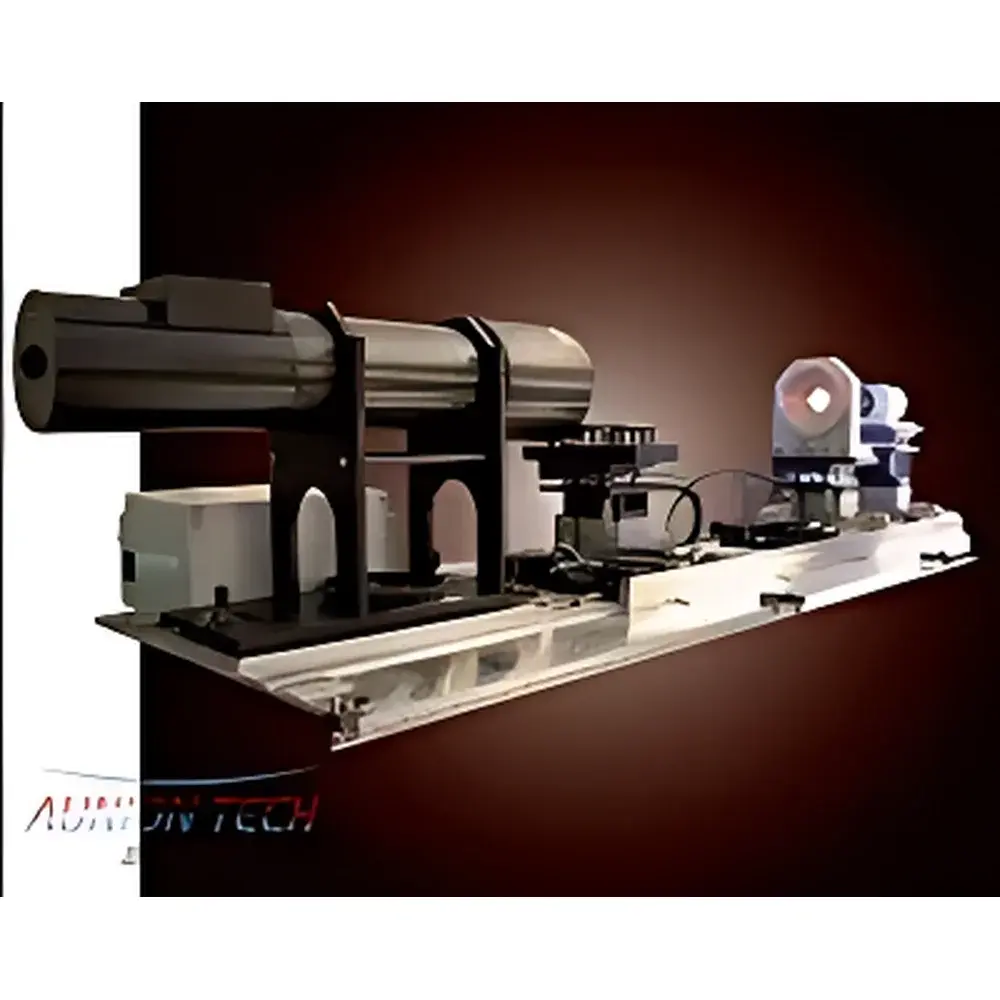
Phasics High-Resolution Four-Wave Shearing Interferometer
| Brand | Phasics |
|---|---|
| Origin | France |
| Model | High_resolution_Interferometer |
| Measurement Principle | Four-wave shearing interferometry |
| Spatial Resolution | 300 × 400 sampling points |
| Wavelength Range | 400–1100 nm |
| Dynamic Range | ±500 µm |
| Chromatic Correction | Achromatic design |
| Vibration Insensitivity | High (no reference optic required) |
| Output | Real-time Zernike coefficients, 3D wavefront map, MTF analysis |
| Compliance | Supports ISO 10110-5, ISO 21247, and ASTM E284 for optical surface characterization |
Overview
The Phasics High-Resolution Four-Wave Shearing Interferometer is a compact, field-deployable wavefront sensor engineered for quantitative, absolute measurement of optical wavefronts without reliance on reference optics. Unlike conventional Michelson or Twyman-Green interferometers—which require stable environmental control, precision-matched reference surfaces, and extensive alignment—this instrument implements patented four-wave shearing interferometry. This principle enables direct, single-shot acquisition of the full complex wavefront by generating four laterally sheared replicas of the input beam within a monolithic, solid-state optical path. The resulting interference pattern is captured by a high-sensitivity CMOS sensor and reconstructed via Fourier-based phase demodulation algorithms, delivering nanometer-level wavefront accuracy across visible to near-infrared spectra (400–1100 nm). Its achromatic architecture eliminates wavelength-dependent calibration drift, while its intrinsic insensitivity to low-frequency mechanical vibration ensures reliable operation in non-laboratory environments—including cleanroom floors, optical assembly stations, and laser facility test bays.
Key Features
- Reference-free operation: Eliminates need for calibrated flats, spheres, or transmission standards—reducing setup time and calibration uncertainty.
- High spatial resolution: 300 × 400 pixel sampling grid provides dense wavefront sampling suitable for characterizing aspheric, freeform, and segmented optics.
- Extended dynamic range: ±500 µm peak-to-valley optical path difference (OPD) accommodates highly aberrated beams (e.g., high-NA focusing optics or misaligned laser cavities).
- Real-time wavefront analytics: Onboard processing delivers Zernike polynomial decomposition up to 36th order, RMS wavefront error, PV error, and Strehl ratio at frame rates exceeding 30 Hz.
- Integrated MTF evaluation: Computes modulation transfer function directly from measured wavefront data using scalar diffraction theory—fully compliant with ISO 9335 and ISO 19246 for optical transfer function validation.
- Ruggedized portable form factor: Sealed aluminum housing, passive thermal stabilization, and USB 3.0 interface enable deployment in industrial QA labs and mobile metrology applications.
Sample Compatibility & Compliance
The interferometer supports collimated, convergent, and divergent beams with diameters ranging from 3 mm to 25 mm. It is routinely deployed for testing laser resonators (including ultrafast Ti:sapphire and high-power fiber lasers), lithographic projection optics (NA > 0.9), ophthalmic intraocular lenses, astronomical adaptive secondary mirrors, and EUV-compatible multilayer coatings (via spectral filtering). All measurement outputs conform to GLP/GMP documentation requirements: timestamped raw interferograms, reconstructed wavefront maps (FITS and HDF5 formats), and audit-trail-enabled Zernike reports are generated with embedded metadata (wavelength, exposure, gain, temperature). Software export modules support FDA 21 CFR Part 11–compliant electronic signatures and traceable calibration logs aligned with ISO/IEC 17025 laboratory accreditation criteria.
Software & Data Management
The proprietary Phasics WFS software suite (v6.x) runs natively on Windows 10/11 and provides a modular GUI for acquisition, analysis, and reporting. Core capabilities include real-time live view with adjustable contrast scaling, batch processing of time-series wavefront data, comparative overlay of multiple measurements (e.g., before/after polishing), and automated pass/fail evaluation against user-defined tolerances per ISO 10110-5 surface irregularity specifications. Data export supports CSV (Zernike coefficients), TIFF (2D phase maps), OBJ (3D surface mesh), and MATLAB-compatible .mat files. An optional Python SDK enables integration into custom automation workflows—supporting LabVIEW, Python-based control systems, and CI/CD pipelines for optical manufacturing process monitoring.
Applications
- Laser beam characterization: M² measurement, focus spot analysis, thermal lensing quantification in high-power amplifiers.
- Optical component certification: Surface figure error mapping of plano-convex lenses, off-axis paraboloids, and diffractive optical elements (DOEs).
- Lithography tool qualification: Wavefront stability assessment of stepper and scanner projection optics under thermal load.
- Adaptive optics closed-loop control: Real-time wavefront sensing for deformable mirror actuation in astronomy and retinal imaging systems.
- Plasma diagnostics: Quantitative electron density profiling in laser-induced plasmas via phase shift tomography.
- MTF validation: Objective assessment of imaging system resolution limits without test charts or slanted-edge methods.
FAQ
Does this interferometer require external calibration with a reference optic?
No. The four-wave shearing architecture is intrinsically self-referencing; no transmission flat, spherical standard, or null optic is needed.
Can it measure wavefronts at wavelengths outside the 400–1100 nm range?
Not natively. UV (1100 nm) operation requires optional bandpass filters and sensor upgrades—contact technical support for OEM integration pathways.
Is the system compatible with vacuum or inert-gas environments?
Yes. The optical head is rated IP54 and can be mounted in nitrogen-purged enclosures; electrical interfaces use hermetically sealed feedthroughs (custom configurations available).
How is measurement traceability maintained for ISO 17025 audits?
Each unit ships with a NIST-traceable calibration certificate covering wavelength sensitivity, pixel pitch, and Zernike reconstruction linearity—valid for 12 months under standard operating conditions.
What is the minimum measurable wavefront gradient?
The system resolves local slopes down to 0.005 waves/mm (λ/200 per mm) at 632.8 nm, enabling detection of sub-micron surface roughness contributions in polished optics.



