
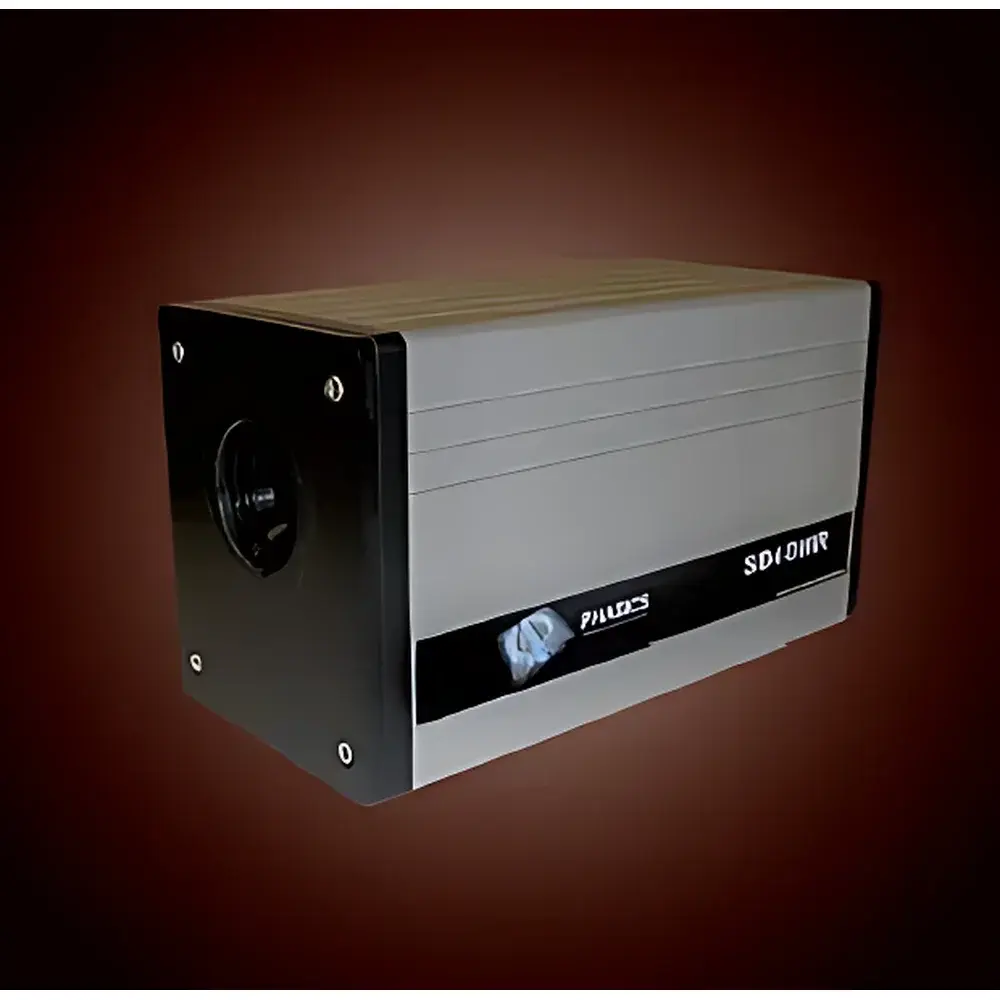
Phasics SID4 DWIR Wavefront Sensor
| Brand | Phasics |
|---|---|
| Origin | France |
| Model | SID4 DWIR |
| Wavelength Range | 3–5 µm and 8–14 µm |
| Aperture | 13.44 × 10.08 mm² |
| Sampling Points | 160 × 120 |
| Spatial Resolution | 68 µm |
| Dynamic Range | ~100 µm |
| Accuracy | 75 nm RMS |
| Sensitivity | <25 nm RMS |
| Frame Rate | >50 fps |
| Processing Rate | 20 Hz |
| Dimensions | 85 × 116 × 179 mm |
| Weight | 1.6 kg |
Overview
The Phasics SID4 DWIR Wavefront Sensor is a high-performance, lensless wavefront measurement instrument engineered for quantitative phase imaging in the mid- and long-wave infrared (MWIR/LWIR) spectral bands. Based on Phasics’ proprietary four-wave lateral shearing interferometry (4-LSI) technology, the SID4 DWIR enables direct, single-shot, non-scanning wavefront reconstruction without moving parts or iterative algorithms. Unlike conventional Shack-Hartmann sensors—whose spot centroid accuracy degrades significantly under high divergence or low signal-to-noise conditions—the SID4 DWIR maintains robust performance across divergent beams, thermal sources, and low-coherence illumination. Its achromatic design ensures consistent calibration across the full 3–5 µm and 8–14 µm atmospheric transmission windows, eliminating the need for wavelength-specific recalibration or optical reconfiguration. This makes it particularly suited for applications requiring real-time, high-fidelity wavefront characterization of CO₂ lasers, quantum cascade lasers (QCLs), thermal emitters, and uncooled microbolometer-based optical systems.
Key Features
- Lensless, interference-based architecture enabling direct phase retrieval with no reliance on spot-fitting or centroid algorithms
- Achromatic operation across dual IR bands: 3–5 µm (MWIR) and 8–14 µm (LWIR), validated over the entire detector spectral response
- High spatial sampling density: 160 × 120 measurement points over a 13.44 × 10.08 mm² active aperture
- Real-time acquisition at >50 frames per second, with onboard wavefront processing at up to 20 Hz (full-resolution mode)
- Integrated thermoelectrically stabilized InSb or microbolometer detector (model-dependent), optimized for low dark current and high dynamic range
- Rugged, compact housing (85 × 116 × 179 mm; 1.6 kg) with standard C-mount interface and vacuum-compatible flange options
- Factory-calibrated sensitivity of <25 nm RMS phase noise, traceable to NIST-traceable reference standards
Sample Compatibility & Compliance
The SID4 DWIR is compatible with both collimated and highly divergent beams (up to ±15° full angle), including those from thermal blackbody sources, quantum cascade lasers, and CO₂ laser cavities. It supports free-space and fiber-coupled configurations via optional beam expanders and IR-transmissive optics (e.g., ZnSe, Ge, or chalcogenide lenses). The sensor complies with ISO 10110-5 (surface irregularity specification), ISO 21247 (laser beam parameter measurement), and ASTM E2846-19 (infrared imaging system performance testing). All firmware and calibration data are stored internally with cryptographic checksums to ensure integrity during GLP/GMP audits. Raw interferograms and reconstructed wavefronts retain full metadata (timestamp, integration time, ambient temperature, detector bias state) required for FDA 21 CFR Part 11–compliant documentation workflows.
Software & Data Management
The sensor is operated via Phasics’ WaveView™ software suite (v6.2+), a platform-independent application supporting Windows, Linux, and macOS. WaveView provides real-time visualization of Zernike decomposition, PV/RMS wavefront error, Strehl ratio, MTF analysis, and beam propagation modeling (via built-in Rayleigh-Sommerfeld back-propagation). Export formats include HDF5 (with embedded SI units and metadata), CSV, TIFF (16-bit signed phase maps), and MATLAB .mat. An open C++/Python SDK enables integration into custom control environments (e.g., LabVIEW, EPICS, Python-based adaptive optics loops). Audit trails record all user actions—including calibration loading, ROI definition, and Zernike truncation order—with timestamps and operator IDs, satisfying traceability requirements for ISO/IEC 17025-accredited laboratories.
Applications
- Laser beam metrology for industrial CO₂ and QCL systems, including M² measurement, focus shift analysis, and cavity alignment verification
- Adaptive optics correction in ground-based MWIR/LWIR astronomy, where atmospheric turbulence compensation requires high-bandwidth, high-dynamic-range sensing
- Non-contact surface topography of IR-transparent optics (e.g., germanium lenses, silicon windows) using reflected or transmitted wavefront analysis
- Thermal emission wavefront characterization in plasma diagnostics and combustion research, where broadband incoherent sources demand achromatic, high-sensitivity detection
- Quality assurance of uncooled thermal imaging modules, including microbolometer array flat-field correction and lens distortion mapping
- Development of IR optical coherence tomography (OCT) systems requiring precise dispersion compensation and source coherence characterization
FAQ
Does the SID4 DWIR require external calibration when switching between 3–5 µm and 8–14 µm bands?
No—its achromatic interferometric design ensures factory calibration remains valid across both spectral ranges without hardware adjustment or software recalibration.
Can the sensor measure wavefronts from low-coherence thermal sources?
Yes—4-LSI is inherently insensitive to temporal coherence length, making it suitable for blackbody emitters, incandescent filaments, and plasma sources.
Is vacuum operation supported?
Yes—optional vacuum-compatible mechanical housing and feedthroughs are available for integration into UHV chambers used in synchrotron IR beamlines or space simulation environments.
What is the maximum allowable beam power density on the detector?
For InSb-equipped variants: ≤100 mW/cm² (CW) or ≤10 mJ/cm² (pulsed, 10 ns–1 µs); for microbolometer variants: ≤500 mW/cm² (CW), with integrated neutral density filtering recommended above 50 mW/cm².
How is traceability maintained for metrological applications?
Each unit ships with a certificate of calibration referencing NIST-traceable phase standards, including uncertainty budgets per ISO/IEC Guide 98-3 (GUM), and annual recalibration services are available through Phasics’ accredited service centers in Lyon and Berlin.



