
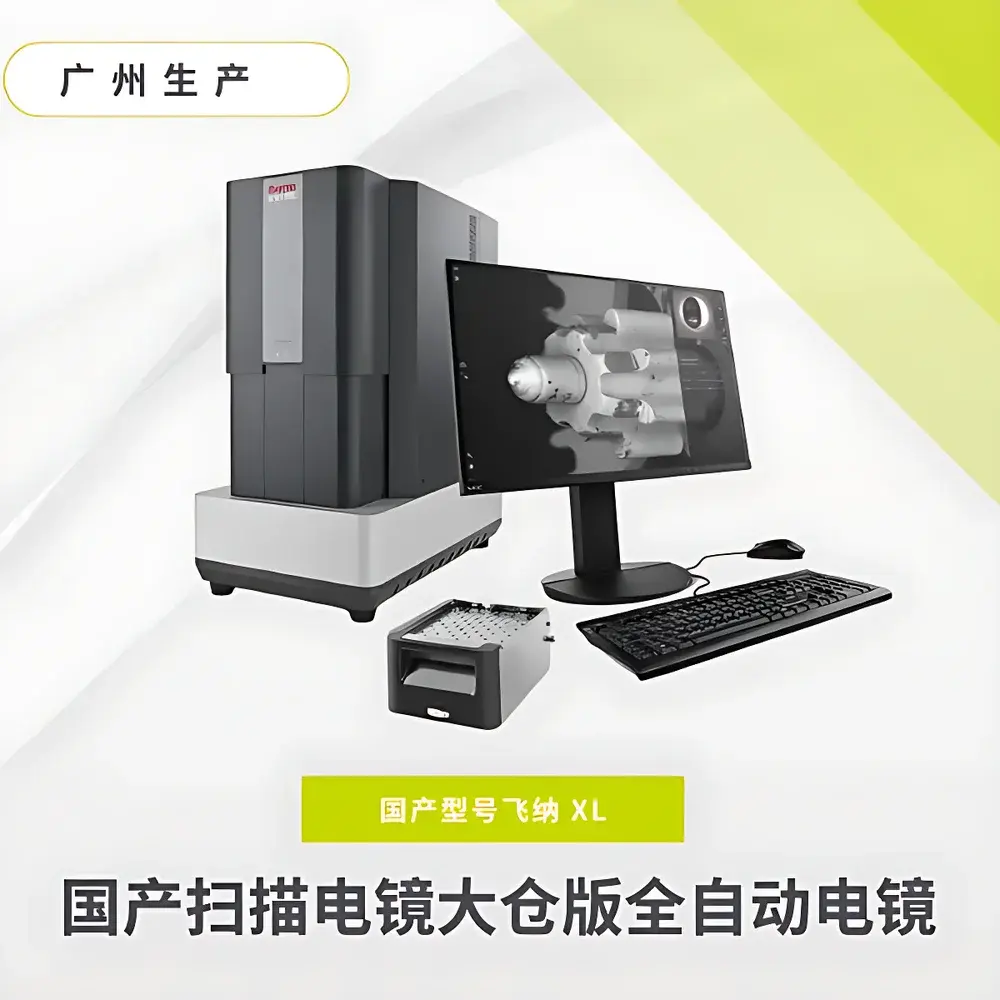
Phenom XL Desktop Scanning Electron Microscope with Large Chamber
| Brand | Phenom |
|---|---|
| Origin | Guangdong, China |
| Manufacturer Type | Authorized Distributor |
| Origin Category | Domestic (China-made) |
| Model | Phenom XL |
| Instrument Type | Desktop SEM |
| Electron Gun | Cerium Hexaboride (CeB6) |
| Secondary Electron Resolution | ≤8 nm |
| Maximum Magnification | 200,000× |
| Accelerating Voltage | 4.8–20.5 kV (continuously adjustable) |
| Backscattered Electron Resolution | ≤8 nm |
| Optical Microscope Magnification | 3–19× |
| Vacuum Pumping Time | <30 s |
| Standard Detector | High-Sensitivity Quad-SEG BSE Detector |
| Filament Lifetime | ~3,000 h |
| Sample Chamber Diameter | 100 mm |
| Optional Add-ons | EDS spectrometer, 3D roughness reconstruction, fiber/particle/porosity statistical analysis modules, in-situ tensile stage (2–1000 N, 0.1–15 mm/min) |
Overview
The Phenom XL Desktop Scanning Electron Microscope (SEM) is an engineered solution for high-resolution, rapid-access microstructural characterization in routine and research laboratories. Based on field-emission-enhanced thermionic emission from a cerium hexaboride (CeB6) electron source, the Phenom XL delivers stable, high-brightness electron beams optimized for both secondary electron (SE) and backscattered electron (BSE) imaging. Its large-chamber design accommodates specimens up to 100 mm in diameter without requiring complex sample preparation or coating—enabling direct observation of insulating, hydrated, or low-conductivity materials. Unlike conventional floor-standing SEMs, the Phenom XL integrates ultra-fast vacuum cycling (<30 s), fully automated beam alignment, stigmation, focus, and contrast/brightness optimization—reducing operator dependency while maintaining reproducibility across users and sessions. The system operates at accelerating voltages ranging from 4.8 kV to 20.5 kV, allowing flexible control over surface sensitivity, penetration depth, and charging mitigation. With a verified SE and BSE resolution of ≤8 nm at optimal conditions, the Phenom XL bridges the performance gap between traditional tungsten-filament benchtop systems and mid-tier floor models—without demanding dedicated infrastructure or vibration-isolated rooms.
Key Features
- Large specimen chamber (100 mm internal diameter) compatible with irregular, bulky, or multi-component samples—including as-received industrial parts, geological cores, and composite laminates.
- CeB6 electron source delivering >10× higher brightness than standard tungsten filaments, enabling consistent signal-to-noise ratio across magnifications up to 200,000×.
- Integrated optical microscope (3–19×) for rapid pre-screening and navigation prior to high-magnification SEM imaging.
- Quad-segmented backscattered electron (BSE) detector supporting atomic number (Z)-contrast imaging, phase discrimination, and topographic shading via signal mixing.
- Robust mechanical design incorporating passive anti-vibration damping—validated for stable operation on standard laboratory benches or office-grade flooring.
- Modular hardware architecture supporting seamless integration of optional analytical tools: energy-dispersive X-ray spectroscopy (EDS), in-situ tensile stages, and environmental control units.
Sample Compatibility & Compliance
The Phenom XL is designed for broad material compatibility: conductive metals, semiconductors, ceramics, polymers, biological tissues (with minimal or no sputter coating), and composites. Its low-voltage imaging capability (down to 4.8 kV) minimizes surface charging on insulators and reduces beam damage on sensitive organic or hydrated specimens. The system complies with IEC 61000-6-3 (EMC emissions) and IEC 61000-6-2 (immunity), and meets CE safety directives for laboratory equipment. When configured with EDS and audit-trail-enabled software, it supports GLP/GMP-aligned workflows per FDA 21 CFR Part 11 requirements—including user authentication, electronic signatures, and immutable data logging. Routine calibration protocols align with ISO/IEC 17025 principles for measurement traceability in accredited testing environments.
Software & Data Management
Acquisition and analysis are managed through Phenom’s proprietary ProSuite software platform—a Windows-based application featuring intuitive workflow-driven interfaces. Core functions include automated image acquisition sequences, real-time drift correction, multi-point navigation mapping, and batch processing for particle or pore analysis. Statistical modules comply with ASTM E1245 (determination of inclusion content) and ISO 13322-2 (image analysis of particle size distributions). All raw data (TIFF, BMP, CSV) and metadata—including instrument parameters, detector settings, and timestamped operator actions—are stored in a structured local database. Export options support LIMS integration via standardized XML or JSON schemas. Software updates follow a documented change-control process, with version history and validation reports available upon request for regulated environments.
Applications
The Phenom XL serves cross-disciplinary applications in quality control, failure analysis, materials development, and academic research. In metallurgy, it characterizes grain boundaries, inclusion morphology, and fracture surfaces under in-situ tensile loading (2–1000 N range). In polymer science, it quantifies filler dispersion, phase separation, and crack propagation kinetics. For geoscience and mining, it enables rapid mineralogical mapping and porosity assessment in uncoated rock thin sections. In electronics manufacturing, it verifies solder joint integrity, wire bond geometry, and contamination presence on PCBs. Its fast turnaround time (<60 s from load to first image) makes it suitable for high-throughput screening in production labs, while its expandable architecture supports method development for emerging techniques such as correlative light-SEM (CLEM) and time-resolved deformation studies.
FAQ
What vacuum level does the Phenom XL achieve, and how is it maintained?
The system reaches operational vacuum (<10⁻³ Pa) within 30 seconds using a turbomolecular pump backed by a dry scroll pump. A pressure-stabilized chamber design ensures long-term vacuum integrity during extended imaging sessions.
Can the Phenom XL be used for elemental analysis?
Yes—when equipped with an optional silicon drift detector (SDD) EDS module, it performs qualitative and semi-quantitative elemental identification and mapping, compliant with ISO 16575 and ASTM E1508 standards.
Is training provided for new users?
Phenom University offers tiered training programs—from foundational SEM theory (Level 1) to advanced in-situ experimentation and metrology (Level 5)—delivered at regional centers in Shanghai, Beijing, and Guangzhou.
How is service and technical support structured in China?
Phenom-China (FuNa Scientific Instruments Co., Ltd.) maintains ISO 9001-certified service operations, including on-site calibration, preventive maintenance contracts, and remote diagnostics supported by native-language engineering teams.
Does the system support automated reporting for regulatory submissions?
Yes—ProSuite includes customizable report templates with embedded metadata, digital signatures, and PDF/A-1a export for archival compliance in pharmaceutical, medical device, and aerospace QA/QC documentation.





