
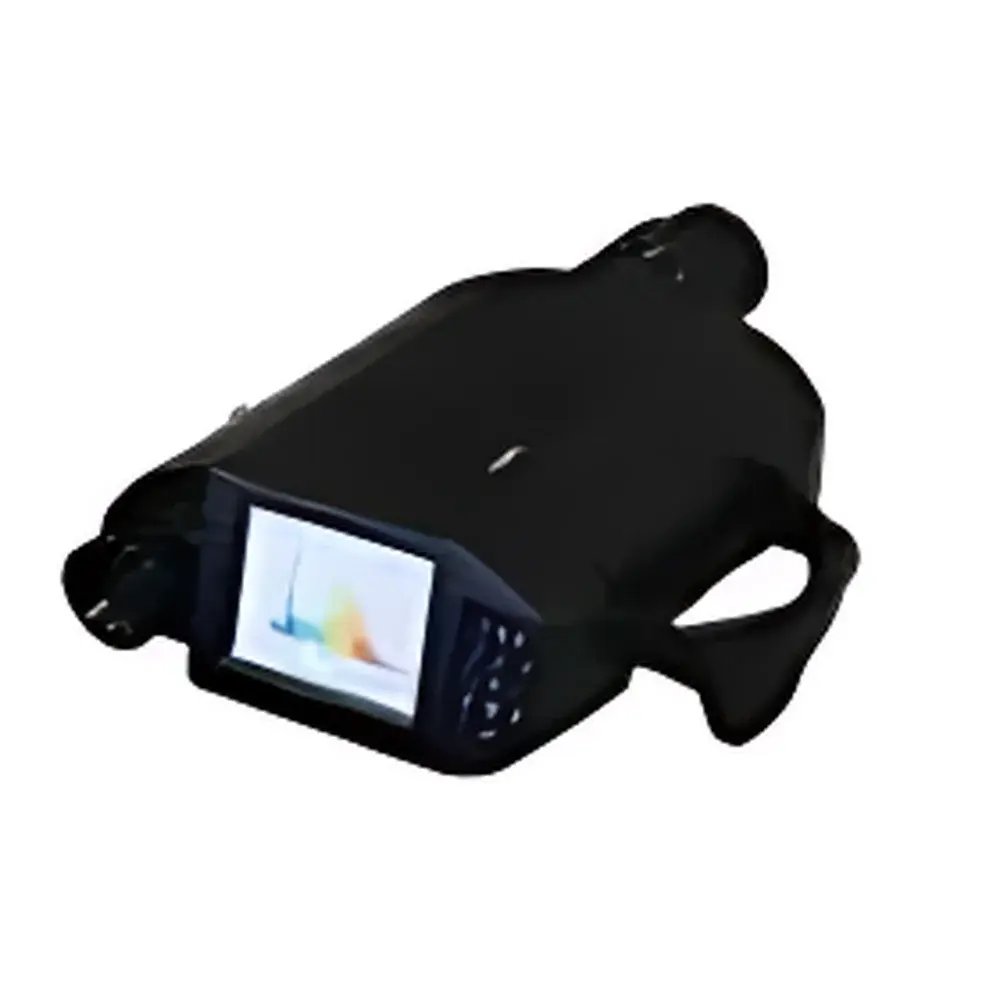
Photo Research PR-655 Portable Spectroradiometer
| Brand | Photo Research |
|---|---|
| Origin | USA |
| Model | PR-655 |
| Spectral Range | 380–780 nm |
| Detector Array | 128-element CCD |
| Spectral Resolution | 3.12 nm/pixel |
| Standard Aperture | 1° |
| Optional Apertures | 0.5° |
| Auto-Synchronization | Yes (to source refresh rate) |
| Data Storage | SD card |
| Interface | USB 2.0, Bluetooth (optional), RS-232 emulation via driver |
| Battery Life | Up to 12 hours (rechargeable Li-ion) |
| Display | 2.25" × 3" full-color touchscreen |
| Measurement Modes | Luminance, Illuminance, Radiance, Irradiance, Chromaticity (CIE x,y & u',v'), CCT, Duv, CRI (Ra, R1–R14), Dominant Wavelength, Purity, Spectral Power Distribution (SPD) |
| Remote Probe Support | Up to 15 filter-based probes (luminance, illuminance, or colorimetric) |
| Compliance | NIST-traceable calibration, ISO/IEC 17025-accredited calibration services available |
Overview
The Photo Research PR-655 Portable Spectroradiometer is a field-deployable, battery-powered instrument engineered for high-fidelity spectral measurement of light sources and illuminated surfaces across photometric, radiometric, and colorimetric domains. Based on a 128-element linear CCD array and optimized optical bench design, the PR-655 implements scanning-spectrometer architecture with fixed grating dispersion and pixel-resolved detection—enabling direct acquisition of spectral power distribution (SPD) from 380 nm to 780 nm at 3.12 nm spectral sampling intervals. Its core measurement principle relies on absolute spectral radiance calibration traceable to NIST standards through Photo Research’s network of thirteen in-house ISO/IEC 17025-accredited calibration laboratories. Unlike filter-based colorimeters, the PR-655 derives all photometric and colorimetric quantities—including luminance (cd/m²), illuminance (lux), chromaticity coordinates (CIE 1931 x,y and CIE 1976 u’,v’), correlated color temperature (CCT), Duv, general and special color rendering indices (CRI Ra, R1–R14), dominant wavelength, and purity—through post-acquisition integration against CIE standard observer functions and luminous efficiency curves. This spectral-first methodology ensures metrological rigor, eliminates interpolation errors inherent in tristimulus systems, and supports retrospective re-evaluation of measurements as standards evolve.
Key Features
- Portable, self-contained operation: Integrated rechargeable lithium-ion battery enables up to 12 hours of continuous field use without external power.
- High-resolution spectral acquisition: 128-pixel CCD detector with 3.12 nm spectral resolution delivers robust SPD data suitable for LED, OLED, microLED, LCD, and projection system characterization.
- Intuitive human interface: 2.25″ × 3″ full-color touchscreen display with five-way navigation keypad supports standalone operation—no PC required for basic measurement, analysis, or reporting.
- Auto-synchronization capability: Dynamically locks to AC mains or PWM-driven light source flicker frequencies (e.g., 50/60 Hz, 120/144 Hz, or variable-frequency drivers), eliminating temporal aliasing in pulsed or modulated emissions.
- Modular aperture system: Standard 1° field-of-view; optional 0.5° aperture available for high-spatial-resolution applications such as small-area display uniformity mapping.
- Dual communication architecture: Native USB 2.0 interface for high-speed data transfer and device control; optional Bluetooth 4.0 module for wireless remote operation and real-time telemetry.
- Expandable probe ecosystem: Supports up to 15 externally connected filter-based remote probes—including luminance, illuminance, and chromaticity variants—enabling simultaneous multi-point measurements (e.g., projector screen uniformity, backlight panel validation).
Sample Compatibility & Compliance
The PR-655 is validated for quantitative measurement of emissive and reflective samples under controlled and ambient conditions. It accommodates displays (LCD, OLED, QLED, microLED), lighting products (LED modules, luminaires, automotive lamps), medical/dental shade guides, printed materials (paper, textiles, inks), and optical components requiring spectral reflectance or transmittance assessment. When paired with optional accessories—including cosine-corrected irradiance receptors (for illuminance), LR-127 LED measurement adapters (per CIE 127:2007), fiber-optic probes (for non-line-of-sight access), and microscope objectives (for sub-millimeter spot analysis)—the system meets application-specific geometries defined in IEC 62368-1, ENERGY STAR SSL V2.1, VESA DisplayHDR, and TM-30-15 test protocols. All factory calibrations are NIST-traceable and documented per ISO/IEC 17025 requirements. On-site recalibration services are supported through Photo Research’s China Calibration Centers in Beijing and Shanghai, ensuring compliance with GLP and internal quality audit requirements.
Software & Data Management
The PR-655 operates natively via embedded firmware with menu-driven measurement workflows, real-time spectral visualization, CIE chromaticity diagram overlay, and pass/fail threshold evaluation. For advanced analysis, SpectraWin v5.x software (Windows-based) provides comprehensive post-processing: spectral smoothing, custom weighting function application, TM-30-15 metrics calculation, binning analysis, batch report generation (PDF/CSV/XLSX), and GLP-compliant audit trail logging. The instrument also supports ASCII text-based remote command mode via USB or emulated RS-232—enabling integration into automated test environments (ATE), production line QC stations, or custom Python/Matlab control scripts. All measurement data—including raw spectra, metadata (timestamp, aperture, integration time, sync status), and derived values—are stored on removable SD cards with timestamped filenames and hierarchical folder organization, facilitating traceability and long-term archival per FDA 21 CFR Part 11 and ISO 9001 documentation requirements.
Applications
- Display metrology: Luminance uniformity, contrast ratio, grayscale tracking, viewing angle dependence, HDR tone mapping verification.
- LED and solid-state lighting development: Spectral binning, CCT shift over drive current/temperature, R9 evaluation, phosphor degradation monitoring.
- Automotive HMI validation: Instrument cluster readability under daylight/sunload, HUD luminance and chromaticity stability, exterior lamp photometry per ECE/SAE regulations.
- Medical device color matching: Dental shade guide verification, endoscopic illumination consistency, surgical display color fidelity per IEC 62304.
- Print and packaging QC: Color gamut mapping, metamerism assessment, substrate-dependent reflectance profiling.
- Human factors and vision research: Mesopic luminance modeling, circadian stimulus quantification (CS, melanopic EDI), glare index computation.
- Regulatory compliance testing: ENERGY STAR, DesignLights Consortium (DLC), California Title 20, and EU Ecodesign Annex III reporting.
FAQ
Is the PR-655 calibrated to NIST standards?
Yes—each unit ships with a NIST-traceable calibration certificate issued by Photo Research’s ISO/IEC 17025-accredited laboratories. Calibration data is stored internally and applied in real time during measurement.
Can the PR-655 measure pulsed or PWM-driven LEDs accurately?
Yes—the AutoSync feature automatically detects and synchronizes to the fundamental frequency of time-modulated sources, ensuring stable spectral integration without flicker-induced artifacts.
What is the smallest measurable spot size?
With the optional 10× microscope objective accessory, the PR-655 achieves a minimum spot size of approximately 0.2 mm diameter at working distance, enabling detailed analysis of individual subpixels or micro-LED die.
Does the PR-655 support TM-30-15 calculations?
Yes—SpectraWin software includes full implementation of ANSI/IES TM-30-15, generating Rf (fidelity index), Rg (gamut index), color vector graphics, and spectral similarity analysis.
How is data security and audit trail handled in regulated environments?
SpectraWin supports electronic signatures, user access levels, and immutable audit logs compliant with FDA 21 CFR Part 11 and ISO 13485 requirements. Raw spectral files are stored unaltered on SD media with SHA-256 checksums.





