
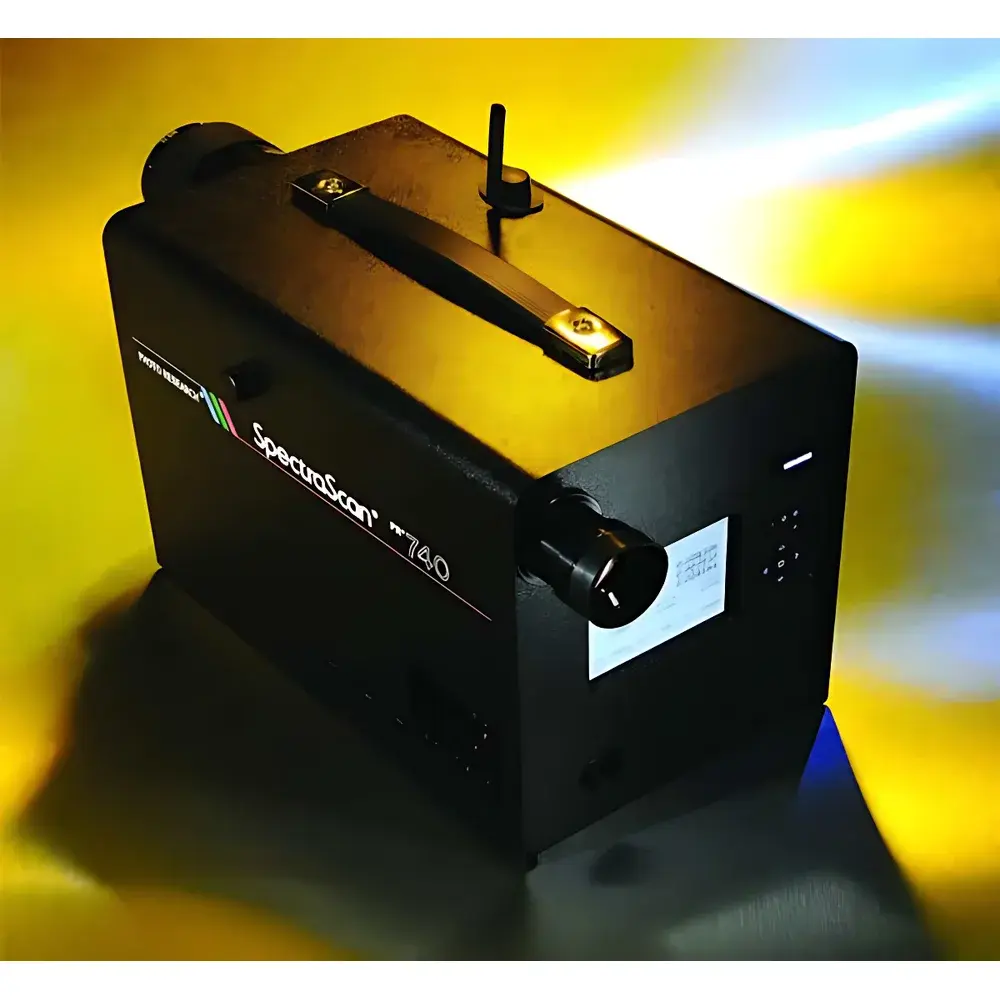
Photo Research PR788 Expandable Dynamic Range Spectrophotometer
| Brand | Photo Research |
|---|---|
| Origin | USA |
| Model | PR788 |
| Dynamic Range | 1,000,000:1 |
| Spectral Bandwidth | Adjustable |
| Interface | USB, RS-232, Bluetooth |
| Application Focus | Backlight Characterization, OLED Emission Analysis, Laser Projector Calibration |
| Compliance | Designed for R&D, QC/QA, and production-line photometric validation |
Overview
The Photo Research PR788 Expandable Dynamic Range Spectrophotometer is a high-precision, field-deployable spectral radiance and luminance measurement instrument engineered for photometric and colorimetric characterization across extreme intensity ranges. Built upon the optical architecture and detector signal-processing heritage of the PR-74X series, the PR788 employs a thermoelectrically cooled back-thinned CCD array coupled with dual-gain analog front-end electronics to achieve an industry-leading 1,000,000:1 dynamic range without mechanical attenuation or optical path reconfiguration. This capability enables traceable, NIST-traceable measurements—from sub-millilambert (mL) black-level emissions of OLED pixels under bias to multi-kilolambert (kL) peak luminance outputs of laser phosphor projectors—within a single acquisition cycle. Its core principle relies on sequential spectral scanning via a precision Czerny–Turner monochromator, calibrated against internal reference sources and validated per ASTM E308 and CIE S 014-2/E:2022 standards.
Key Features
- Expandable dynamic range architecture: Maintains linearity and photometric accuracy from 0.001 cd/m² to >10,000 cd/m² without neutral density filters, aperture changes, or user intervention.
- Adjustable spectral bandwidth: Selectable slit widths (1–5 nm FWHM) support high-resolution analysis of narrowband emitters (e.g., quantum dot LCDs, RGB laser primaries) while preserving throughput for low-light OLED pixel mapping.
- Sub-second spectral acquisition: Full 380–780 nm spectrum captured in ≤800 ms; repeatable within ±0.5% at 100 cd/m² (k = 2, 1σ).
- Multi-interface connectivity: Native USB 2.0 (CDC class), RS-232 (TTL/RS-232 level selectable), and Bluetooth 4.2 (BLE) enable seamless integration into automated test environments (ATE), including those governed by IEC 61000-4-3 EMC requirements.
- Ruggedized portable form factor: Magnesium alloy chassis, IP52-rated enclosure, and integrated rechargeable Li-ion battery support field deployment in cleanroom, lab, and factory-floor settings.
- Factory-calibrated traceability: Each unit ships with NIST-traceable calibration certificate covering spectral responsivity, linearity, and angular response (f/2.5 input optics).
Sample Compatibility & Compliance
The PR788 is optimized for planar and quasi-diffuse light sources typical in display manufacturing and projection systems. It accommodates standard display geometries—including 0.1° to 2° field-of-view configurations via interchangeable telescopic adapters—and supports both contact and non-contact measurement modes. The instrument complies with ISO/CIE joint guidelines for display metrology (CIE Publication 177:2006, ISO 13406-2 Annex B), and its firmware implements audit-trail logging required for GLP-compliant quality assurance workflows. Data export formats include CSV, XML (CIE 15:2018-compliant), and binary .SPD files compatible with industry-standard analysis platforms such as LightTools, ASAP, and MATLAB-based spectral modeling toolchains.
Software & Data Management
PR788 operation is managed through Photo Research’s SpectraWin v6.x software suite, which provides real-time spectral visualization, CIE 1931/1976 chromaticity mapping, and luminance uniformity heatmaps. The software supports script-driven batch testing (VBScript/JScript), remote command execution via SCPI over USB/RS-232, and full 21 CFR Part 11 compliance when deployed with optional digital signature and electronic record modules. All measurement metadata—including instrument ID, calibration date, operator ID, environmental temperature/humidity stamps, and spectral acquisition parameters—is embedded in exported files to satisfy FDA-regulated device validation documentation requirements.
Applications
- Backlight unit (BLU) characterization: Quantifying spatial uniformity, spectral shift vs. drive current, and edge-lit LED binning consistency.
- OLED emissive layer validation: Measuring pixel-level luminance decay, color gamut stability over lifetime, and IR/UV leakage in encapsulated panels.
- Laser projector radiometric calibration: Verifying ANSI lumen output, speckle contrast ratio, and wavelength-specific radiant flux per IEC 62897.
- Automotive HUD and micro-LED display certification: Supporting AEC-Q200 stress-test correlation and ISO 15008 readability assessments.
- AR/VR waveguide efficiency mapping: Enabling angular-resolved spectral radiance profiling for exit pupil characterization.
FAQ
Does the PR788 require recalibration after field use?
Yes—annual recalibration is recommended per ISO/IEC 17025:2017 clause 7.7.1; Photo Research offers certified on-site or depot recalibration services with turnaround under 10 business days.
Can the PR788 measure pulsed or PWM-driven displays?
Yes—its gated acquisition mode synchronizes to external TTL triggers (1–100 kHz), enabling accurate time-resolved spectral capture of flicker-sensitive sources.
Is spectral irradiance measurement supported?
No—the PR788 is configured exclusively for spectral radiance and luminance; irradiance requires accessory cosine correctors and separate calibration per CIE S 023/E:2020.
What is the minimum measurable spot size?
With the optional 2° telephoto adapter and 300 mm working distance, the PR788 resolves spots down to 10.5 mm diameter; custom collimation optics are available for sub-millimeter targeting.
How does the PR788 handle ambient light interference?
It incorporates synchronized dual-scan background subtraction and optional motorized shutter control, reducing stray-light contribution to <0.1% of full-scale signal under 500 lux ambient conditions.
Related Products




