
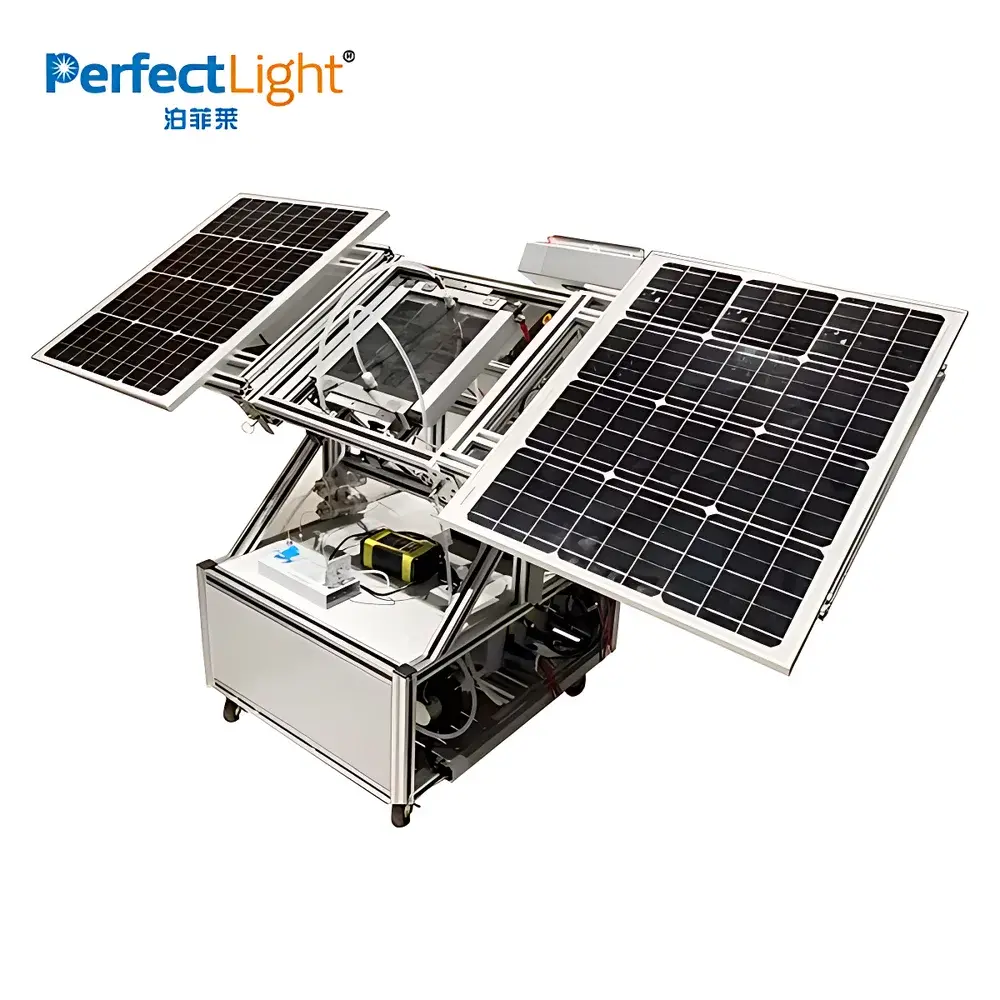
Photocatalytic Hydrogen Production System – PerfectLight PV-H2 Demo Unit
| Brand | PerfectLight |
|---|---|
| Origin | Beijing, China |
| Model | PV-H2 Demo Unit |
| Photoreactor Active Area | 20 × 20 cm² |
| Optical Window Material | High-Transmittance Borosilicate Glass |
| Liquid Flow Channel Thickness | 2 mm |
| Solution Flow Rate | 0.1–3 L/min |
| Circulation Pump Capacity | 3 L/min |
| Integrated Dual Reservoirs | 3 L each |
| Operating Temperature Range | 5–60 °C |
| Maximum Reactor Working Pressure | 40 kPa |
| Power Supply | DC 12 V |
| Mounting Frame | Outdoor Mobile & Tilt-Adjustable |
| Data Acquisition | Real-time Current, Voltage, Temperature, and Pressure Logging |
| Control Interface | Local HMI or Remote PLC Integration |
| Compliance | Designed for outdoor demonstration under ambient environmental conditions per IEC 61215 (photovoltaic module mounting), ISO 8502-9 (corrosion resistance of structural components), and GLP-aligned data integrity practices |
Overview
The PerfectLight PV-H2 Demo Unit is a field-deployable photocatalytic hydrogen production system engineered for outdoor demonstration and small-scale feasibility validation of solar-driven water splitting. It integrates photovoltaic energy harvesting with electrochemical catalysis in a single-platform architecture, enabling direct conversion of incident solar irradiance into chemical energy stored as molecular hydrogen (H₂). The core reaction mechanism follows the photoelectrochemical (PEC) pathway: photons absorbed by the photoanode generate electron–hole pairs; holes oxidize water at the anode surface (2H₂O → O₂ + 4H⁺ + 4e⁻), while electrons reduce protons at the cathode (4H⁺ + 4e⁻ → 2H₂). This unit operates without external grid power—its DC 12 V supply is derived from an integrated photovoltaic array coupled with battery storage—making it suitable for off-grid educational, municipal, or R&D site demonstrations where real-world insolation profiles and diurnal cycling are critical performance variables.
Key Features
- 20 × 20 cm² active photocatalytic area with high-transmittance borosilicate glass optical window, optimized for spectral transmission across 300–1100 nm (AM1.5G relevant range)
- Modular flow-through reactor design with precisely controlled 2 mm liquid channel height, ensuring uniform light penetration and minimized mass-transfer limitations
- Dual 3 L integrated reservoirs enable continuous recirculation and pH/ionic strength stabilization during extended operation
- Outdoor-rated mobile frame with tilt-adjustable mounting supports seasonal solar angle optimization (±30° mechanical adjustment range)
- Onboard data acquisition system records time-synchronized current, voltage, solution temperature, and head pressure at 1 Hz sampling rate
- DC 12 V architecture eliminates AC/DC conversion losses and enables seamless integration with standard PV charge controllers and lithium-iron-phosphate (LiFePO₄) battery banks
- Corrosion-resistant 316 stainless steel and PTFE-wetted components comply with ISO 8502-9 for long-term exposure to aqueous electrolytes under variable humidity
Sample Compatibility & Compliance
The system accommodates aqueous electrolyte solutions including neutral, acidic (pH 1–4), and alkaline (pH 11–14) media, supporting benchmark catalysts such as BiVO₄, Fe₂O₃, TiO₂, NiFe LDH, and Pt/C. Its sealed reactor vessel maintains up to 40 kPa gauge pressure—sufficient for safe H₂ accumulation and periodic gas sampling via septum-piercing ports—while remaining compatible with ASTM D1946 gas chromatographic analysis protocols. All electrical enclosures meet IP65 ingress protection standards. Data logging adheres to GLP principles: timestamps, operator ID fields, and audit-trail-capable storage ensure traceability for academic reporting or preliminary technology readiness level (TRL) assessment (TRL 4–5).
Software & Data Management
Data is acquired via industrial-grade analog-to-digital converters (16-bit resolution) and logged to onboard microSD storage or streamed in real time to a local HMI touchscreen interface. Optional Modbus RTU or Ethernet/IP communication allows integration into existing SCADA or PLC environments for centralized supervision. Exported CSV files include calibrated sensor metadata (NIST-traceable calibration coefficients embedded), enabling post-processing in MATLAB, Python (Pandas/NumPy), or OriginLab. No cloud dependency is required; all firmware and configuration tools run offline to support secure institutional deployment.
Applications
- Educational demonstration of renewable H₂ generation principles in university laboratories and science outreach programs
- Field validation of photoelectrode durability and Faradaic efficiency under natural solar flux variation
- Pre-commercial testing of membrane-electrode assemblies (MEAs) and ion-conducting separators in ambient-pressure PEC configurations
- Benchmarking of solar-to-hydrogen (STH) efficiency using standardized protocols (e.g., ASTM E2577)
- Integration studies with downstream H₂ utilization devices such as PEM fuel cells or catalytic methanation reactors
- Environmental impact assessment of decentralized H₂ production in low-infrastructure settings
FAQ
Is the system compatible with third-party photoelectrodes?
Yes—the reactor features standardized 20 × 20 cm² electrode mounting fixtures with spring-loaded current collectors and replaceable gasket seals.
Can the system operate continuously for >72 hours unattended?
Under stable irradiance (>600 W/m²) and ambient temperatures between 15–35 °C, continuous operation is supported; battery capacity and reservoir volume determine maximum runtime.
What safety provisions are included for hydrogen handling?
The reactor incorporates overpressure relief valves (set at 45 kPa), integrated H₂ sensors (0–4% vol detection range), and passive ventilation ducting compliant with NFPA 55 guidance for low-pressure gaseous H₂ systems.
Does the data logger support FDA 21 CFR Part 11 compliance?
While not certified out-of-box, the firmware architecture supports electronic signatures, role-based access control, and immutable audit logs—enabling customization for regulated GxP environments upon customer specification.
Are spare optical windows and gaskets available?
Yes—high-transmittance borosilicate glass windows (200 × 200 × 6 mm) and FKM elastomer gaskets are stocked as consumables with documented shelf-life and lot traceability.
Related Products



