
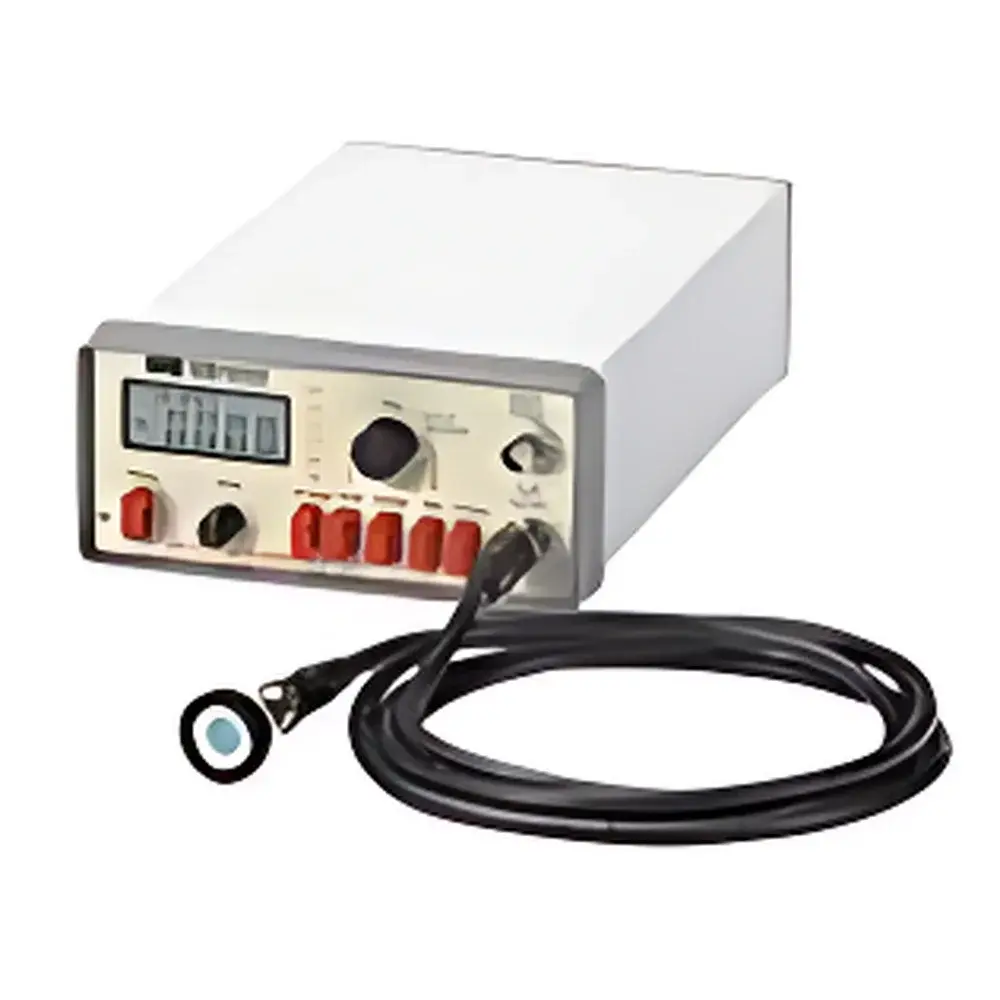
Photomultiplier Tube & Photodiode Amplifier – NewOpto Series by Edmund Optics
| Key | Brand: Edmund Optics |
|---|---|
| Model | NewOpto |
| Full-Scale Input Range | ±20 nA to ±20 mA (decade steps, 1 pA resolution) |
| Bias Voltage | Selectable from –14 V to +14 V (6.5 mV increments) |
| A/W Calibration Factor | 0.100–1.000 A/W (0.005 increments) |
| Analog Output | ±2 V (corresponds to ±20,000 counts of selected range) |
| Frequency Response | DC–40 kHz (least sensitive range), DC–2 kHz (most sensitive range) |
| Display | 4½-digit LCD (0.4" height) |
| Noise & Drift | <1 pA over 5 s (most sensitive range) |
| Output Impedance | 100 Ω |
| Power | Rechargeable Ni-MH battery (≈10 h operation) or external 85–250 VAC, 50–60 Hz (<9 VA) |
| Dimensions | 140 mm (W) × 63 mm (H) × 215 mm (L) |
| Weight | 0.9 kg (excluding external PSU) |
| Operating Temperature | 0–40 °C |
| Interfaces | RS-232 serial port, analog output port |
| Accessories | RS-232 cable, AC/DC power supply & charger, operator manual |
Overview
The NewOpto Photomultiplier Tube (PMT) and Photodiode Amplifier is a precision current-to-voltage converter engineered for laboratory-grade optical signal conditioning in low-light detection applications. Designed to interface directly with current-output photodetectors—including silicon PIN photodiodes, avalanche photodiodes (APDs), and photomultiplier tubes—the amplifier implements transimpedance architecture with selectable gain and programmable bias voltage to optimize signal fidelity across diverse detector types and operational configurations. Its core function is the high-stability conversion of photocurrents ranging from femtoampere-level signals (±20 nA full scale, 1 pA resolution) up to milliampere-level outputs (±20 mA), enabling quantitative photometric and radiometric measurements without external signal conditioning stages. The instrument supports dual display modes: current (A) or optical power (W), achieved via user-defined responsivity calibration (A/W factor), effectively transforming it into a traceable optical power meter compliant with ISO/IEC 17025-aligned measurement workflows.
Key Features
- Ultra-low-noise transimpedance amplifier with <1 pA drift over 5 seconds on the most sensitive range—critical for long-integration spectroscopy and photon counting validation.
- 11-decade full-scale input range (±20 nA to ±20 mA), adjustable in precise decade steps with 1 pA minimum resolution at the lowest range.
- Digitally controlled, fine-resolution bias voltage source (–14 V to +14 V in 6.5 mV increments) for optimal depletion depth control in APDs and linear-mode PMTs.
- Calibratable A/W conversion factor (0.100–1.000 A/W, 0.005 step) supporting NIST-traceable power measurements when paired with calibrated detectors.
- High-fidelity analog output (±2 V, 100 Ω impedance) synchronized to internal 20,000-count digital scaling—enabling seamless integration with data acquisition systems and lock-in amplifiers.
- Wide bandwidth flexibility: DC–40 kHz on least sensitive ranges; DC–2 kHz on highest-gain settings—ensuring temporal fidelity for pulsed laser characterization and fluorescence lifetime pre-screening.
- Embedded 4½-digit LCD display (0.4″ character height) with real-time unit indication (A or W), range status, and bias voltage confirmation—reducing reliance on host software during setup.
Sample Compatibility & Compliance
The NewOpto amplifier is compatible with a broad spectrum of current-mode optical detectors, including vacuum and solid-state PMTs, silicon and InGaAs PIN photodiodes, and linear-mode APDs operating under reverse bias. It accommodates both grounded-cathode and floating-anode configurations via its isolated analog output and configurable bias polarity. From a regulatory standpoint, the device meets IEC 61010-1:2010 safety requirements for laboratory electrical equipment and complies with electromagnetic compatibility standards EN 61326-1:2013 (industrial environment). While not certified for medical or process-critical use, its stable analog output, RS-232 command set (SCPI-compatible), and audit-ready parameter logging support GLP-compliant documentation when integrated into validated optical test benches per ASTM E275, ISO 13406-2, and USP photometric system qualification protocols.
Software & Data Management
The amplifier communicates via standard RS-232 serial interface (no driver installation required) using ASCII-based command syntax for remote configuration of range, bias voltage, A/W factor, and display mode. All settings are retained in non-volatile memory across power cycles. While no proprietary GUI is bundled, the device is fully scriptable via Python (pySerial), LabVIEW (VISA), or MATLAB (Instrument Control Toolbox), enabling automated calibration routines, time-series acquisition, and multi-channel synchronization in custom optical metrology platforms. Output data streams include timestamped readings (current or power), active range code, and bias status—facilitating metadata-rich dataset generation suitable for FDA 21 CFR Part 11–aligned electronic records when deployed with appropriate audit-trail software layers.
Applications
- Low-light spectral radiometry and laser power stabilization in UV–NIR wavelength bands (200–1700 nm), especially when paired with calibrated InGaAs or Si detectors.
- Fluorescence correlation spectroscopy (FCS) and time-resolved photoluminescence pre-amplification prior to TCSPC modules.
- Optical encoder feedback conditioning and position-sensitive detector (PSD) signal normalization in precision motion control systems.
- Educational optics labs requiring stable, intuitive current-to-digital conversion for teaching photoelectric effect, quantum efficiency, and detector linearity concepts.
- Environmental sensor calibration where photodiode-based turbidity or UV index sensors require traceable analog output scaling.
FAQ
Can this amplifier be used with photomultiplier tubes requiring high-voltage dynode chains?
No—it supplies only a single, low-current bias voltage (±14 V, ≤10 mA) suitable for cathode/anode biasing, not for multi-stage PMT dynode stacks. External HV supplies must be used for conventional PMT operation.
Is the A/W calibration factor NIST-traceable?
The amplifier itself does not provide traceability; however, it accepts user-defined A/W values derived from NIST-calibrated reference detectors—enabling end-user traceability within an accredited calibration hierarchy.
Does the RS-232 interface support hardware flow control?
Yes—RTS/CTS handshaking is implemented and enabled by default, ensuring reliable communication at baud rates up to 115,200 bps.
What is the warm-up time required for specified accuracy?
Less than 15 minutes at 23 °C ambient; full thermal stabilization (for <0.05% gain drift) is achieved within 30 minutes.
Can the analog output drive a 50 Ω load?
The output is buffered for 100 Ω source impedance; driving 50 Ω loads may reduce dynamic range by ~0.5% and is not recommended for metrological applications—use a 1 kΩ or higher termination for optimal linearity.



