
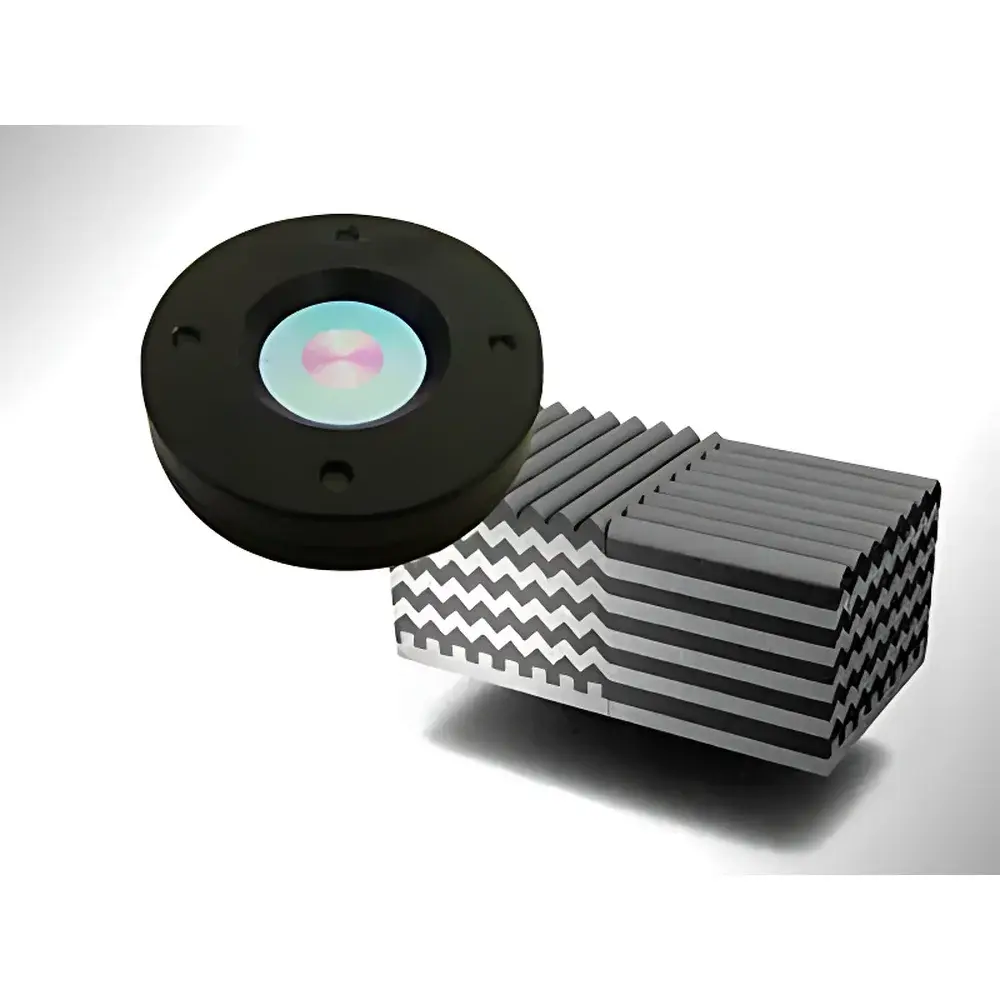
Photonic-Lattice PL Series Photonic Crystal Waveplate
| Origin | Japan |
|---|---|
| Manufacturer Type | Authorized Distributor |
| Origin Category | Imported |
| Model | PL-1/2 & PL-1/4 (Dual-Order, Tunable Retardation) |
| Price | Upon Request |
Overview
The Photonic-Lattice PL Series Photonic Crystal Waveplate is a precision polarization control element engineered for high-stability, broadband retardation in demanding optical metrology and ultrafast laser systems. Unlike conventional birefringent waveplates based on crystalline quartz or magnesium fluoride, the PL Series leverages proprietary two-dimensional photonic crystal nanostructures fabricated via electron-beam lithography and reactive ion etching on fused silica substrates. This architecture enables exceptional wavelength-specific phase retardation with minimal angular sensitivity, negligible temperature-induced drift (<0.005°/°C), and near-zero dispersion across designated bands. The device operates on the principle of engineered anisotropic effective refractive index contrast between orthogonal polarization modes propagating through the subwavelength periodic lattice—providing deterministic half-wave (λ/2) or quarter-wave (λ/4) retardation at design wavelengths without mechanical rotation or thermal tuning.
Key Features
- Monolithic fused silica substrate with 5 J/cm² @ 10 ns, 1064 nm)
- Dual-order configuration: single optic supports both λ/2 and λ/4 functionality via selective wavelength selection—no physical reconfiguration required
- Customizable design wavelengths from 240 nm to 1500 nm; standard stock units available for 266 nm and 355 nm UV applications
- High extinction ratio (>30,000:1) and low wavefront distortion (<λ/10 @ 633 nm)
- No adhesive layers or bonded interfaces—eliminates delamination risk and spectral ghosting in ultrafast or high-repetition-rate environments
- AR-coated on both surfaces (R < 0.25% per surface) for specified wavelength bands, with optional broadband or multi-band coatings
Sample Compatibility & Compliance
The PL Series is compatible with collimated free-space beams up to 12 mm clear aperture (standard); custom apertures up to 25 mm available upon request. It maintains nominal retardation accuracy within ±0.5° across its specified working wavelength band and over ±5° field angle. The device complies with ISO 10110-7 (optical component surface quality) and meets RoHS Directive 2011/65/EU for hazardous substance restrictions. All units undergo full spectral retardation mapping using a calibrated rotating analyzer polarimeter traceable to NIST standards. Documentation includes individual test reports with measured retardation vs. wavelength curves, transmitted wavefront error (Zygo interferometer data), and coating spectral reflectance/transmittance curves (200–1800 nm).
Software & Data Management
While the PL Series is a passive optical component requiring no firmware or embedded electronics, Photonic-Lattice provides comprehensive metrological support documentation compatible with industry-standard optical design and alignment workflows. Each unit ships with a digital calibration certificate in PDF and CSV formats, including wavelength-dependent retardation values at 0.1 nm resolution. These datasets are directly importable into Zemax OpticStudio, CODE V, and FRED for polarization-sensitive system modeling. For integration into automated test benches, retardation stability data (temperature, humidity, and aging) is provided in accordance with IEC 61215 and MIL-STD-810G environmental test protocols—supporting long-term GLP-compliant validation in regulated photonics R&D labs.
Applications
- Polarization-resolved time-resolved spectroscopy (e.g., pump-probe setups requiring sub-10 fs pulse preservation)
- UV lithography beam conditioning and polarization homogenization at 266 nm and 355 nm
- Ellipsometric calibration references for in-situ thin-film metrology tools
- Quantum optics experiments requiring high-fidelity polarization state generation and analysis (e.g., Bell-state preparation)
- High-power femtosecond amplifier chains where conventional waveplates exhibit thermal lensing or damage
- Space-qualified instrumentation requiring radiation-hardened, zero-outgassing optical elements (certified per ECSS-Q-ST-70-02C)
FAQ
What is the typical retardation tolerance at the design wavelength?
Retardation accuracy is ±0.3° for standard units and ±0.15° for metrology-grade configurations, verified at 22°C ±0.1°C in controlled environment.
Can the PL waveplate be used with pulsed lasers?
Yes—designed for ultrashort pulses (fs to ps duration) and high peak power densities; no nonlinear absorption or thermal depolarization observed below damage threshold.
Is custom wavelength design supported?
Yes—Photonic-Lattice offers full custom design services with lead times of 8–12 weeks; minimum order quantity applies for non-standard wavelengths.
Do you provide mounting solutions?
Standard kinematic mounts (SM1-threaded, 30 mm cage-compatible) are available; custom optomechanical integration (e.g., vacuum-flange, motorized rotation stages) can be engineered upon request.
How is long-term stability validated?
Accelerated aging tests per Telcordia GR-1221-CORE confirm <0.02° retardation shift after 10,000 hours at 70°C and 85% RH—validated for Class 100 cleanroom deployment.




