

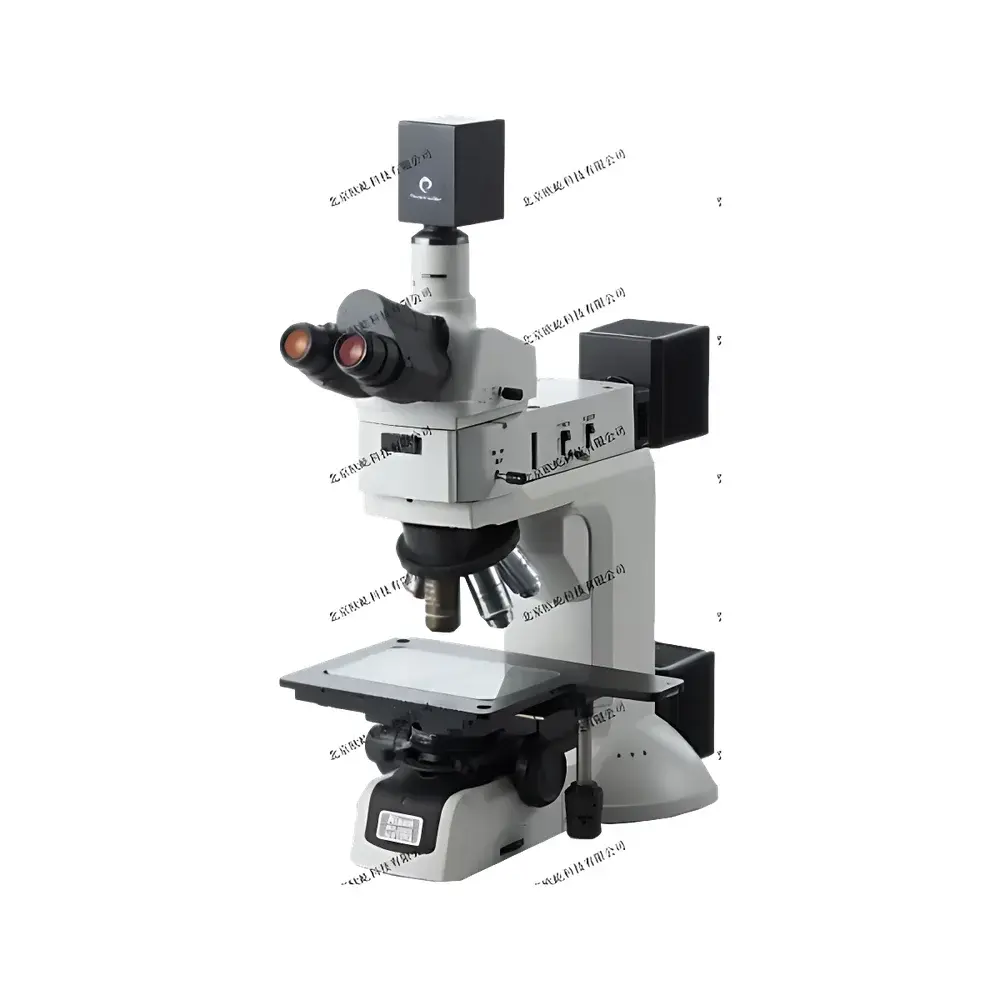
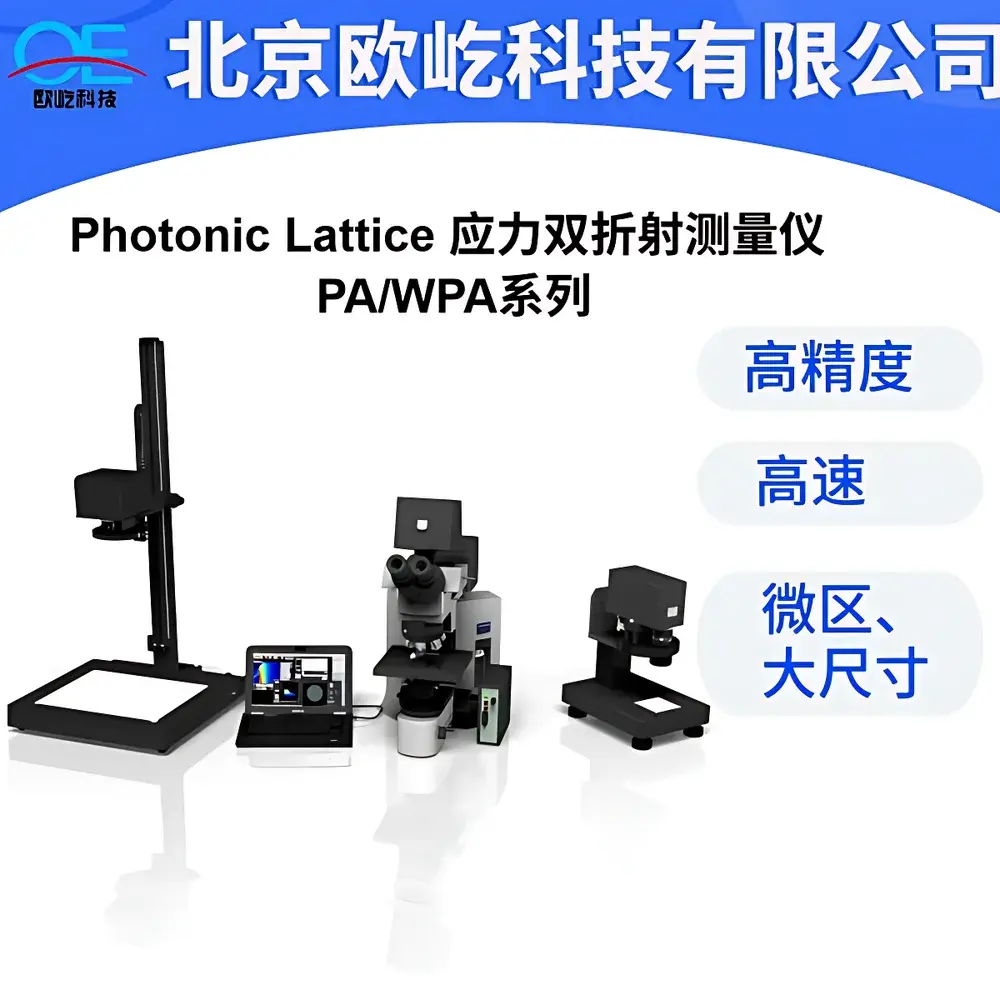
Photonic Lattice WPA-MICRO Microscopic Photoelastic Stress Analyzer
| Brand | Photonic Lattice |
|---|---|
| Origin | Japan |
| Model | WPA-MICRO |
| Measurement Range | 0–3500 nm |
| Repeatability | <1.0 nm |
| Pixel Resolution | 384 × 288 |
| Measurement Wavelengths | 523 nm, 543 nm, 575 nm |
| Field of View (FOV) | 5× objective: 1.1 × 0.8 mm |
| 10× | 0.5 × 0.4 mm |
| 20× | 270 × 200 µm |
| 50× | 110 × 80 µm |
| 100× | 55 × 40 µm |
| Dimensions | 250 × 487 × 690 mm |
| Weight | 11 kg |
| Data Interface | GigE (camera), RS-232C (motor control) |
| Power Supply | AC 100–240 V, 50/60 Hz |
| Software | WPA-View (for Micro) |
Overview
The Photonic Lattice WPA-MICRO Microscopic Photoelastic Stress Analyzer is a high-precision, full-field quantitative polarimetric instrument engineered for the spatially resolved measurement of stress-induced birefringence in transparent and semi-transparent solid materials. Based on the principle of quantitative photoelasticity—where mechanical stress induces anisotropic optical retardation—the WPA-MICRO employs a dual-wavelength, phase-resolved polarization modulation technique to determine both the magnitude (retardation, in nanometers) and orientation (fast-axis angle) of local birefringence with sub-nanometer repeatability. Unlike conventional qualitative polariscopes or single-point ellipsometers, the WPA-MICRO delivers calibrated, pixel-by-pixel retardation maps across the entire microscope field of view, enabling non-contact, label-free evaluation of residual stress, thermal gradients, and fabrication-induced strain in optically active materials.
Key Features
- Quantitative full-field birefringence imaging with spatial resolution down to 55 × 40 µm (using 100× objective), supporting microstructural stress analysis at critical process interfaces.
- Triple-wavelength acquisition (523 nm, 543 nm, 575 nm) to mitigate dispersion-related artifacts and enhance measurement robustness across diverse material dispersion profiles.
- High-stability polarization optics incorporating motorized waveplate rotation and synchronized lock-in detection, ensuring <1.0 nm measurement repeatability under controlled environmental conditions.
- Integrated GigE vision interface for real-time image streaming and low-latency data transfer to host PC; RS-232C port enables precise coordination with motorized stages and objective turrets.
- Compact modular design (250 × 487 × 690 mm, 11 kg) optimized for integration into cleanroom-compatible optical benches or inverted/microscope-coupled configurations.
- Thermally stabilized optical path and vibration-damped mechanical housing to maintain calibration integrity during extended acquisition sequences.
Sample Compatibility & Compliance
The WPA-MICRO accommodates a broad range of industrial and research-grade specimens—including annealed and tempered glass substrates, sapphire and fused silica wafers, polymer films (e.g., PET, PC, TAC), optical lens blanks, semiconductor packaging epoxies, and crystalline thin films deposited on opaque or reflective backplanes. Its wide dynamic range (0–3500 nm retardation) supports both low-strain quality control (e.g., display cover glass homogeneity verification per ISO 10110-5) and high-retardation failure analysis (e.g., edge stress in bonded SiC substrates). The system complies with fundamental metrological traceability requirements for optical stress measurement and is routinely deployed in environments governed by ISO/IEC 17025-accredited testing laboratories. While not intrinsically FDA- or GLP-certified, its data output structure and software audit trail capabilities (via WPA-View metadata logging) support alignment with 21 CFR Part 11 documentation practices when implemented within validated workflows.
Software & Data Management
WPA-View (for Micro) is a dedicated Windows-based application providing real-time acquisition, multi-wavelength synthesis, vectorial retardation mapping, and export of calibrated TIFF/CSV datasets. The software implements pixel-wise least-squares fitting of polarization state trajectories to extract retardation and azimuth with uncertainty estimation. It supports region-of-interest (ROI) statistical reporting (mean, std dev, max/min), line-profile extraction, false-color overlay on optical images, and batch processing of time-series or multi-position acquisitions. All measurement parameters—including objective ID, wavelength selection, exposure time, and calibration timestamp—are embedded as EXIF-like metadata. Raw camera frames and processed maps are stored with versioned file naming, enabling retrospective reprocessing and long-term data integrity verification.
Applications
- Residual stress mapping in chemically strengthened glass for smartphone displays and automotive HUDs, aligned with ASTM C1422 and ISO 12780-2 protocols.
- In-process monitoring of thermal stress development during wafer bonding, thin-film deposition, or laser annealing in microelectronics fabrication.
- Quality assurance of optical polymer films used in LCD backlight units and AR/VR waveguide substrates.
- Fundamental research on stress-optic coefficients in novel chalcogenide glasses and perovskite thin films.
- Failure root-cause analysis of microcracking initiation sites in precision optics subjected to mechanical clamping or thermal cycling.
FAQ
What types of microscopes is the WPA-MICRO compatible with?
The WPA-MICRO is designed as a modular add-on unit for standard upright or inverted research microscopes equipped with trinocular ports and C-mount adapters. It does not include an integrated microscope but couples directly to the imaging path via a custom relay lens system.
Can the system measure birefringence on metallized or opaque substrates?
Yes—when used in reflection mode with appropriate illumination geometry (e.g., Köhler illumination with polarized incident light), the WPA-MICRO can quantify surface-layer stress in coated or metallized samples such as ITO-on-glass or SiN-on-Si wafers.
Is calibration traceable to national standards?
Photonic Lattice provides factory calibration using NIST-traceable quarter-wave and half-wave reference plates; users may perform periodic verification using supplied calibration kits containing certified retardation standards.
Does WPA-View support automated pass/fail grading against user-defined tolerance thresholds?
Yes—customizable threshold masks and statistical limits can be defined per ROI; the software generates annotated reports with color-coded compliance status and summary histograms.
What environmental conditions are recommended for optimal performance?
Operation is specified for ambient temperatures of 15–25 °C with ≤50% RH and minimal air turbulence; temperature stability better than ±0.5 °C/hour is recommended to maintain sub-nm repeatability over multi-hour sessions.





