
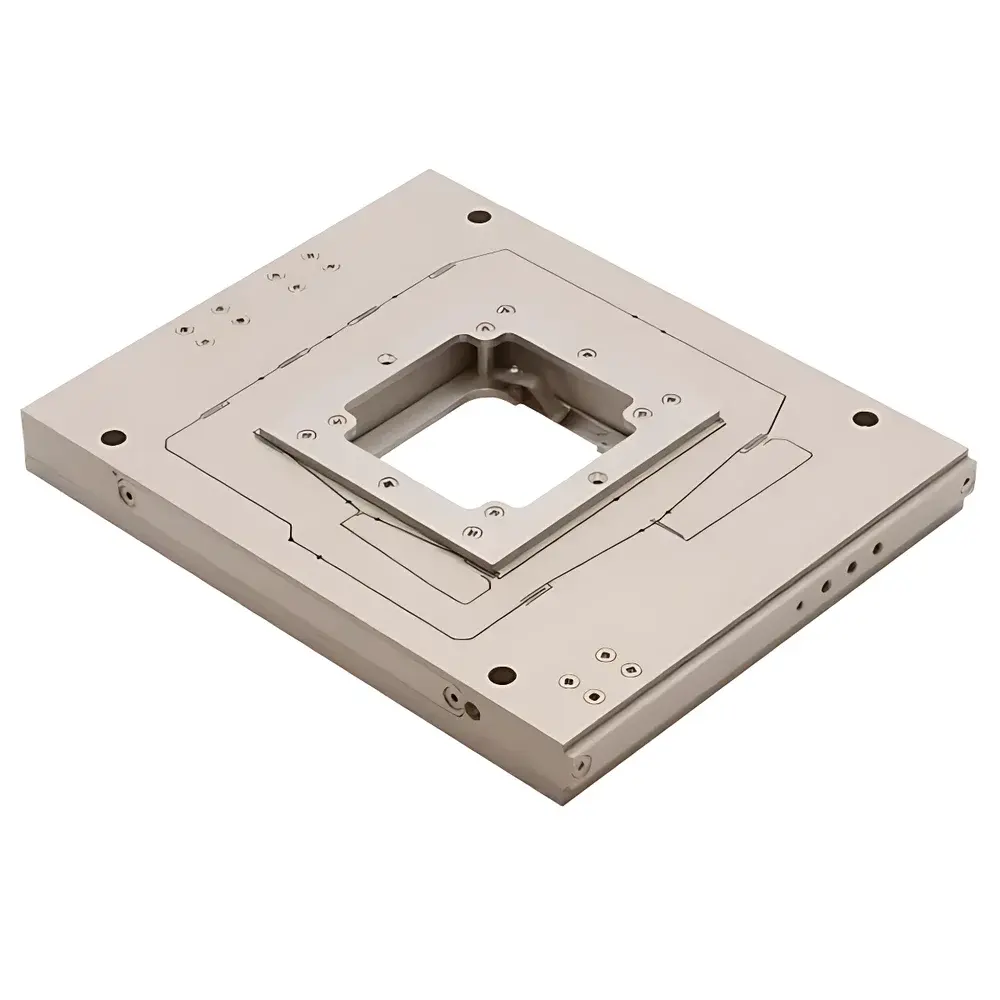
Piezoconcept AU-LT5 / AU-LT6 Piezoelectric Direct-Drive 5-Axis / 6-Axis Nanopositioning Stage
| Brand | Piezoconcept |
|---|---|
| Origin | France |
| Model | AU-LT5 / AU-LT6 |
| Travel (XYZ) | 100 / 200 / 300 µm |
| Angular Range (θx, θy) | 1.1–4.5 mrad |
| Angular Range (θz) | 5 mrad |
| Sensor Type | Si-HR silicon strain gauge |
| Closed-loop Resolution | < 0.1 nm |
| Noise Floor | 10–50 pm |
| Linearity | 0.02% FS |
| Controller | 16-bit DAC, analog (BNC, ±5 V / ±10 V / 0–10 V) & USB interface |
| Material | Aluminum (standard), Invar (LT5.100 optional) |
| Thickness | 21 mm |
| Compatibility | Inverted optical microscopes (Zeiss, Olympus, Nikon, Leica) |
Overview
The Piezoconcept AU-LT5 and AU-LT6 are high-precision, direct-drive piezoelectric nanopositioning stages engineered for multi-degree-of-freedom motion control in demanding optical and scanning applications. Based on monolithic flexure-guided architecture and driven by low-hysteresis piezoceramic actuators, these stages deliver true nanometer-scale positioning fidelity across five (X, Y, θx, θy, and optionally Z) or six (X, Y, Z, θx, θy, θz) degrees of freedom. Unlike traditional stepper- or voice-coil-based systems, the AU-LT series eliminates mechanical transmission elements—such as leadscrews, gears, or ball bearings—thereby eliminating backlash, friction-induced drift, and wear-related degradation. Position feedback is implemented via proprietary Si-HR (Silicon High-Resolution) strain gauge sensors, which offer superior signal-to-noise ratio, thermal stability, and long-term repeatability compared to conventional capacitive sensors. This sensor architecture enables closed-loop operation with sub-100 pm noise floor, millisecond-level step response, and linearity better than 0.02% of full scale—critical parameters for quantitative microscopy, interferometric alignment, and dynamic sample manipulation.
Key Features
- Monolithic flexure design ensures zero backlash, no lubrication, and vacuum-compatible operation (optional)
- Si-HR silicon strain gauge sensors integrated at the actuator level for real-time, high-bandwidth closed-loop control
- Configurable XYZ linear travel: 100 µm, 200 µm, or 300 µm; angular ranges up to ±4.5 mrad (θx/θy) and ±5 mrad (θz)
- Standard aluminum construction (21 mm total height); Invar variant available for LT5.100 to minimize thermal drift (< 0.1 µm/°C)
- 16-bit digital-to-analog controller supporting analog voltage input (BNC, selectable ±5 V / ±10 V / 0–10 V) and USB 2.0 host interface
- Four configurable TTL I/O lines (input/output) on rear panel for synchronization with external devices (e.g., cameras, lasers, shutters)
- Designed for seamless integration into inverted optical microscope frames—including Zeiss Axio Observer, Olympus IX series, Nikon Ti, and Leica DMi8 platforms
Sample Compatibility & Compliance
The AU-LT5 and AU-LT6 are routinely deployed in GLP- and GMP-aligned laboratories where traceable, auditable motion control is required. While not certified to a specific ISO standard out-of-the-box, the stages’ closed-loop architecture, deterministic hysteresis compensation, and controller logging capabilities support compliance with ISO 17025 (for calibration labs), ASTM E2552 (for scanning probe microscopy), and USP (for optical system qualification). All controllers record timestamped position data with metadata (voltage setpoint, actual sensor reading, error signal), enabling full audit trails per FDA 21 CFR Part 11 requirements when paired with validated software environments. The stages are compatible with standard Petri dishes, glass-bottom culture wells, silicon wafers, and custom substrates—facilitated by a modular clamp system supporting magnetic, vacuum, and mechanical fastening.
Software & Data Management
Piezoconcept provides native drivers for Windows (DLL, .NET), Linux (C/C++ API), and MATLAB. Third-party compatibility includes LabVIEW (NI-VISA), Python (PyUSB + NumPy), and EPICS IOC support for synchrotron and large-scale facility integration. The controller firmware supports real-time waveform generation (sine, triangle, sawtooth) with user-defined frequency (DC to 1 kHz) and amplitude resolution ≤ 0.001% FS. Position logs are exported in CSV or HDF5 format, preserving sub-millisecond time stamps and dual-channel sensor validation (setpoint vs. measured). Optional software modules include automated focus lock (Z-drift correction), multi-point registration mapping, and trajectory replay with jitter compensation—essential for structured illumination microscopy (SIM) and light-sheet volume scanning.
Applications
- Super-resolution fluorescence microscopy (STED, PALM, STORM) requiring precise specimen translation during multi-angle acquisition
- Optical trapping and holographic optical tweezers with simultaneous lateral and axial particle manipulation
- Atomic force microscopy (AFM) coarse approach and tip-sample alignment subsystems
- Laser beam steering and cavity length stabilization in interferometric setups (e.g., LIGO-style metrology)
- Nanoscale photolithography and maskless direct-write patterning with sub-50 nm overlay accuracy
- In vivo cellular imaging in developmental biology and space-based microgravity experiments, where thermal and vibrational stability are non-negotiable
- Quantitative phase imaging (QPI) and digital holographic microscopy requiring synchronized XYθ scanning
FAQ
What is the difference between AU-LT5 and AU-LT6?
The AU-LT5 provides five degrees of freedom: X, Y, θx, θy, and optionally Z (in select configurations). The AU-LT6 adds full six-axis control including independent θz rotation, enabling complete orientation correction for tilted samples or oblique illumination geometries.
Can the stage be used in vacuum or cleanroom environments?
Yes—the base material (aluminum or Invar), flexure geometry, and piezoceramic stack are inherently vacuum-compatible. Optional bake-out rated versions (10−6 mbar) and non-outgassing cabling are available upon request.
Is third-party software integration supported?
Yes—native APIs for MATLAB, Python, LabVIEW, and C/C++ are provided. EPICS IOC and Micro-Manager device adapters are also available under NDA for academic and national lab users.
How is thermal drift managed in long-duration experiments?
Invar variants (LT5.100-Invar) reduce coefficient of thermal expansion to < 1.2 × 10⁻⁶ /°C. Additionally, the Si-HR sensor’s intrinsic temperature compensation and real-time closed-loop correction maintain positional stability within ±0.3 nm over 8 hours at constant ambient (±0.1°C).
What mounting interfaces are standard?
M4 and M6 threaded holes conforming to ISO 2768-mK tolerances are provided on all base surfaces. Custom kinematic mounts, dovetail rails, and microscope-specific adapter plates (e.g., for Zeiss PicoStage or Olympus Cell-TIRF) are offered as OEM options.



