
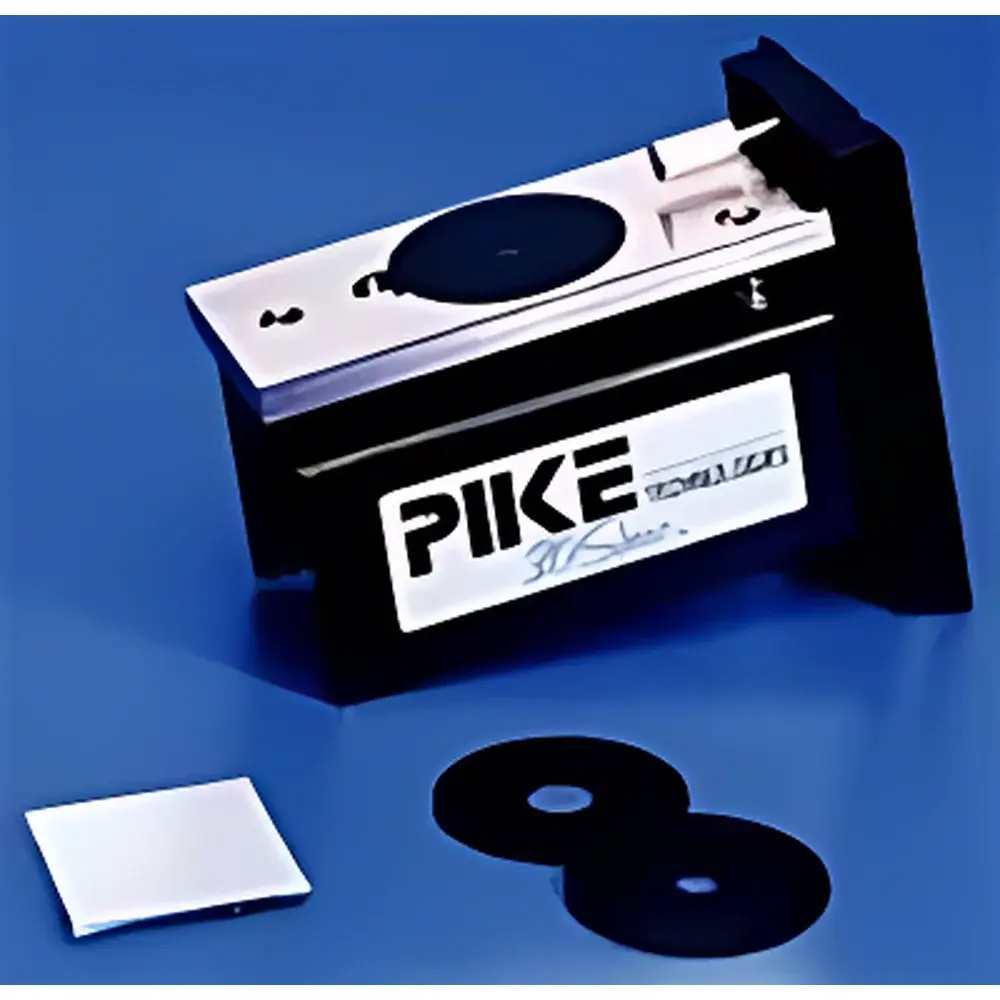
PIKE 30° Spec™ Specular Reflection Accessory for FTIR Spectrometers
| Brand | PIKE |
|---|---|
| Origin | USA |
| Model | 16x-xxx (Compatible with TL011-1000 configuration) |
| Mounting Interface | Universal FTIR Beam Port |
| Incident Angle | 30° ± 0.5° |
| Sample Holder Options | 3/8", 1/4", and 3/16" diameter sample caps |
| Optical Path | Fixed-angle, non-adjustable specular geometry |
| Compatibility | Bruker Tensor, Thermo Nicolet iS Series, PerkinElmer Frontier, Agilent Cary 630/670, Shimadzu IRTracer, and domestic FTIR systems with standard KBr beam path exit |
| Material | Gold-coated aluminum mirror optics (R > 98% @ 4000–400 cm⁻¹) |
| Weight | 185 g |
| Dimensions (L×W×H) | 82 × 54 × 32 mm |
Overview
The PIKE 30° Spec™ Specular Reflection Accessory is a precision-engineered optical interface designed for Fourier Transform Infrared (FTIR) spectrometers to enable rapid, non-destructive characterization of thin films, coatings, and surface layers via fixed-angle specular reflection. Unlike grazing-angle or ATR configurations, this accessory implements a rigorously controlled 30° incidence geometry—optimized to balance signal intensity, penetration depth, and surface sensitivity for dielectric and semi-conductive thin-film analysis. The accessory operates on the principle of Fresnel reflection, where infrared radiation impinges at a defined angle onto the sample surface, and the reflected beam is collected along the same plane for interferometric detection. This geometry yields high signal-to-noise ratio spectra with minimal scattering artifacts, making it particularly suitable for quantitative thickness estimation (via interference fringe analysis) and qualitative structural assessment (e.g., C=O, Si–O–Si, or NH₂ vibrational signatures) in multilayer architectures.
Key Features
- Fixed 30° incidence angle ensures reproducible measurement conditions compliant with ASTM E1252–98 (Standard Practice for General Techniques for Qualitative Infrared Analysis) and ISO 18387:2015 (FTIR spectroscopy — Requirements for accessories).
- Gold-coated aluminum mirror optics provide broadband reflectivity (>98% across 4000–400 cm⁻¹), minimizing spectral distortion and enabling reliable measurements in both mid-IR and extended-range configurations.
- Modular sample cap system includes three interchangeable apertures (3/8″, 1/4″, and 3/16″) to accommodate varying sample sizes while maintaining consistent beam alignment and minimizing edge diffraction effects.
- Universal mounting flange with standardized O-ring seal interface ensures mechanical and optical compatibility with major FTIR platforms—including Bruker Tensor series, Thermo Scientific Nicolet iS50/iS10, PerkinElmer Frontier, Agilent Cary 630/670, and Shimadzu IRTracer-100—without requiring beam realignment or hardware modification.
- Compact, lightweight design (185 g) minimizes thermal drift and vibration coupling; no motorized components or alignment screws reduce long-term calibration drift and maintenance requirements.
Sample Compatibility & Compliance
The 30° Spec™ accessory supports solid, flat, and optically homogeneous samples including polymer films (e.g., PET, PVDF), metal oxide coatings (TiO₂, Al₂O₃), spin-cast organic semiconductors, and vacuum-deposited thin films (≤5 µm thick). It is not intended for rough, highly scattering, or strongly absorbing substrates (e.g., carbon black composites or thick graphite layers), where diffuse reflectance or transmission modes are preferred. All optical components comply with RoHS Directive 2011/65/EU and meet CE marking requirements for laboratory instrumentation. The accessory is validated for use in GLP-compliant environments when paired with FTIR systems equipped with audit-trail-capable software (e.g., Thermo OMNIC v10+, Bruker OPUS 8.5+).
Software & Data Management
No proprietary software is required. Spectral acquisition and processing leverage native instrument control packages. Interference fringe analysis for thickness determination is performed using built-in peak-picking algorithms (e.g., Thermo OMNIC’s “Thin Film Thickness Calculator” or Bruker’s “Spectrum Evaluation” module), which apply the standard equation: d = mλ / (2n cosθ), where d = film thickness, m = fringe order, λ = wavelength of adjacent maxima/minima, n = refractive index (input by user), and θ = effective internal angle (derived from 30° incident angle and Snell’s law). Raw interferograms retain full phase information, supporting advanced processing such as Mie scattering correction or Kramers–Kronig transformation where applicable.
Applications
- Quality control of anti-reflective and hard-coat layers on optical lenses and display panels.
- In-process monitoring of ALD/CVD-deposited dielectric films in semiconductor fabrication.
- Characterization of biodegradable polymer film degradation kinetics via carbonyl index tracking.
- Quantification of residual solvent content in spin-coated photoresist films.
- Identification of interfacial reactions in laminated packaging materials (e.g., EVOH–PE adhesion layers).
FAQ
Can this accessory be used for quantitative thickness measurement?
Yes—provided the film is uniform, transparent in the IR region, and deposited on a reflective substrate (e.g., silicon or aluminum), thickness can be determined with ±5% uncertainty using interference fringe spacing analysis.
Is alignment required after installation on an FTIR system?
No—optical alignment is factory-set and mechanically locked; users only need to verify beam centering using the instrument’s alignment laser or visible preview mode.
Does the accessory support purge-compatible operation?
Yes—the sealed optical housing is compatible with standard dry-air or nitrogen purge lines connected to the spectrometer’s auxiliary port.
What is the minimum detectable film thickness?
Typically 100 nm for high-refractive-index films (n > 1.7) on reflective substrates; lower limits depend on signal-to-noise ratio and fringe contrast.
Is NIST-traceable calibration available?
PIKE does not supply NIST-traceable reference films with this accessory; however, certified polystyrene or polyethylene standards (e.g., NIST SRM 1921b) may be used for wavenumber accuracy verification.




