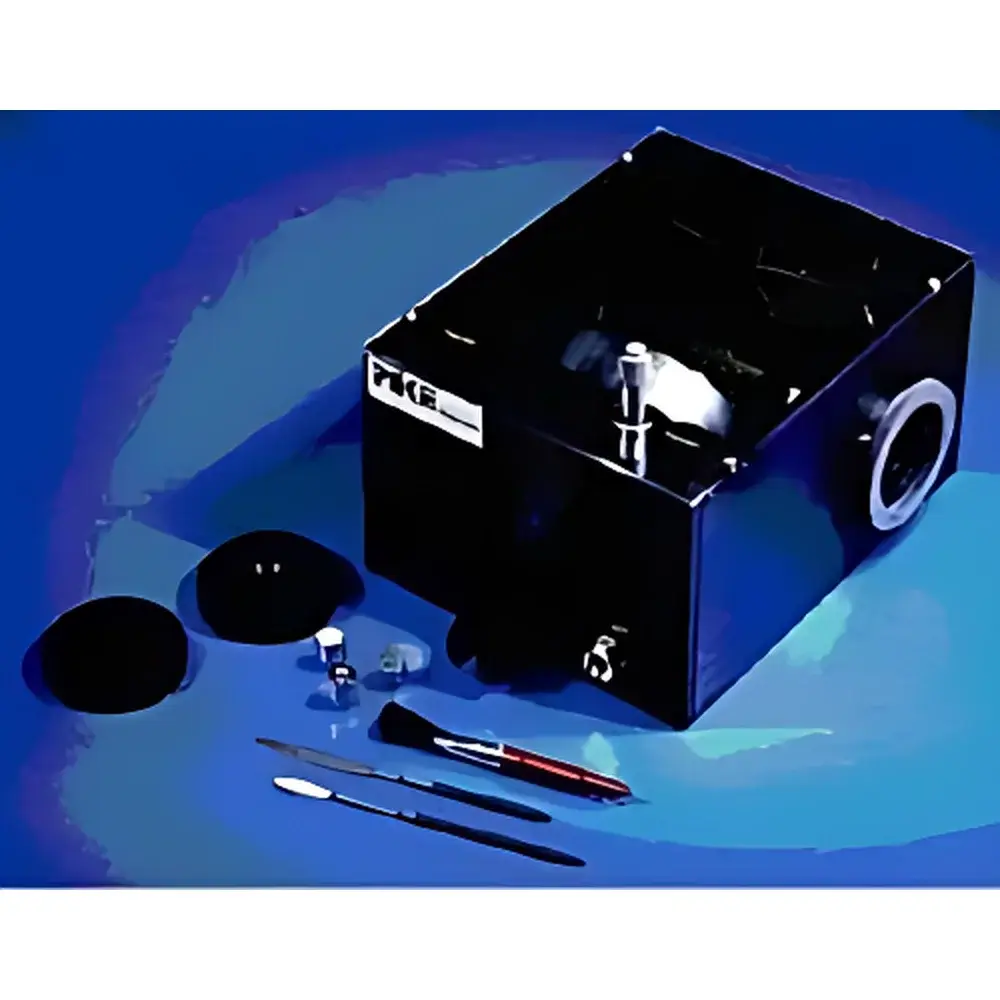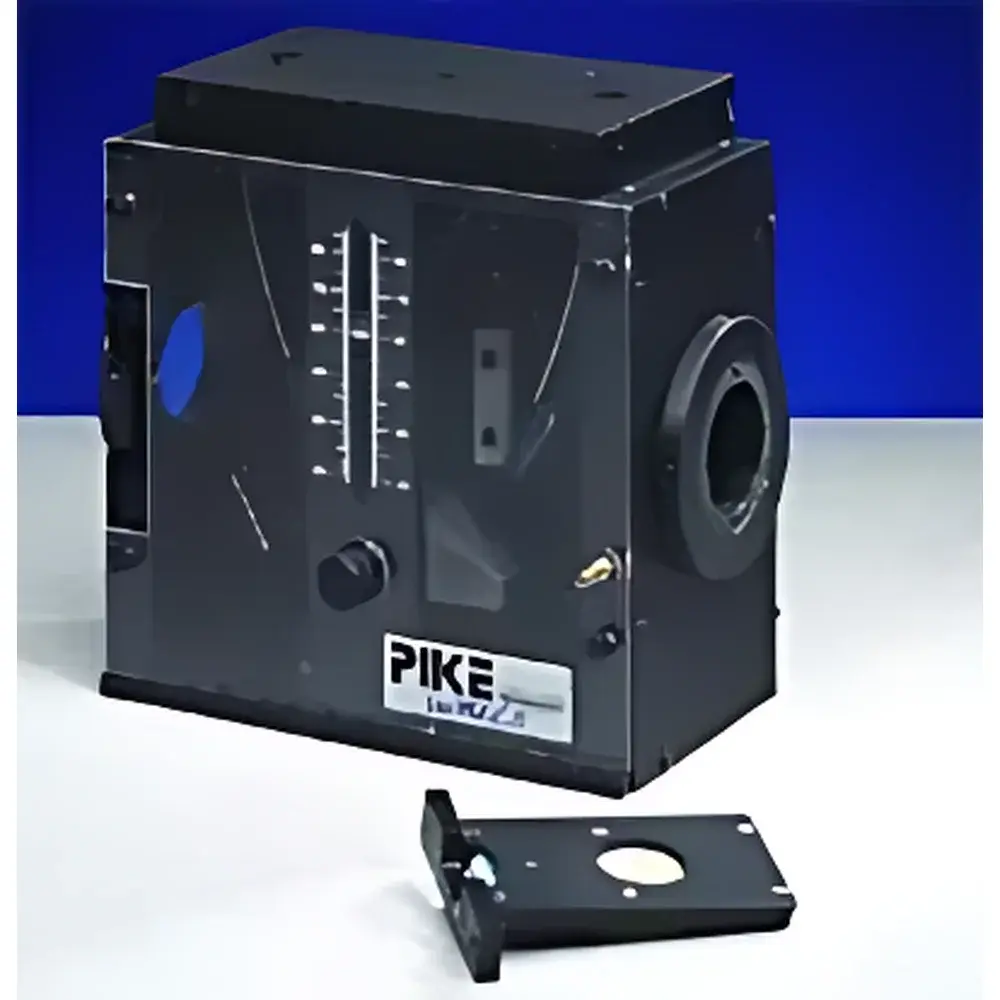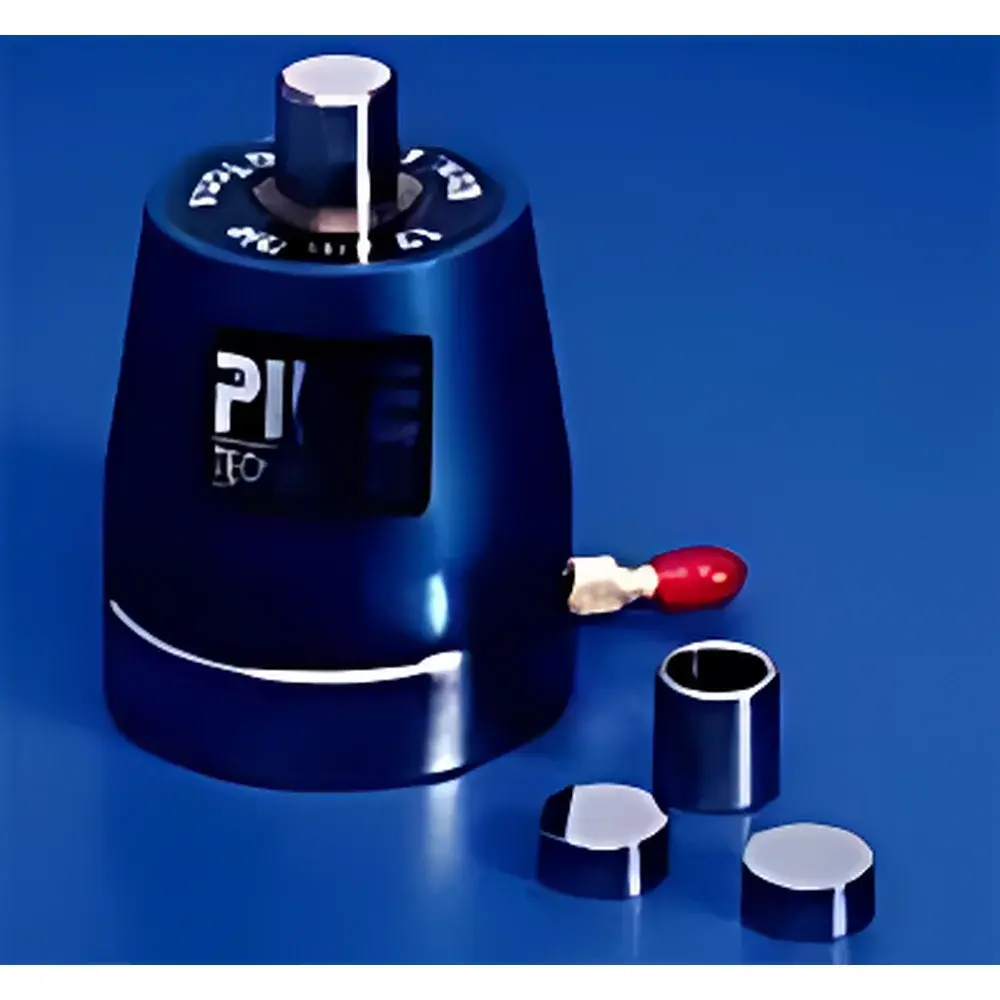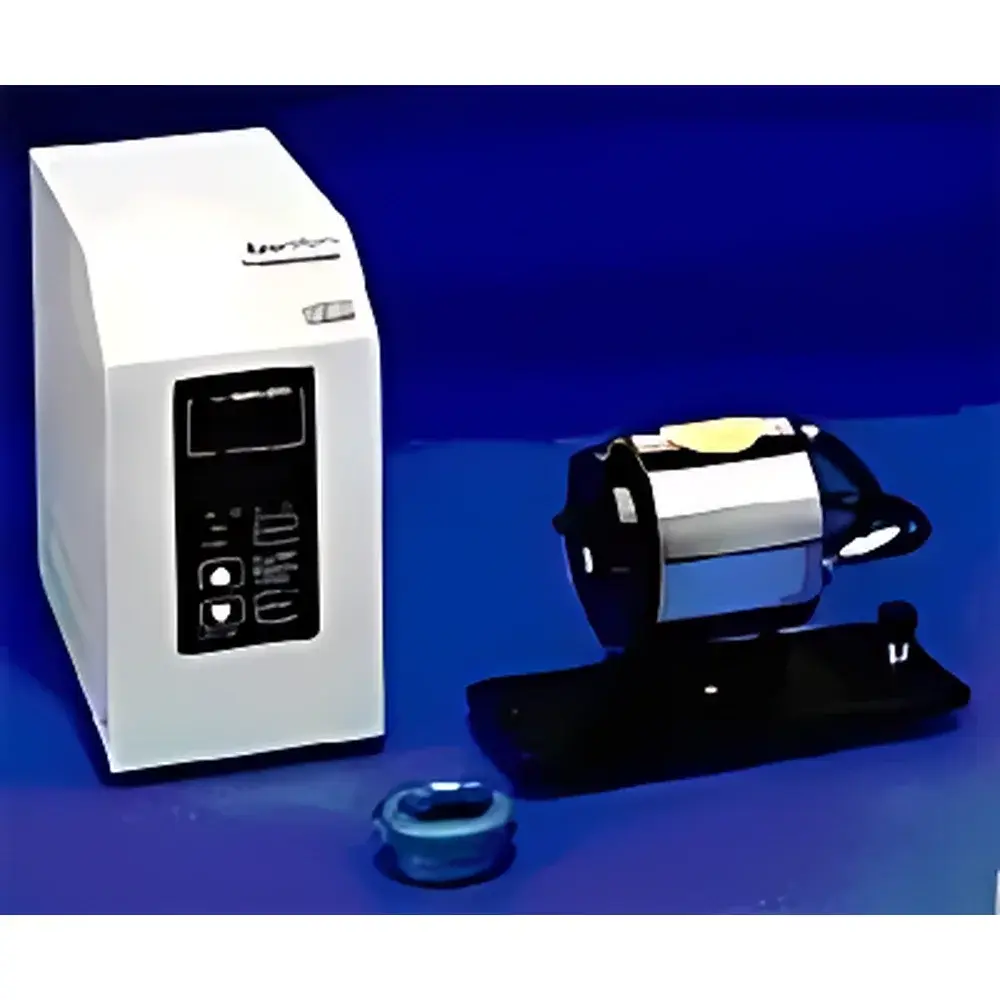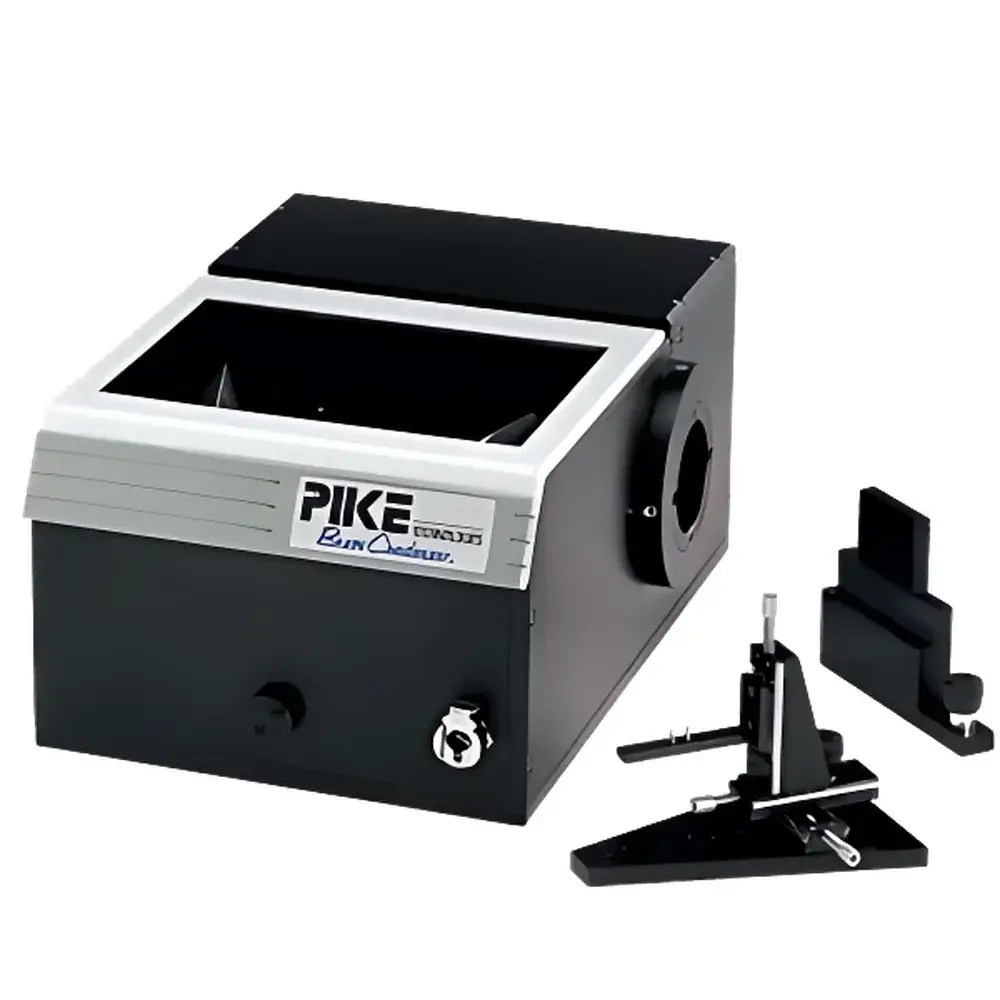
Pike Beam Condenser for FTIR Spectroscopy

| Brand | Pike |
|---|---|
| Origin | USA |
| Model | Beam Condenser |
| Magnification Options | 4× and 6× |
| Compatible Instrument Brands | Thermo, Bruker, Shimadzu, Agilent, JASCO |
| Sample Stage Options | X-Y-Z Adjustable Stage, Magnetic Sample Holder, KBr Pellet Holder, Universal Spring-Loaded Holder |
| Application Domain | FTIR Microspectroscopy, Gemological Analysis, Thin-Film & Micro-Sample Characterization |
Ask about pricing, availability and specifications.
Overview
The Pike Beam Condenser is a precision optical accessory engineered for Fourier Transform Infrared (FTIR) spectrometers to enhance spatial resolution and signal intensity in micro-sampling applications. Designed in strict accordance with the optical layout requirements of commercial benchtop and microscope-coupled FTIR systems, this condenser integrates seamlessly into the external beam path—typically between the interferometer output and the sample compartment—to concentrate the collimated IR beam onto sub-millimeter sample areas. Its optical design employs high-transmission, low-absorption CaF₂ or ZnSe lens elements (depending on spectral range), minimizing thermal drift and chromatic aberration across the mid-IR region (4000–400 cm⁻¹). Unlike generic focusing optics, the Pike Beam Condenser maintains beam collimation integrity upstream and preserves the instrument’s inherent photometric accuracy, enabling quantitative absorbance measurements without calibration recalibration.
Key Features
- Two fixed magnification configurations: 4× and 6×, optimized for trade-offs between spot size reduction (down to ~100 µm diameter at focal plane) and usable working distance (>15 mm)
- Modular mechanical interface compatible with standard FTIR sample compartments—no custom alignment tools or firmware modification required
- Thermally stable aluminum housing with black anodized finish to suppress stray light and minimize thermal lensing effects
- Integrated kinematic mounting with three-point contact design ensures repeatable positioning within ±2 µm axial tolerance
- Optical axis pre-aligned to ISO 8578-compliant reference boresight; factory-verified using HeNe laser collimation and IR camera profiling
Sample Compatibility & Compliance
The Beam Condenser supports diverse sampling geometries through interchangeable stage modules. The X-Y-Z adjustable stage provides ±5 mm travel in all axes with micrometer-driven fine positioning (1 µm resolution), enabling precise raster scanning for mapping applications. The magnetic holder accommodates ferromagnetic substrates (e.g., steel-backed thin films); the KBr pellet holder features recessed alignment grooves and pressure-distribution geometry compliant with ASTM E1252-98 for reproducible pellet preparation. The universal spring-loaded holder applies controlled, uniform clamping force (0.8–1.2 N) suitable for fragile gemstone fragments or polymer foils. All components are manufactured to RoHS 2011/65/EU specifications and undergo traceable dimensional inspection per ASME Y14.5-2018 GD&T standards.
Software & Data Management
While the Beam Condenser operates as a passive optical component, its use directly impacts data acquisition protocols in supported platforms. When used with Thermo OMNIC, Bruker OPUS, or JASCO Spectra Manager software, users must adjust aperture settings and detector integration time to compensate for increased irradiance density—guidelines are embedded in each vendor’s “Micro-FTIR Configuration Wizard.” Audit trails generated during mapping experiments retain full metadata (condenser model, magnification, stage coordinates), satisfying GLP documentation requirements under 21 CFR Part 11 when paired with validated instrument control software. Raw interferograms remain unaltered; no proprietary file conversion or vendor lock-in is introduced.
Applications
- Gemological identification: Differentiation of natural vs. synthetic diamonds, detection of HPHT treatment signatures via C–H and N–H band morphology at micron-scale domains
- Pharmaceutical solid-state analysis: Mapping polymorphic distribution in tablet cross-sections with lateral resolution sufficient to resolve individual API crystals (≥5 µm)
- Micro-contamination forensics: Isolation and spectral acquisition from sub-100 µm particulates on silicon wafers or polymer packaging films
- Thin-film interfacial studies: Depth-resolved analysis of oxidation layers on coated metals using attenuated total reflection (ATR) coupling with condenser-enhanced beam delivery
- Biological tissue sectioning: Correlative IR imaging of formalin-fixed paraffin-embedded (FFPE) samples without staining, leveraging intrinsic biochemical contrast amplified by focused illumination
FAQ
Is the Beam Condenser compatible with vacuum or purged FTIR systems?
Yes—its sealed optical housing and metal-gasketed flange interface meet ISO-KF25 vacuum compatibility standards up to 10⁻³ mbar; purge gas flow paths are integrated into the base plate design.
Does installation require realignment of the spectrometer’s internal optics?
No—Pike specifies zero-alignment installation: the condenser mounts externally and does not intersect the internal interferometer beam path; factory alignment tolerances ensure <0.3 mrad angular deviation.
Can the 4× and 6× versions be interchanged without recalibrating the instrument’s wavelength scale?
Yes—both models share identical entrance and exit pupil positions per ANSI Z80.10-2020 optical interface standards; spectral calibration remains invariant across magnifications.
What maintenance is required for long-term performance stability?
Annual verification of lens surface cleanliness using certified IR-grade swabs and spectroscopic-grade methanol; no lubrication or recalibration is needed under normal laboratory conditions (20–25°C, 30–60% RH).