
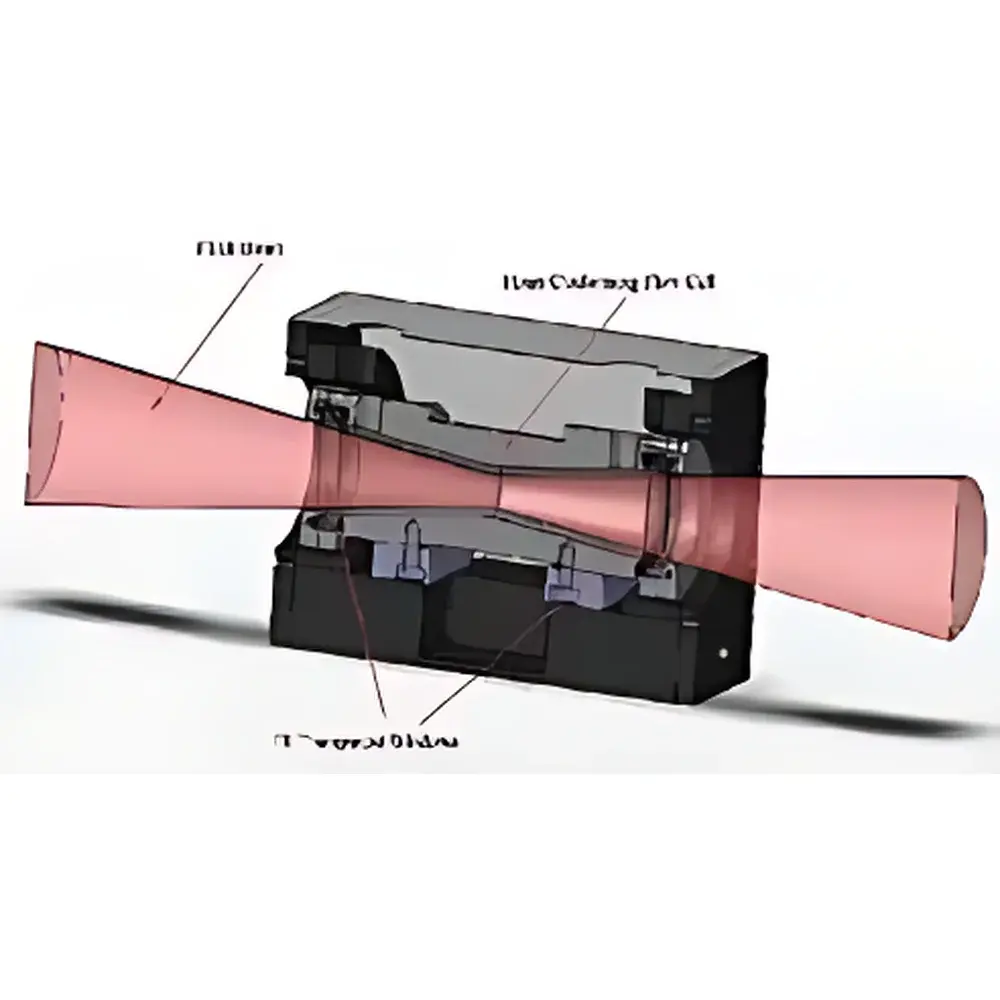
Pike Technologies 16x-xxx Heated Gas Cell for FTIR Spectroscopy
| Brand | Pike Technologies |
|---|---|
| Origin | USA |
| Model | 16x-xxx |
| Cell Volume | 38.5 mL |
| Path Length | 100 mm |
| Max Operating Temperature | 260 °C |
| Maximum Pressure Rating | 100 psi |
| Construction | Stainless Steel Body with O-ring Seals |
| Window Mounting | 38 × 6 mm Rectangular Aperture (Windows Not Included) |
Overview
The Pike Technologies 16x-xxx Heated Gas Cell is a precision-engineered optical accessory designed for quantitative and qualitative gas-phase analysis using Fourier Transform Infrared (FTIR) spectroscopy. It operates on the principle of absorption spectroscopy, where infrared radiation passes through a gaseous sample confined within a thermally stabilized cell, enabling detection and quantification of molecular vibrational transitions. Unlike ambient-temperature gas cells, this model incorporates integrated resistive heating elements and multi-layer thermal insulation to maintain uniform, stable temperature profiles across the entire optical path—critical for studying temperature-dependent spectral shifts, equilibrium constants in reversible reactions (e.g., NO₂ ⇌ N₂O₄), or volatile organic compound (VOC) behavior under process-relevant conditions. Its 100 mm optical path length ensures sufficient absorbance for low-concentration species while maintaining compatibility with standard FTIR spectrometer sample compartments.
Key Features
- Stainless steel construction with electropolished interior surfaces to minimize catalytic surface reactions and ensure long-term chemical inertness toward corrosive or reactive gases (e.g., HCl, NH₃, SO₂).
- Hermetically sealed design utilizing high-temperature Viton® or Kalrez® O-rings rated for continuous operation up to 260 °C, supporting both static and dynamic (flow-through) gas configurations.
- Integrated heating assembly with distributed thermal mass and embedded PT100 RTD sensor enables precise temperature control and monitoring—accuracy ±1.0 °C over full range when paired with a compatible external PID controller.
- Optimized thermal insulation layer reduces radial heat loss and mitigates thermal gradients along the beam path, minimizing refractive index fluctuations that could distort interferogram stability.
- Standard 100 psi pressure rating allows safe handling of pressurized samples—including liquefied petroleum gas (LPG) mixtures, calibration standards, and high-boiling-point vapors—without mechanical deformation or seal failure.
- Modular window mount accepts standard 38 × 6 mm rectangular infrared-transmitting windows (e.g., KBr, CsI, CaF₂, or ZnSe), facilitating spectral range selection from mid-IR (4000–400 cm⁻¹) to far-IR (down to 50 cm⁻¹) based on application requirements.
Sample Compatibility & Compliance
The 16x-xxx Heated Gas Cell supports a broad spectrum of gaseous analytes including permanent gases (O₂, N₂, CO, CO₂), halogenated hydrocarbons, sulfur-containing compounds, and thermally labile organics. Its materials of construction comply with ASTM E1492-22 (Standard Practice for Handling and Collection of Gaseous Samples for FTIR Analysis) and are suitable for use in GLP-compliant laboratories conducting method validation per ICH Q2(R2). The cell’s pressure and temperature ratings align with ISO 17025:2017 requirements for equipment suitability assessment. While the cell itself does not include intrinsic data logging, its analog temperature output signal is compatible with controllers meeting FDA 21 CFR Part 11 criteria when deployed in regulated QC environments.
Software & Data Management
The cell functions as a passive optical component and does not contain embedded firmware or digital interfaces. Temperature setpoint and real-time feedback are managed externally via a dedicated temperature controller (e.g., Omega CNi16 series or Thermo Fisher TC-200), which may provide RS-232/USB output for integration into laboratory information management systems (LIMS) or instrument control platforms such as Thermo OMNIC, Bruker OPUS, or Agilent MicroLab. Users can log temperature metadata alongside spectral acquisitions to support traceable, auditable workflows required under ISO/IEC 17025 accreditation.
Applications
- In-situ monitoring of catalytic reaction kinetics in heterogeneous gas-phase systems (e.g., CO oxidation over Pt/Al₂O₃ at elevated temperatures).
- Thermodynamic characterization of gas-phase equilibria, including enthalpy and entropy determination via van’t Hoff analysis.
- Calibration and verification of environmental air monitoring instruments using certified gas standards at non-ambient temperatures.
- Study of hydrogen-bonding dynamics in vapor-phase alcohols or carboxylic acids through temperature-dependent OH-stretch band deconvolution.
- Validation of computational chemistry models (e.g., DFT-predicted vibrational frequencies) under experimentally controlled thermal conditions.
FAQ
Is the temperature controller included with the cell?
No—the 16x-xxx Heated Gas Cell requires an external temperature controller with 0–10 V or 4–20 mA analog input/output capability. Recommended models include Omega CNi16, Eurotherm 2408, or Thermo Fisher TC-200.
What infrared window materials are compatible with this cell?
Standard 38 × 6 mm rectangular windows made from KBr (hygroscopic, 4000–400 cm⁻¹), CsI (moisture-resistant, 4000–200 cm⁻¹), CaF₂ (UV-IR transparent, 4000–1000 cm⁻¹), or ZnSe (durable, 4000–500 cm⁻¹) are mechanically and thermally compatible.
Can the cell be used under vacuum conditions?
Yes—the stainless steel body and metal-seated O-rings support operation down to ≤10⁻³ mbar when properly conditioned; however, thermal conductivity changes under vacuum require recalibration of heater power vs. temperature response.
Does the cell support gas flow-through operation?
Yes—two 1/4″-28 UNF threaded ports allow inlet/outlet connection for continuous purge or recirculation configurations; recommended flow rates: 10–100 mL/min to avoid turbulence-induced spectral artifacts.
How is the cell mounted in the FTIR sample compartment?
It uses a standardized baseplate interface compatible with most commercial FTIR spectrometers (e.g., Thermo Nicolet iS50, Bruker Tensor II, PerkinElmer Frontier); alignment is achieved via kinematic pins and locking screws per ASTM E1421-18 guidelines.
Related Products





