
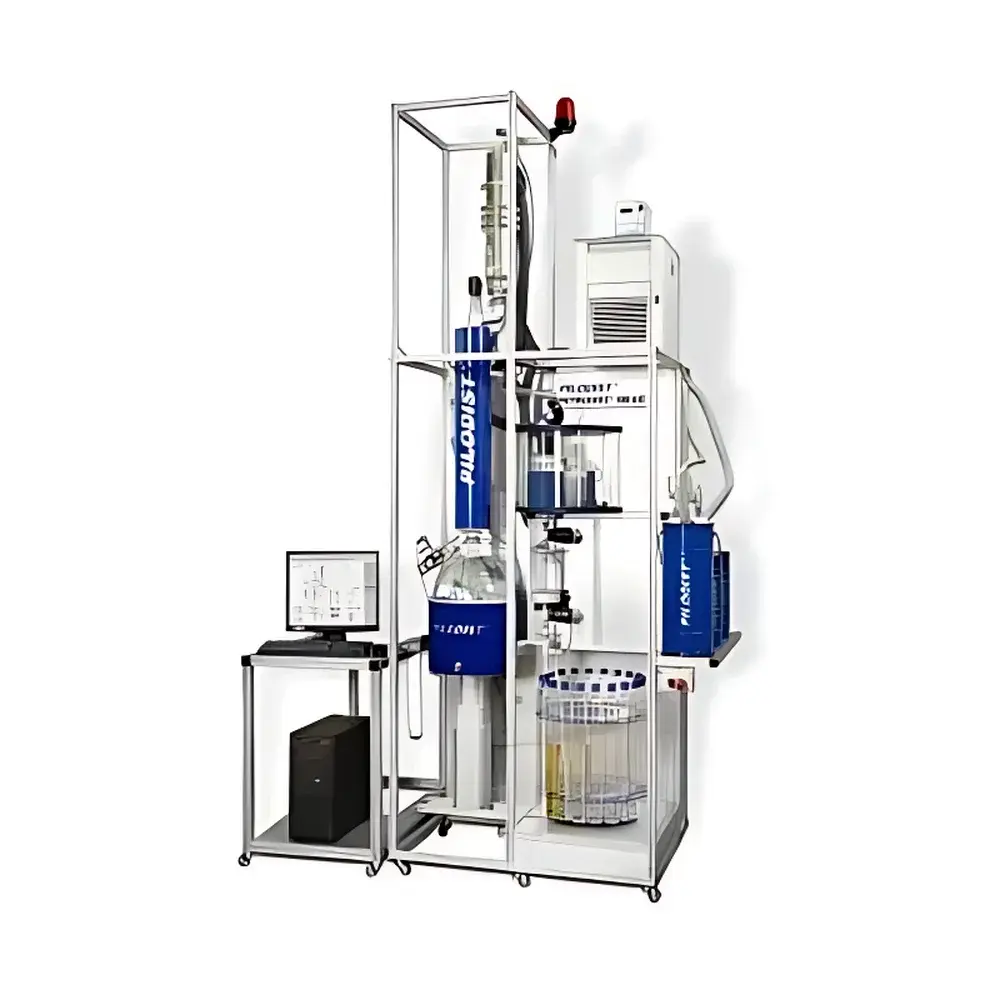
Pilodist PD 100CC Automated True Boiling Point (TBP) Distillation System
| Brand | Pilodist |
|---|---|
| Origin | Germany |
| Model | PD 100CC |
| Compliance | ASTM D2892, ASTM D5236 |
| Control System | Windows-based PC software with real-time process visualization |
| Vacuum Control | Auto-adjusted residual pressure (100, 50, 10, 2 Torr) with manual override |
| Safety Features | Overtemperature shutdown, nitrogen purge activation, audible/visual alarms |
| Fraction Collection | 20-position airtight fraction collector with automated cooling, weighing, logging, and cleaning |
| Interface | Ground-glass joints with elastomeric seals — grease-free vacuum integrity |
| Distillation Modes | Integrated atmospheric-to-vacuum transition with automatic gap cooling |
| Data Output | Excel-native reporting, TBP curve generation, AET temperature conversion |
Overview
The Pilodist PD 100CC Automated True Boiling Point (TBP) Distillation System is an engineered solution for precise, repeatable hydrocarbon fractionation of crude oil and heavy petroleum fractions in accordance with ASTM D2892 (Standard Test Method for Distillation of Crude Petroleum) and ASTM D5236 (Standard Test Method for Distillation of High-Boiling Petroleum Fractions). Unlike conventional batch distillation units, the PD 100CC implements a continuous, computer-controlled equilibrium-stage distillation protocol under dynamically regulated vacuum conditions. It operates on the principle of true boiling point distillation—where vapor–liquid equilibrium is maintained at each theoretical plate across a precisely controlled temperature and pressure gradient—enabling accurate reconstruction of the crude’s compositional profile. The system integrates thermal management, vacuum dynamics, and fraction handling into a single coordinated architecture, delivering traceable, GLP-compliant data suitable for refinery feedstock characterization, assay development, and process simulation input.
Key Features
- Full compliance with ASTM D2892 and D5236 test protocols—including mandatory column geometry, reflux ratio control, and temperature measurement accuracy requirements.
- Automated atmospheric-to-vacuum transition with programmable gap cooling, eliminating manual intervention during pressure regime shifts.
- Real-time vacuum regulation across four discrete setpoints (100, 50, 10, and 2 Torr), with closed-loop feedback from calibrated capacitance manometers and proportional vacuum valve actuation.
- 20-position airtight fraction collector featuring integrated Peltier cooling, high-resolution mass measurement (0.001 g resolution), auto-zeroing tare function, and post-collection solvent rinse cycle.
- Grease-free vacuum integrity achieved via precision-ground glass joints (ISO K 29/32, K 35/40) paired with chemically resistant fluorosilicone O-rings—eliminating contamination risk and ensuring long-term seal reliability under thermal cycling.
- Comprehensive safety architecture including dual redundant temperature sensors, programmable overtemperature cutoff, automatic nitrogen purge initiation upon critical fault detection, and hardware-enforced interlocks on heating, vacuum, and collection subsystems.
Sample Compatibility & Compliance
The PD 100CC accepts crude oils, topped crudes, atmospheric and vacuum residues, and synthetic blends with initial boiling points ranging from ~30 °C to >565 °C. Sample volume is standardized at 100 mL (±0.5 mL), compatible with standard ASTM sample preparation procedures. All wetted components—including distillation column, condensers, receivers, and transfer lines—are constructed from borosilicate 3.3 glass or electropolished stainless steel (316L), ensuring inertness toward sulfur compounds, naphthenic acids, and trace metals. The system supports full audit trail generation per FDA 21 CFR Part 11 requirements when operated with validated software configuration, and meets ISO/IEC 17025 documentation standards for accredited testing laboratories. Calibration certificates for temperature sensors (Pt100 Class A), pressure transducers, and load cells are provided with NIST-traceable documentation.
Software & Data Management
The Windows-based control interface provides synchronized visualization of all process variables—including column top/bottom temperatures, reflux ratio, vacuum level, receiver weight gain, and heater power—on a dynamic flow schematic. Users define distillation protocols via intuitive parameter templates (e.g., “Crude Assay – ASTM D2892 Mode”), with editable setpoints for cut-point temperatures, hold times, and vacuum ramp rates. All raw data streams are timestamped and stored in a relational database (SQLite format), enabling retrospective analysis, multi-run comparison, and export to CSV or native Excel (.xlsx) formats. TBP curves are auto-generated using ASTM-recommended AET (Average Endpoint Temperature) conversion algorithms, with optional correction for barometric pressure and vapor pressure depression. Electronic signatures, user access levels (admin/operator/observer), and change history logging satisfy GLP and internal QA requirements.
Applications
- Refinery crude assay for unit charge planning, yield prediction, and process modeling (e.g., LP, ASPEN, Petro-SIM inputs).
- Characterization of unconventional feeds (oil sands bitumen, shale oil) and heavy residuals for coker/fcc feed evaluation.
- Quality control of crude blends prior to pipeline injection or marine loading.
- Research into vapor–liquid equilibrium behavior of complex hydrocarbon mixtures under varying pressure regimes.
- Validation of simulated distillation (SimDis) GC methods against reference TBP data.
- Regulatory reporting for customs classification (HS Code 2709), environmental speciation, and sulfur distribution profiling.
FAQ
Does the PD 100CC support ASTM D1160 (vacuum gas oil distillation)?
Yes—the system’s vacuum control range (2–100 Torr) and temperature stability (< ±0.3 °C at 400 °C) meet all critical requirements of ASTM D1160 when configured with the optional short-path column module.
Can the software perform real-time AET calculation during distillation?
Yes—AET values are computed continuously using ASTM D2892 Annex A1 equations, incorporating measured cut-point temperatures, recovered volume percentages, and instantaneous vacuum pressure.
Is remote monitoring supported?
The system supports secure RDP and VNC connections over local networks; however, remote operation is disabled by default and requires site-specific cybersecurity validation per IEC 62443.
What maintenance intervals are recommended for the vacuum system?
Oil-free dry scroll pumps require inspection every 2,000 operating hours; glass joint integrity and O-ring condition should be verified before each assay series.
How is method validation documented?
Pilodist provides IQ/OQ documentation templates aligned with ISO/IEC 17025, including temperature uniformity mapping, vacuum repeatability testing, and fraction recovery accuracy verification using certified reference materials (e.g., NIST SRM 1848).






