
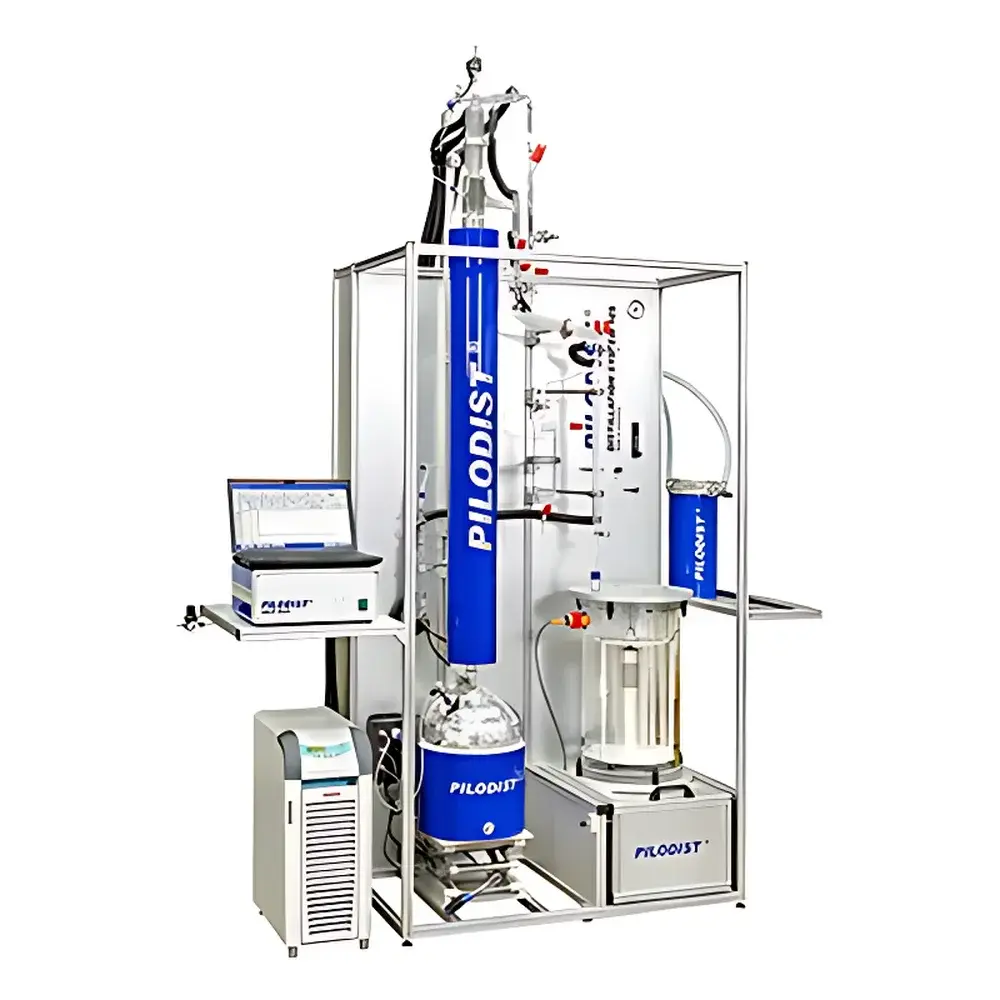
Pilodist PD 105 Precision Fractional Distillation System
| Brand | Pilodist |
|---|---|
| Origin | Germany |
| Model | PD 105 |
| Application Domain | Petroleum & Petrochemical R&D, Fine Chemical Synthesis, High-Purity Separation |
| Operating Pressure Range | Atmospheric to Vacuum (≤ 0.1 mbar) |
| Temperature Control Method | Programmable Oil Bath with PID Regulation |
| Reflux Ratio Control | Adjustable via Motorized Reflux Divider |
| Fraction Collection Modes | Temperature-Triggered, Volume-Triggered, or Time-Triggered |
| Receiver Options | 6-, 9-, or 18-position Automated Fraction Collector with Overflow Protection |
| Software Platform | Windows-Based Control Suite with Real-Time Parameter Logging and Curve Visualization |
| Compliance Framework | Designed to Support ASTM D2892 (True Boiling Point Distillation), ASTM D5236 (Extended True Boiling Point), and ISO 3405 |
Overview
The Pilodist PD 105 Precision Fractional Distillation System is an engineered laboratory-scale distillation platform designed for high-resolution separation of complex hydrocarbon mixtures and thermally sensitive compounds. Built upon the legacy of Fischer’s foundational distillation architecture and refined by Pilodist’s dedicated engineering team in Germany, the PD 105 implements classical fractional distillation principles—leveraging precise temperature gradient control across a structured packed column, programmable reflux management, and vacuum-compatible operation—to achieve reproducible cut-point definition in petroleum cuts, synthetic intermediates, and specialty chemicals. Unlike simple batch distillers, the PD 105 integrates continuous vapor–liquid equilibrium (VLE) management through dynamic reflux ratio modulation and real-time boiling point tracking, enabling accurate simulation of industrial fractionation behavior under controlled lab conditions. Its modular design supports both atmospheric and high-vacuum operation (down to 0.1 mbar), making it suitable for applications ranging from naphtha characterization to high-boiling aromatic purification and fatty acid isolation.
Key Features
- Programmable oil bath heating system with ±0.5 °C temperature stability and ramp/soak profile capability
- Motor-driven reflux divider enabling precise, software-controlled reflux ratios (0–100% total reflux)
- Automated fraction collector with configurable receiver arrays (6, 9, or 18 positions), each equipped with mechanical overflow detection and individual thermal shielding
- Vacuum-integrated column head with borosilicate glass construction, calibrated pressure transducer, and inert gas purge port
- Integrated level sensors for boiler and condensate reservoirs, triggering low-level alarms and automatic shutdown sequences
- Full system interlock architecture compliant with IEC 61508 functional safety guidelines for laboratory equipment
Sample Compatibility & Compliance
The PD 105 accommodates feed volumes from 100 mL to 2 L, supporting single- or multi-component liquid feeds including crude fractions, reformates, bio-oils, polymerization solvents, and natural product extracts. Column packing options include stainless steel helices, glass Raschig rings, or structured metal gauze—selected based on relative volatility and fouling propensity. The system meets essential requirements for method validation under ASTM D2892 (TBP distillation of petroleum products), ASTM D5236 (extended TBP for heavy ends), and ISO 3405 (petroleum products—determination of distillation characteristics). All electronic modules—including temperature controllers, vacuum gauges, and data acquisition units—are CE-marked and RoHS-compliant. For regulated environments, the control software supports audit trail generation, user access levels, and electronic signature functionality aligned with FDA 21 CFR Part 11 expectations when deployed with validated IT infrastructure.
Software & Data Management
The PD 105 operates via a native Windows-based control interface developed in-house by Pilodist. The application provides synchronized real-time visualization of up to eight process variables—including boiler temperature, column top temperature, condenser temperature, system pressure, reflux flow rate, collected volume per receiver, and cumulative distillate mass. Users define distillation protocols using intuitive graphical editors for temperature ramps, pressure steps, and fraction switching logic (e.g., “switch receiver at 185 °C column top temperature” or “trigger next fraction after 25 mL collected”). All raw sensor data are timestamped and stored in .csv and proprietary .pds binary formats; export to LIMS-compatible schemas (ASTM E1394, ANSI/NIST ITL 1702) is supported. Data integrity safeguards include cyclic redundancy checks (CRC), write-once storage mode, and optional network backup to NAS or cloud endpoints with TLS 1.2 encryption.
Applications
- True boiling point (TBP) analysis of crude oils and refinery streams per ASTM D2892/D5236
- Isolation of narrow-cut hydrocarbons for calibration standards or reference material production
- Purification of heat-labile compounds such as terpenes, esters, and unsaturated fatty acids under reduced pressure
- Development and optimization of distillation columns for pilot-scale process design
- Characterization of synthetic reaction mixtures containing high-boiling byproducts or catalyst residues
- Supporting GLP-compliant studies in contract research organizations serving petrochemical and pharmaceutical clients
FAQ
What vacuum level can the PD 105 achieve, and how is vacuum integrity maintained during extended runs?
The system achieves base pressures down to 0.1 mbar using a two-stage rotary vane pump coupled with a cold trap; vacuum stability is ensured via active pressure regulation and leak-tested glass-to-metal seals throughout the column and receiver manifold.
Can the PD 105 be integrated into an existing laboratory automation framework?
Yes—the instrument exposes OPC UA and Modbus TCP interfaces for bidirectional communication with SCADA systems, LIMS, or MES platforms; hardware I/O terminals support dry-contact triggers for external balance or GC sampling initiation.
Is column calibration required before first use, and how is separation efficiency verified?
Each PD 105 is supplied with a factory-generated HETP (Height Equivalent to a Theoretical Plate) certificate derived from n-decane/n-dodecane test runs; users may perform periodic verification using standardized ASTM surrogate mixtures.
How does the system handle foaming or entrainment during high-reflux operation?
The column incorporates a demister section above the packing bed and adjustable vapor velocity limits within the control software; combined with variable reflux timing, this minimizes carryover without compromising separation resolution.
What documentation is provided for regulatory submissions?
Pilodist supplies IQ/OQ documentation templates, traceable calibration certificates for all critical sensors, and a full Design Qualification (DQ) summary outlining compliance with relevant ASTM, ISO, and IEC standards.






