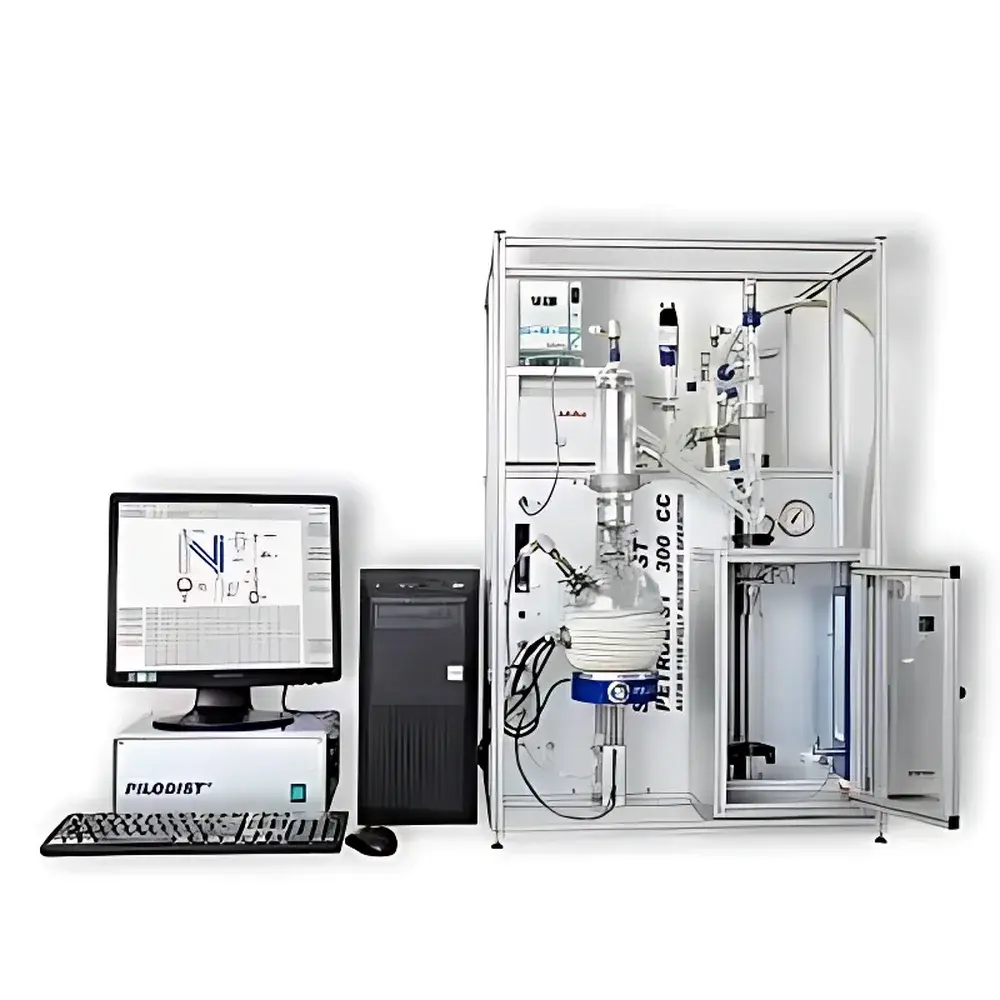
PILODIST PD300CC Automated Vacuum Distillation Apparatus
| Brand | PILODIST |
|---|---|
| Origin | Germany |
| Model | PD300CC |
| Max. Distillation Temperature | 400 °C |
| Temperature Accuracy | ±0.1 °C |
| Cold Bath Temperature Range | 0–25 °C |
| Distillation Rate | 180–360 mL/h |
| Volume Detection Range | 1–200 mL |
| Volume Resolution | 0.1 mL |
| Compliance | ASTM D1160 |
| Control Interface | 15.6″ IP65-rated touchscreen with integrated thermal printer |
| Data Export Formats | PDF, XLS, CSV, TXT |
| Safety | Dual independent heating safety circuits, auto-termination on AET limit, bath temperature limit, flask temperature limit, distillate volume limit, pressure drop, or flask fracture detection |
| Optional Accessory | 4-position automated fraction collector |
Overview
The PILODIST PD300CC Automated Vacuum Distillation Apparatus is an engineered solution for precise, reproducible vacuum distillation of petroleum fractions in accordance with ASTM D1160 (“Standard Test Method for Distillation of Petroleum Products at Reduced Pressure”). Designed and manufactured in Germany, the system employs a controlled vacuum environment combined with high-stability temperature regulation to determine boiling point distributions of high-boiling hydrocarbon streams—including lubricating oils, residual fuels, and heavy feedstocks—without thermal degradation. The apparatus operates via a closed-loop vacuum control system that maintains setpoint pressure stability throughout the distillation run, while its dual-zone heating architecture ensures uniform thermal input to the distillation flask and vapor path. All operational parameters—including initial and final cut points, pressure ramp profiles, and condensate collection criteria—are defined prior to initiation and executed without manual intervention. The system’s core measurement principle relies on real-time volumetric tracking of condensed distillate coupled with simultaneous temperature monitoring at the vapor line (ASTM-defined “vapor temperature”) and receiver bath, enabling accurate atmospheric equivalent temperature (AET) calculation per ASTM D1160 Annex A1.
Key Features
- Full ASTM D1160 compliance with automated pressure ramping, AET calculation, and endpoint determination based on user-defined criteria (e.g., maximum AET, flask temperature limit, or distillate volume threshold)
- Integrated 15.6″ industrial-grade IP65 touchscreen interface with intuitive menu navigation and on-board thermal printer for immediate report generation
- Self-calibrating volumetric measurement system with 0.1 mL resolution and 1–200 mL dynamic range, eliminating operator-dependent meniscus reading errors
- Dual independent safety circuits for flask heating—each independently monitored for overtemperature and open-circuit failure—ensuring robust process containment
- Automated post-run cleaning cycle with solvent-compatible fluid pathways, minimizing cross-contamination between samples
- Grease-free mechanical design throughout the vapor path and condenser assembly, preventing sample adulteration and extending maintenance intervals
- Modular architecture supporting optional 4-position automated fraction collector for discrete cut collection aligned with refinery cut-point specifications
Sample Compatibility & Compliance
The PD300CC is validated for use with crude oil fractions, vacuum gas oils, deasphalted oils, and other non-polar, thermally sensitive petroleum products exhibiting boiling points up to 400 °C under atmospheric conditions. Its vacuum control system accommodates absolute pressures from 0.1 kPa to 10 kPa, allowing flexibility across low- and high-vacuum distillation protocols. The apparatus meets essential requirements for GLP-compliant laboratories: all method parameters, raw sensor data (temperature, pressure, volume, time), and calculated results are timestamped and stored locally on the embedded PC with full audit trail capability. Data files are generated in vendor-neutral formats (PDF, XLS, CSV, TXT) to support integration into LIMS environments and satisfy regulatory documentation requirements under ISO/IEC 17025 and FDA 21 CFR Part 11 when deployed with appropriate IT validation controls.
Software & Data Management
Control and data acquisition are managed by PILODIST’s proprietary PetroDist software, running on an embedded Windows-based industrial PC. The software provides real-time visualization of vapor temperature, cold bath temperature, system pressure, and cumulative distillate volume. All distillation curves—including volume % vs. AET—are computed in accordance with ASTM D1160 Annex A1 algorithms and rendered dynamically during the run. Post-analysis, users may reprocess historical runs using updated density inputs or alternative AET correction models. Raw data logs include millisecond-resolution timestamps for each sensor channel, facilitating root-cause analysis of anomalous events. Exported reports contain full metadata: operator ID, sample ID, method version, instrument serial number, calibration status flags, and digital signatures where enabled.
Applications
- Determination of boiling point distribution for vacuum gas oils (VGO) in refinery process optimization
- Characterization of thermal stability and volatility of base oil stocks per API 1509 and ASTM D2500
- Quality control of heavy fuel oils and marine distillates per ISO 8217 Annex B
- Supporting development of FCC and hydrocracking feed assays through cut-point correlation
- Research-scale isolation of narrow-boiling fractions for compositional analysis (e.g., GC×GC, SARA)
- Verification of vacuum distillation performance against reference materials traceable to NIST SRMs
FAQ
Does the PD300CC support multi-step pressure programming during a single distillation run?
Yes—the system allows up to three discrete pressure segments per run, enabling optimized separation of complex mixtures with varying volatility profiles.
How is atmospheric equivalent temperature (AET) calculated in real time?
AET is computed continuously using the ASTM D1160-approved naphtha correction equation, incorporating measured vapor temperature, system pressure, and user-input density of the receiving medium.
Can distillation data be exported directly to a laboratory information management system (LIMS)?
Yes—via network share or USB export, all reports and raw data files (XLS, CSV) are structured for automated ingestion into common LIMS platforms without proprietary middleware.
What maintenance is required between analyses?
Beyond routine cleaning of the condenser and receiver, no daily calibration is needed; the volumetric system performs automatic zero-checks before each run, and temperature sensors are factory-traceable to DIN EN ISO/IEC 17025.
Is the 4-position fraction collector compatible with all PD300CC configurations?
Yes—it integrates seamlessly via standardized I/O ports and is fully coordinated with the main controller for synchronized cut timing based on volume, temperature, or time thresholds.