
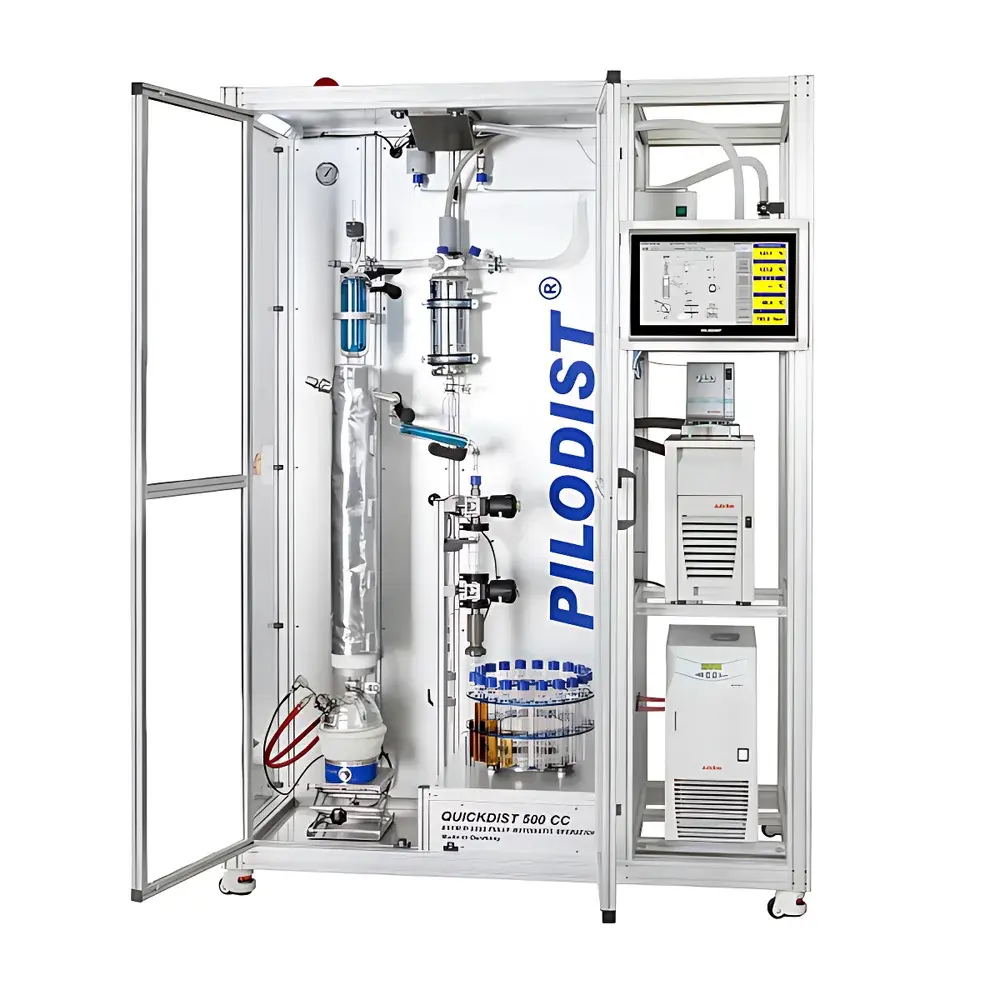
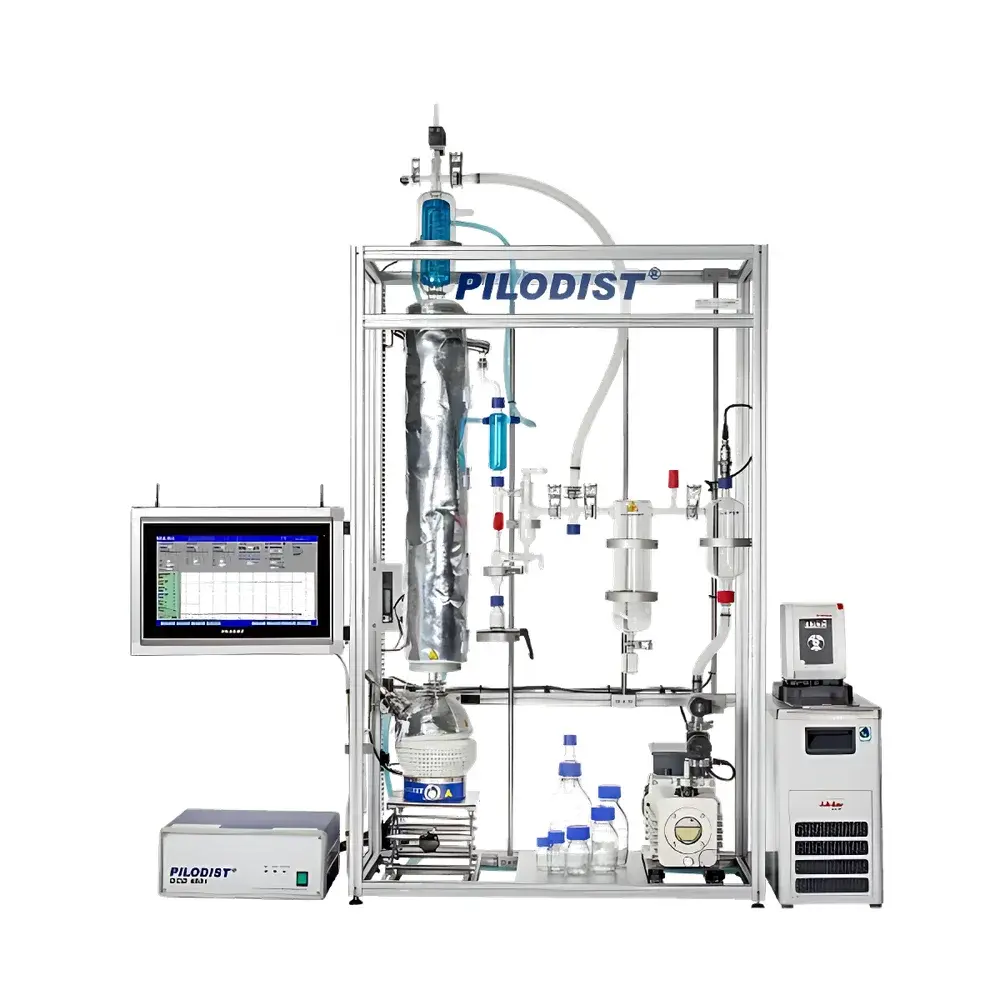
Pilodist QUICKDIST 500 CC and QUICKDIST 500M Miniature Multifunctional Distillation System
| Brand | Pilodist |
|---|---|
| Origin | Germany |
| Model | QUICKDIST 500 CC, QUICKDIST 500M |
| Operating Temperature (Flask) | Up to 350°C |
| Final Boiling Point (AET) | Up to 420°C |
| Operating Pressure | Atmospheric to <1 mbar (vacuum) |
| Theoretical Plates | Up to 60 |
| Flask Volumes | 100 mL, 500 mL, 1 L, 2 L |
| Feed Capacity | Up to 60% of flask volume |
Overview
The Pilodist QUICKDIST 500 CC and QUICKDIST 500M are miniature, modular distillation systems engineered for precise, scalable batch fractional distillation of multicomponent liquid mixtures in research, quality control, and process development laboratories. Based on classical equilibrium-stage separation principles—specifically continuous vapor–liquid equilibrium (VLE) establishment within structured or packed columns—these systems replicate industrial-scale fractionation behavior at laboratory scale while maintaining high thermal and pressure control fidelity. Designed to meet the procedural rigor of ASTM D2892 (“Standard Test Method for Distillation of Crude Petroleum (15-Theoretical-Plate Column)”), the QUICKDIST 500 platforms support both atmospheric and controlled vacuum operation (<1 mbar), enabling accurate simulation of refinery unit operations such as crude assay, hydrotreater feed characterization, and renewable feedstock deoxygenation studies. Their compact footprint and configurable architecture make them suitable for environments where space, sample economy, and operational flexibility are critical—particularly in petroleum R&D, catalysis screening, pharmaceutical intermediate purification, and specialty fragrance isolation.
Key Features
- Modular column configuration supporting up to 60 theoretical plates via interchangeable structured packings, sieve trays, or random packing options—enabling optimization for volatility distribution, azeotrope resolution, or heat-sensitive compound recovery.
- High-precision temperature control: flask heating up to 350°C with ±0.5°C stability; final boiling point (AET) detection up to 420°C using calibrated Pt100 sensors and dynamic endpoint algorithms.
- Vacuum-compatible design with integrated pressure regulation and digital readout (0.1–1000 mbar range), facilitating low-boiling component separation and thermal degradation mitigation.
- Flexible feed handling: compatible with 100 mL, 500 mL, 1 L, and 2 L round-bottom flasks; maximum feed volume set at 60% of flask capacity to ensure consistent reflux dynamics and avoid flooding.
- Integrated safety architecture including overtemperature cutoff, pressure relief valves, condenser flow monitoring, and emergency shutdown protocols compliant with IEC 61010-1 for laboratory equipment.
- Dual-platform versatility: QUICKDIST 500 CC supports semi-automated operation with manual fraction collection and programmable heating ramps; QUICKDIST 500M adds full automation—including motorized fraction collector, real-time composition tracking via optional integrated GC interface, and remote protocol execution.
Sample Compatibility & Compliance
The QUICKDIST 500 series accommodates a broad spectrum of feedstocks, including crude oils, vacuum gas oils, bio-oils from pyrolysis or hydrothermal liquefaction, catalytic cracking fractions, essential oil extracts, and active pharmaceutical ingredients (APIs). All wetted parts are constructed from borosilicate glass (DIN ISO 3585) and PTFE-sealed joints; metal-free configurations (e.g., quartz condensers, ceramic heaters) are available upon request for semiconductor-grade solvent purification or ultra-trace metal analysis. The system conforms to ASTM D2892, D1078 (distillation range), and ISO 3405 (petroleum products—determination of distillation characteristics), and supports GLP-compliant workflows through audit-trail-enabled software (see Software & Data Management). Vacuum components meet ISO 2859-1 sampling standards for leak integrity verification.
Software & Data Management
QUICKDIST 500M is operated via the proprietary Pilodist Control Suite—a Windows-based application supporting method creation, real-time parameter logging (temperature, pressure, time, fraction weight), and automated report generation in PDF/CSV formats. The software implements electronic signatures, user role management (admin/operator/auditor), and full 21 CFR Part 11 compliance—including immutable audit trails, data encryption at rest, and backup-integrated redundancy. Raw sensor data is timestamped with microsecond precision and synchronized across all subsystems (heating, condensation, collection, vacuum). Optional integration with LIMS platforms (via ASTM E1384-compliant XML export) enables traceability from raw sample ID to final distillate cut specification.
Applications
- Petroleum refining: Crude assay, cut-point determination (IBP, FBP, T10–T90), and simulated distillation correlation for FCC feed evaluation.
- Renewable fuels R&D: Fractionation of fast pyrolysis bio-oils to isolate phenolic monomers, levoglucosan, or hydrocarbon precursors under reduced pressure.
- Catalyst testing: In situ assessment of catalyst selectivity and deactivation kinetics by monitoring distillate composition shifts across reaction time.
- Pharmaceutical & fine chemical synthesis: Isolation of thermolabile APIs or chiral intermediates without racemization or decomposition.
- Flavor & fragrance industry: High-resolution separation of terpene isomers (e.g., limonene, pinene) and oxygenated derivatives from steam-distilled botanical extracts.
- Materials science: Purification of high-purity solvents (e.g., anhydrous THF, DMF) for thin-film deposition or nanoparticle synthesis under inert, metal-free conditions.
FAQ
What ASTM standards does the QUICKDIST 500 support?
It is validated for ASTM D2892 (crude distillation), D1078 (volatility), and D86 (distillation of petroleum products), with column efficiency and temperature calibration traceable to NIST-certified references.
Can the system operate under inert atmosphere?
Yes—optional nitrogen purge ports and sealed glovebox-compatible interfaces are available for oxygen-sensitive or moisture-reactive samples.
Is method transfer possible between QUICKDIST 500 and larger-scale pilot units?
The system’s dimensionless scaling parameters (Reynolds, Froude, and HETP-based correlations) enable predictive scale-up to commercial columns per API RP 932-B guidelines.
How is column efficiency verified?
Efficiency is determined experimentally using standard test mixtures (e.g., n-heptane/toluene/xylene) and calculated via the Fenske–Underwood–Gilliland method; certified calibration reports accompany each column configuration.
Does Pilodist provide validation documentation for regulated environments?
Yes—IQ/OQ/PQ protocols, 3Q documentation packages, and GMP-aligned maintenance logs are supplied with each system shipment.





