
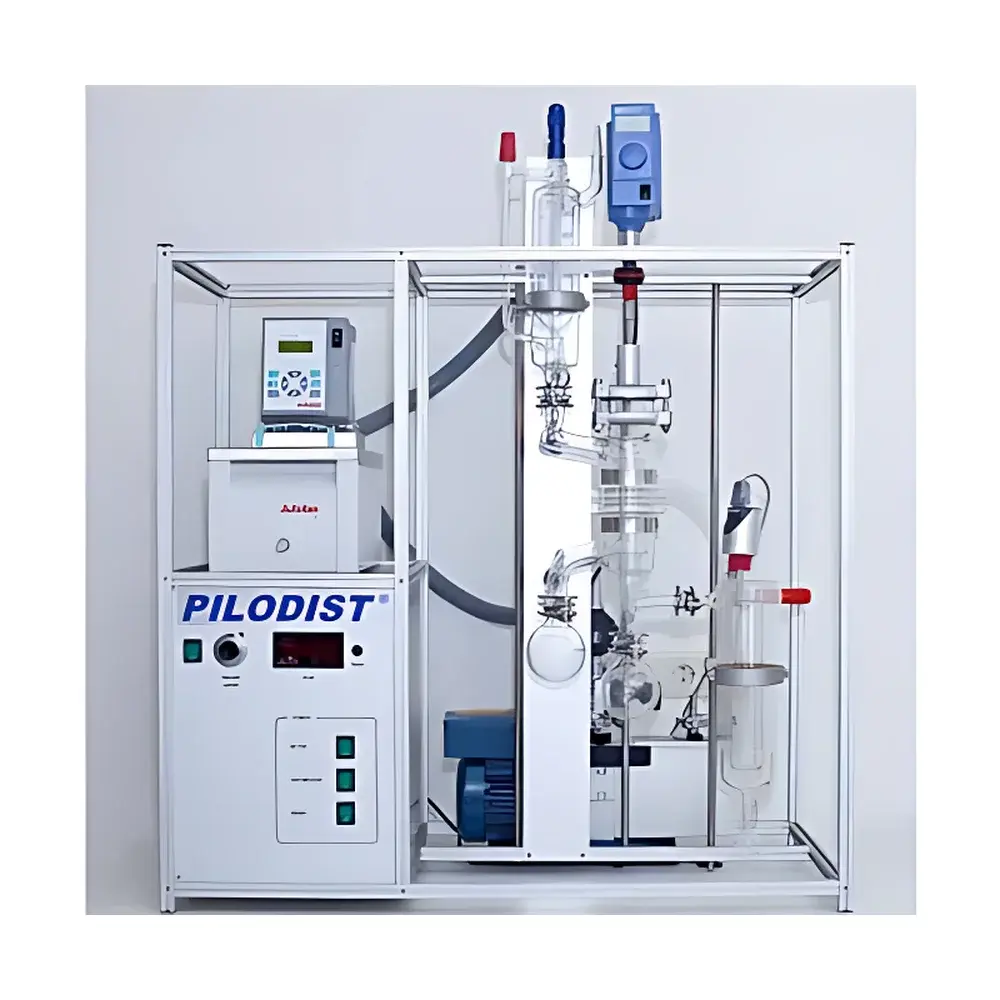
Pilodist SP200 Molecular Distillation System
| Brand | Pilodist |
|---|---|
| Origin | Germany |
| Model | SP200 |
| Vacuum Range | 1–0.001 mbar |
| Temperature Control Accuracy | ±0.01 °C |
| Construction Options | All-Glass or Glass-Metal Hybrid |
| Evaporator Type | Double-Jacketed Glass Rotating Film Evaporator |
| Condenser | Integrated Helical Coil Internal Condenser |
| Display | LED Digital Readouts for Film Speed, Vacuum Pressure, and Temperature |
| Application Scope | Lab-Scale & Pilot-Scale Molecular Distillation of Thermolabile, High-Boiling, High-Viscosity, or High-Molecular-Weight Organic Compounds |
| Compliance | Designed to Support ASTM D2892 / D5236, ISO 9145, and GLP/GMP-aligned documentation workflows |
Overview
The Pilodist SP200 Molecular Distillation System is a precision-engineered laboratory-scale apparatus designed for the gentle, high-efficiency separation of thermally sensitive, high-molecular-weight, or highly viscous organic compounds. Operating under ultra-high vacuum (1–0.001 mbar), the SP200 leverages short-path molecular distillation principles—where mean free path exceeds the distance between evaporator and condenser surfaces—to enable selective volatilization without thermal degradation. Unlike conventional fractional distillation, molecular distillation relies on differences in molecular weight and vapor pressure at sub-atmospheric conditions, making it indispensable for isolating labile actives (e.g., polyunsaturated fatty acids, natural antioxidants, pharmaceutical intermediates), purifying silicone oils, recovering heat-sensitive fragrances, or refining bio-based lubricants. The system’s core architecture centers on a double-jacketed rotating glass evaporator with precisely controlled conductive oil heating, ensuring uniform thermal distribution and real-time visual monitoring of film formation, phase behavior, and component segregation.
Key Features
- Double-jacketed borosilicate glass evaporator with 360° optical visibility—enables direct observation of thin-film dynamics, color evolution, and phase separation during operation.
- High-precision temperature regulation via circulating thermostatic oil bath; stability maintained within ±0.01 °C across the full operating range (room temperature to 250 °C).
- Integrated helical coil internal condenser fabricated from stainless steel and cooled by recirculating chiller fluid—optimized for high condensation efficiency (>95% recovery) of low-volatility fractions.
- Digital LED interface displaying real-time values for vacuum pressure (mbar), rotational speed (rpm), feed rate (mL/min), and jacket temperature—supports traceable parameter logging.
- Modular construction available in all-glass or glass-metal hybrid configurations to balance chemical inertness, mechanical robustness, and compatibility with aggressive solvents or corrosive feedstocks.
- Compact footprint and CE-compliant electrical architecture—designed for integration into ISO 17025-accredited laboratories and pilot development suites requiring audit-ready instrumentation.
Sample Compatibility & Compliance
The SP200 accommodates a broad spectrum of challenging feed materials including triglyceride-rich fish oil concentrates, polymerized rosin esters, crude tocopherol mixtures, hydrogenated vegetable waxes, and synthetic ester base stocks. Its all-glass pathway eliminates catalytic surface interactions, preserving sample integrity for regulatory submissions. The system supports method development aligned with ASTM D2892 (petroleum fractionation), ASTM D5236 (high-boiling petroleum products), and ISO 9145 (molecular distillation of edible oils). Vacuum control and temperature recording meet data integrity requirements for GLP environments; optional analog/digital signal outputs facilitate integration with LIMS or 21 CFR Part 11–compliant electronic lab notebooks.
Software & Data Management
While the SP200 operates as a stand-alone instrument with embedded digital controls, its analog voltage outputs (0–10 V) for vacuum, temperature, and rotation allow seamless connection to external DAQ systems or SCADA platforms. Users may configure automated data capture using third-party software (e.g., LabVIEW, MATLAB, or custom Python scripts) to generate time-stamped CSV logs compliant with internal QA protocols. Optional RS-485 communication enables remote parameter adjustment and alarm triggering—critical for unattended overnight runs during process optimization studies.
Applications
- Purification of omega-3 EPA/DHA ethyl esters from fish oil hydrolysates while minimizing cis-trans isomerization.
- Deodorization and decolorization of natural vitamin E (mixed tocopherols) without oxidative loss.
- Recovery of phytosterols from tall oil pitch under non-oxidizing conditions.
- Refining of silicone fluids to remove cyclic oligomers per ISO 11448 specifications.
- Scale-down validation of industrial wiped-film evaporators used in API manufacturing.
- Thermal stability assessment of bio-lubricant additives prior to formulation screening.
FAQ
What vacuum level is required to achieve true molecular distillation conditions?
True molecular distillation requires operating pressures below 0.1 mbar—typically 0.001–0.01 mbar—to ensure mean free path exceeds the evaporator-to-condenser gap. The SP200 achieves this via dual-stage vacuum pumping (rotary vane + turbomolecular) with integrated Pirani/capacitance manometers.
Can the SP200 handle highly viscous feeds such as polymer melts?
Yes—the rotating wiper design and adjustable film thickness control (via speed and feed rate) enable stable thin-film formation even with feeds up to 50,000 cP at processing temperature.
Is the system compatible with reactive or moisture-sensitive compounds?
All-glass configuration provides full inertness; optional nitrogen purge ports and cold traps support anhydrous, oxygen-free operation.
How does the SP200 support technology transfer to production-scale equipment?
Its scalable geometry, documented residence time distribution, and reproducible heat/mass transfer coefficients serve as foundational data for designing industrial falling-film or centrifugal molecular stills.
Does Pilodist provide application support or method development assistance?
Yes—Pilodist offers remote technical consultation and collaborates with customers on feasibility studies, including feed characterization, parameter mapping, and distillate quality profiling.






