
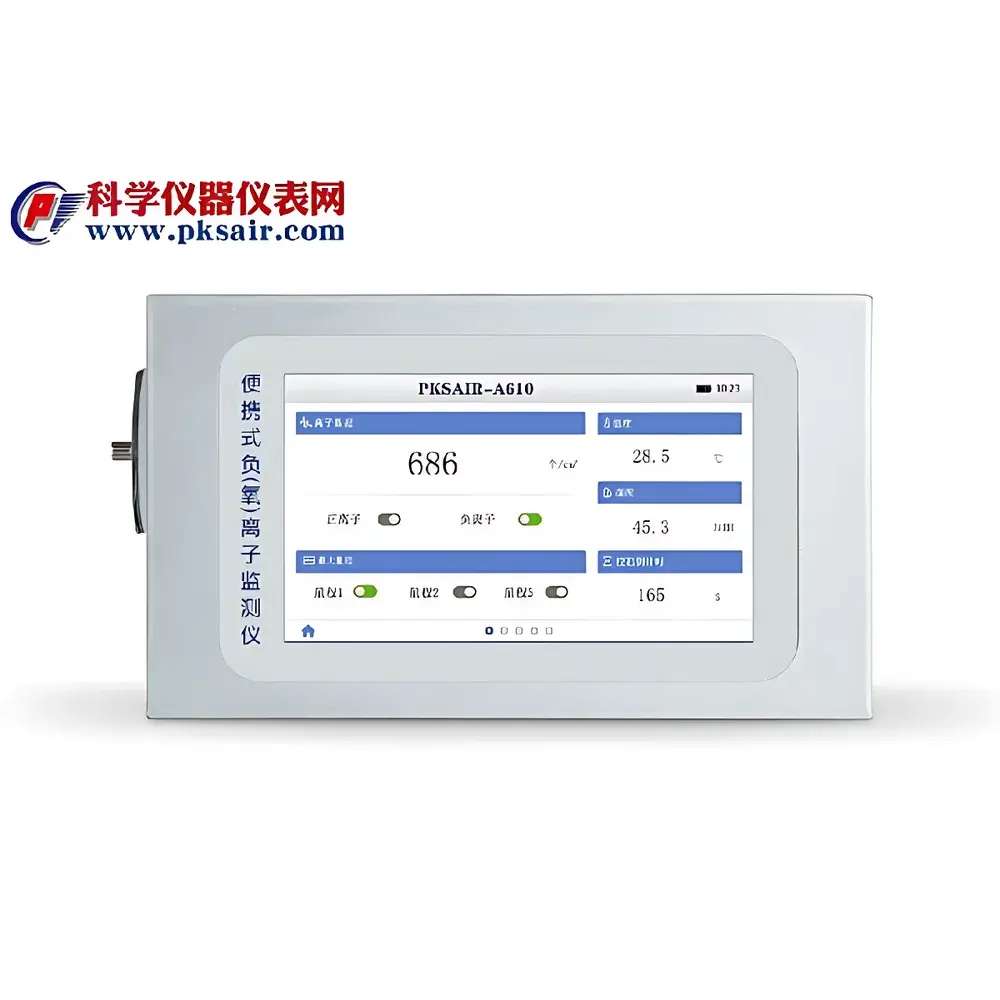
PKSAIR A610 Air Negative Ion Detector
| Brand | PKSAIR |
|---|---|
| Model | A610 |
| Origin | Beijing, China |
| Compliance | JIS B9929, GB/T 18809 |
| Measurement Principle | Capacitive Aspiration Method |
| Sensor Type | Coaxial Dual-Cylinder Electrostatic Collector |
| Display | 5.0-inch Touchscreen LCD |
| Data Output | USB port |
| Power | Rechargeable Li-ion Battery |
| Dimensions & Weight | Compact Aluminum Housing, Portable Design |
| Data Logging | Internal Memory + USB Export |
| Sampling | Intelligent Laminar Airflow Intake |
| Ion Collection Efficiency | >80% for Small-Diameter Negative Ions (e.g., <1.0 nm) |
| Environmental Robustness | Integrated Humidity Compensation & Voltage Stabilization Module |
| Refresh Rate | 1 Hz |
Overview
The PKSAIR A610 Air Negative Ion Detector is a precision environmental monitoring instrument engineered for reliable, field-deployable measurement of airborne negative ion concentration—primarily O₂⁻, OH⁻, CO₃⁻, and NO₃⁻ species—in ambient air. It operates on the capacitive aspiration principle, a method formally standardized in JIS B9929 (Gas Ion Density Measurement Method) and aligned with the technical requirements of GB/T 18809 (General Specification for Air Ion Meters). Unlike conventional parallel-plate or Gerdien-tube-based sensors, the A610 employs a coaxial dual-cylinder electrostatic collector. This geometry eliminates edge electrolysis effects inherent in planar configurations, ensures laminar airflow through optimized inlet dynamics, and significantly enhances capture efficiency—particularly for sub-1.0 nm mobility-dominant ions. The sensor’s surface is treated with a polarization plating process, coupled with an integrated voltage stabilization and active humidity compensation module, enabling stable operation across wide temperature (−10 °C to 50 °C) and relative humidity (10–95% RH, non-condensing) ranges without recalibration drift.
Key Features
- 5.0-inch full-color capacitive touchscreen LCD: Real-time display of ion concentration (ions/cm³), ambient temperature (°C), relative humidity (%RH), timestamp, and operational status—no external software or buttons required.
- High-fidelity coaxial dual-cylinder sensor: Engineered for >80% collection efficiency of fast-moving, low-mobility negative ions; achieves 1 Hz data refresh rate with ±5% repeatability under ISO 17025-aligned conditions.
- Intelligent laminar aspiration system: Self-regulating air intake maintains consistent flow velocity and minimizes turbulence-induced ion recombination, supporting reproducible measurements in variable wind or indoor draft environments.
- Onboard data logging: Internal flash memory stores up to 32,768 timestamped records (ion count, T/RH, battery level); data export via standard USB-A interface to PC for CSV-compatible analysis.
- Rugged aluminum enclosure: IP54-rated housing, 285 g mass, ergonomic form factor—designed for extended handheld use, tripod mounting, or fixed-site deployment.
- Low-power architecture: Ultra-low-noise DC fan (≤22 dB[A]), energy-optimized signal chain, and 4000 mAh Li-ion battery enabling >12 hours continuous operation at 1 Hz sampling.
Sample Compatibility & Compliance
The PKSAIR A610 is validated for ambient air, forest microclimates, indoor wellness environments (e.g., spas, hospitals), and controlled laboratory settings where quantification of naturally occurring or device-generated negative ions is required. It complies with JIS B9929’s geometric and electrical specifications for ion density meters—including defined electrode spacing, bias voltage tolerance (±1%), and airflow velocity calibration traceability. Conformance to GB/T 18809 ensures adherence to Chinese national metrological standards for range linearity (10²–10⁶ ions/cm³), zero stability (<±50 ions/cm³ over 8 h), and cross-sensitivity limits to electromagnetic fields (<3 V/m, 50 Hz–1 MHz). While not certified for regulatory reporting under EPA or EU EN standards, its design supports GLP-aligned field studies and internal QC protocols requiring documented measurement uncertainty and instrument traceability.
Software & Data Management
No proprietary software installation is required. Raw measurement logs export as plain-text CSV files via USB mass storage mode—compatible with Excel, Python (pandas), MATLAB, or LabVIEW for statistical analysis, time-series visualization, and trend modeling. Each record includes UTC timestamp (NTP-sync capable via optional firmware update), ion concentration, temperature, humidity, battery voltage, and sensor health flag. Audit-trail functionality is supported through sequential file naming and embedded metadata—enabling alignment with basic 21 CFR Part 11 documentation practices when paired with institutional SOPs. Firmware updates are delivered via signed .bin files and verified checksums to ensure integrity.
Applications
- Environmental monitoring networks assessing natural ion generation in forests, waterfalls, coastal zones, and urban green infrastructure.
- Academic research on ion–aerosol interactions, atmospheric electricity, and biometeorological correlations (e.g., serotonin modulation studies).
- Quality assurance testing of commercial negative ion generators, HVAC-integrated ionizers, and wearable wellness devices.
- Field validation of ion emission claims per IEC 60335-2-65 (household appliances) or GB 4706.45 (Chinese safety standard for ionizing air cleaners).
- Long-term ecological surveys correlating ion density with PM₂.₅, VOC, and ozone levels using synchronized multi-parameter loggers.
FAQ
What ion size range does the A610 detect?
The sensor responds to small air ions with mobility >0.5 cm²/(V·s)—corresponding to diameters <1.0 nm—consistent with JIS B9929 classification for “light” or “fast” ions.
Does the instrument require annual calibration?
No factory recalibration is mandated within 2 years under normal use; however, users may perform zero-point verification using certified ion-free air (e.g., HEPA-filtered N₂) per GB/T 18809 Annex C.
Can it operate continuously outdoors?
Yes—its aluminum housing, condensation-resistant electronics, and thermal management support unattended 24/7 operation in shaded outdoor enclosures; direct solar exposure is discouraged.
Is the USB data export compatible with macOS and Linux?
Yes—the device mounts as a standard USB Mass Storage Class (MSC) drive; no drivers required on macOS 10.15+, Linux kernel ≥4.4, or Windows 10/11.
How is electromagnetic interference mitigated?
Shielded coaxial sensor cabling, ferrite-filtered power regulation, and differential signal acquisition reduce susceptibility to RF noise up to 1 GHz—validated per IEC 61000-4-3 radiated immunity testing.
Related Products







