
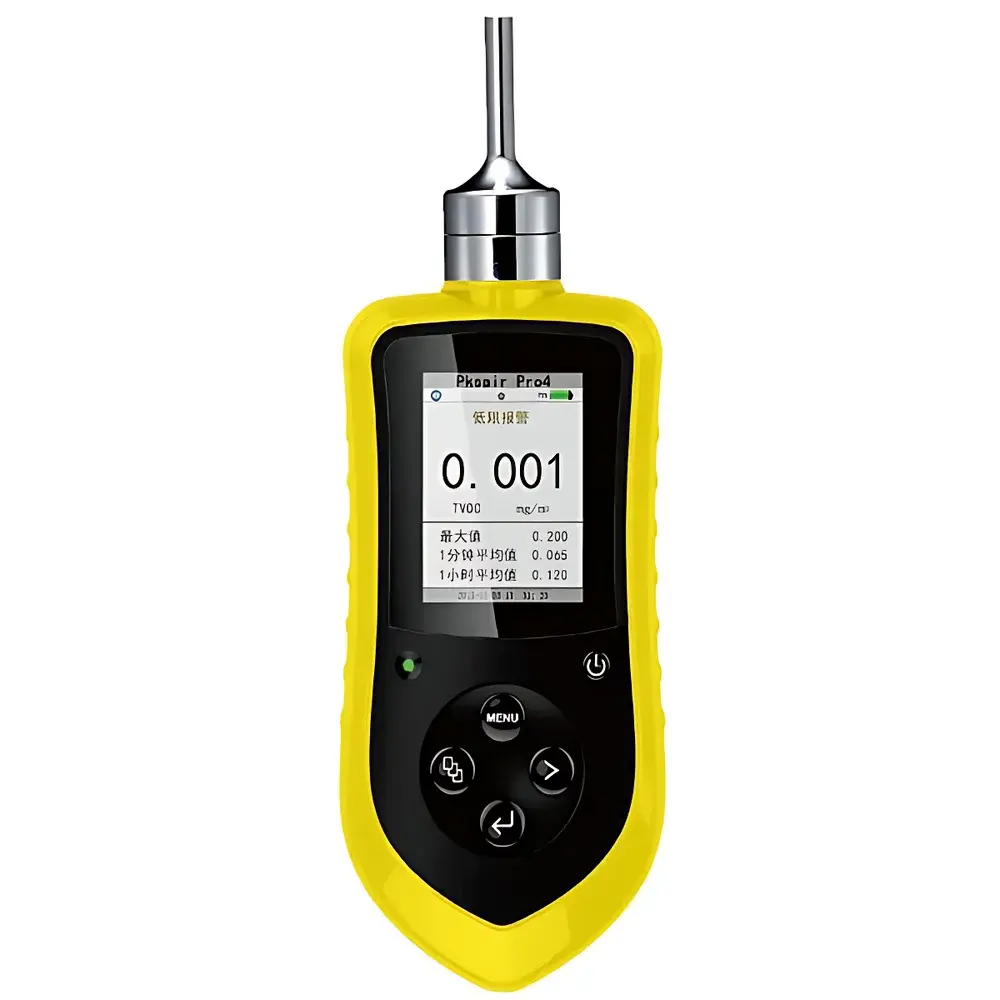
PKSAIR C4 Portable VOC Detector with Photoionization Detector (PID)
| Brand | PKSAIR |
|---|---|
| Origin | Beijing, China |
| Manufacturer Type | Authorized Distributor |
| Country of Manufacture | China |
| Model | PKSAIR-C4 (PID) |
| Detection Principle | Photoionization Detection (PID) |
| Instrument Type | Portable |
| Typical Configuration | Total VOC (TVOC) Analyzer |
| Measurement Range | 0–10,000 ppb (0–10.00 ppm / mg/m³) |
| Resolution | 0.001 ppm (mg/m³) |
| Accuracy | ≤ ±3% of reading |
| Response Time | ≤ 30 s (T90) |
| Display | 2.4″ color TFT LCD (320 × 240 px) |
| Operating Temperature | −20 °C to +50 °C |
| Operating Humidity | ≤ 95% RH (non-condensing) |
| Ingress Protection | IP65 |
| Explosion Protection | Ex ib IIC T4 Gb |
| Power Supply | Rechargeable 2800 mAh Li-polymer battery (≈20 h continuous operation) |
| Data Storage | Up to 100,000 records (optional) |
| Sampling Method | Integrated Thomas® micro-vacuum pump (300–500 mL/min) |
| Microprocessor | 32-bit nanoscale MCU + 24-bit high-precision ADC |
| Environmental Compliance | GB 50493-2009, GB 12358-2006, GBZ 2.1-2007, GB 3836.1/4-2010 |
Overview
The PKSAIR C4 is a portable, intrinsically safe volatile organic compounds (VOC) detector engineered for real-time, field-deployable quantification of total VOCs in ambient air and occupational environments. It employs a high-sensitivity photoionization detector (PID) sensor—sourced from a leading international OEM manufacturer—to ionize VOC molecules using ultraviolet (UV) photons (typically 10.6 eV lamp), generating a current proportional to analyte concentration. This principle enables broad-spectrum detection of aromatic hydrocarbons, ketones, aldehydes, amines, and other photoionizable compounds without consumables or chemical reagents. Designed for rapid response and stable baseline performance, the PKSAIR C4 meets rigorous requirements for industrial hygiene monitoring, confined space entry verification, leak detection, and emergency response. Its compact form factor, integrated Thomas® micro-vacuum pump, and robust mechanical architecture support reliable operation across diverse environmental conditions—from sub-zero outdoor surveys to high-humidity indoor facilities.
Key Features
- Intrinsically safe circuit design certified to Ex ib IIC T4 Gb per GB 3836.1 and GB 3836.4-2010, suitable for use in Zone 1 hazardous areas.
- High-fidelity PID sensor with factory-calibrated linear response, ≤ ±2% linearity error, and ≤ ±1% full-scale zero drift per year.
- Integrated Thomas® miniature vacuum pump delivering consistent 300–500 mL/min sampling flow, minimizing aspiration delay and enhancing T90 response stability.
- 32-bit nanoscale microcontroller paired with 24-bit analog-to-digital converter ensures high-resolution signal acquisition and low-noise data processing.
- 2.4-inch high-definition color TFT display (320 × 240 px) with dual-language (English/Chinese) interface, real-time concentration readout, status icons, and configurable alarm prompts.
- Full-range temperature and humidity compensation algorithms applied in firmware to maintain measurement fidelity across −20 °C to +50 °C and ≤95% RH (non-condensing).
- Multi-layer hardware protection: anti-clogging pump safeguards, overvoltage suppression, ESD shielding, electromagnetic interference (EMI) filtering, and overload current limiting.
- On-device configuration of dual-level alarms (high/low), zero calibration, pump activation, and audible/visual alert thresholds via intuitive cross-key navigation.
Sample Compatibility & Compliance
The PKSAIR C4 is optimized for direct analysis of gaseous-phase VOCs in ambient air, workplace breathing zones, stack emissions, and indoor environments. It detects compounds with ionization energies below 10.6 eV—including benzene, toluene, xylene (BTX), styrene, acetone, isopropanol, formaldehyde (at elevated concentrations), and many chlorinated solvents. While not compound-specific, its calibrated response to isobutylene enables traceable TVOC quantification referenced to ISO 16000-29 and ASTM D5197. The instrument complies with Chinese national standards for gas detection instrumentation: GB 50493-2009 (petrochemical site design), GB 12358-2006 (general technical requirements), and GBZ 2.1-2007 (occupational exposure limits). Its intrinsic safety certification aligns with international best practices for deployment in potentially explosive atmospheres, supporting GLP-aligned field documentation when used with timestamped data logging.
Software & Data Management
Data integrity and traceability are maintained through embedded non-volatile memory supporting up to 100,000 timestamped records—including concentration values, alarm events, power-on/off logs, calibration timestamps, and fault diagnostics. All stored entries include date/time stamps, sensor status flags, and environmental metadata (temperature/humidity). Data export is performed via Micro-USB connection using vendor-provided PC software compatible with Windows OS, enabling direct export to CSV or Excel-compatible formats for post-processing, statistical analysis, and graphical reporting. The firmware implements audit-trail-capable event logging, satisfying documentation requirements under GB/T 19022-2003 (measurement management systems) and facilitating internal quality audits. Optional firmware updates are delivered via signed binary packages to ensure system integrity.
Applications
- Occupational health and safety: Real-time personal exposure monitoring during maintenance, painting, cleaning, or solvent-handling tasks.
- Environmental site assessment: Soil vapor intrusion screening, landfill perimeter monitoring, and remediation verification.
- Indoor air quality (IAQ) evaluation: Post-construction off-gassing surveys, HVAC duct contamination checks, and office building commissioning.
- Industrial process safety: Leak detection in chemical transfer lines, reactor vent monitoring, and fugitive emission surveys per LDAR protocols.
- Emergency response: Rapid hazard identification during chemical spills, fire aftermath assessments, or illicit lab investigations.
- Academic and regulatory research: Field validation of fixed-site monitors, method development for VOC speciation correlation studies, and teaching laboratory demonstrations.
FAQ
What VOC compounds does the PKSAIR C4 detect?
It responds to photoionizable VOCs with ionization potentials below 10.6 eV, including aromatics, alkenes, aldehydes, ketones, and many halogenated organics. Sensitivity varies by compound; isobutylene is used as the primary calibration standard.
Is the device suitable for use in explosive atmospheres?
Yes—it carries Ex ib IIC T4 Gb intrinsic safety certification per GB 3836.1/4-2010, permitting deployment in Zone 1 hazardous locations where flammable gases may be present.
How is sensor calibration performed?
Zero calibration is conducted in clean ambient air; span calibration uses certified isobutylene gas at known concentration (e.g., 100 ppm). Both procedures are accessible via on-device menu and require no external tools.
Does the instrument support data export for regulatory reporting?
Yes—stored records include ISO 8601 timestamps and can be exported to Excel for inclusion in OSHA 1910.120, EPA Method TO-15, or local environmental agency submissions.
What is the expected service life of the PID lamp and sensor?
Under normal operating conditions, the UV lamp maintains >85% output intensity for ≥6,000 hours; the electrochemical sensor demonstrates ≥24 months functional stability with periodic bump testing and calibration.
Related Products







