
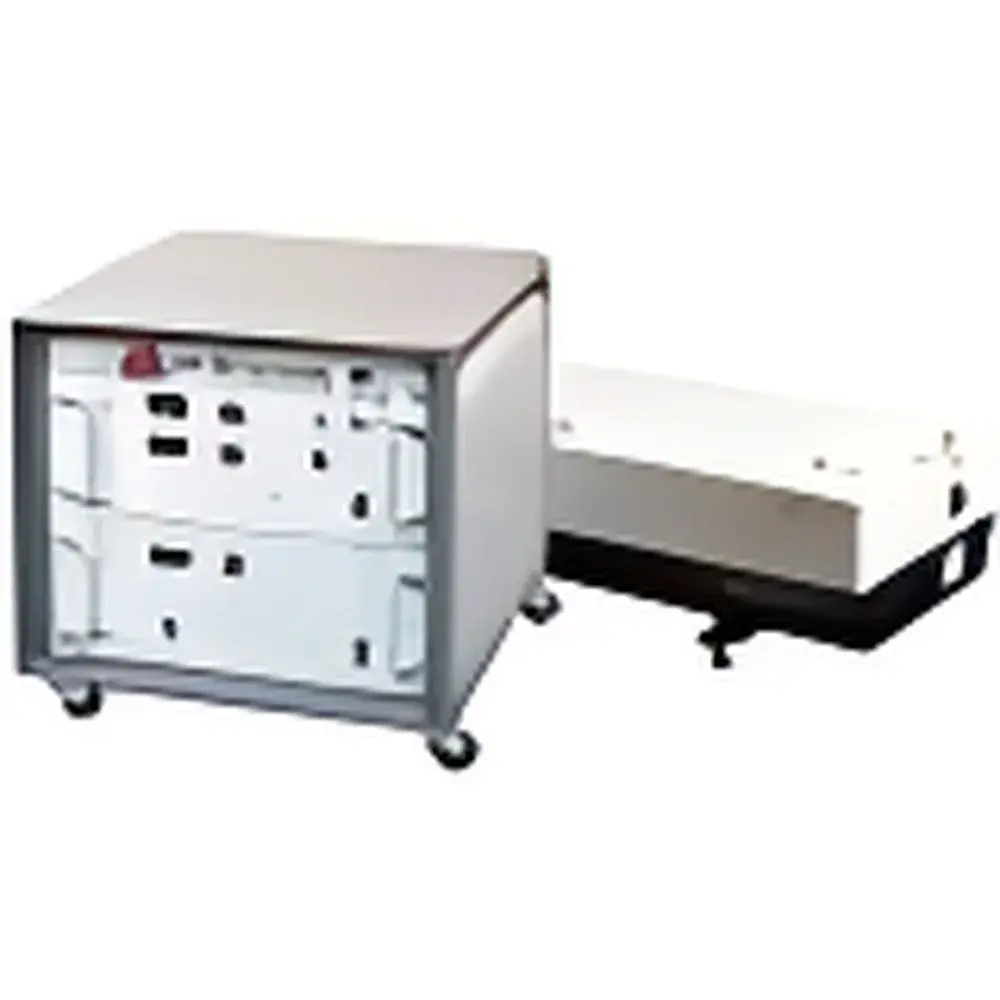
PL2241 Series High-Energy Picosecond Mode-Locked Nd:YAG Laser
| Brand | Ekspla |
|---|---|
| Origin | Lithuania |
| Manufacturer Type | Authorized Distributor |
| Product Category | Imported |
| Model | PL2241 |
| Core Configuration | Diode-Pumped Solid-State (DPSS) Master Oscillator + Flashlamp-Pumped Regenerative Amplifier |
| Pulse Energy | Up to 100 mJ @ 1064 nm |
| Pulse Duration | <30 ps (<25 ps optional) |
| Repetition Rate | Up to 250 Hz |
| Beam Pointing Stability | <5 µrad RMS over 8 hours |
| Harmonic Generation | Second (532 nm), Third (355 nm), Fourth (266 nm) via thermostabilized KD*P/KDP crystals |
| Trigger Jitter | <0.1 ns (optical sync output) |
| Control Interface | RS-232 with included LabVIEW drivers + standalone backlit keypad |
Overview
The PL2241 Series is a high-energy, diode-pumped solid-state (DPSS) picosecond laser system engineered for demanding time-resolved spectroscopy, nonlinear optics, and pump-probe experiments. At its core lies a hermetically sealed monolithic DPSS master oscillator operating in passive mode-locking regime, delivering sub-30 ps pulses at 1064 nm with exceptional temporal stability and low amplitude noise. This oscillator seeds a flashlamp-pumped regenerative amplifier stage, enabling scalable pulse energy up to 100 mJ while preserving near-diffraction-limited beam quality (M² < 1.3) and minimal wavefront distortion (<λ/8 PV). The system’s architecture eliminates mechanical drift-sensitive alignment points—critical for long-duration experiments under laboratory or industrial metrology conditions. Designed and manufactured in Lithuania by Ekspla, the PL2241 complies with IEC 60825-1:2014 Class 4 laser safety requirements and integrates fully with ISO/IEC 17025-compliant calibration workflows for traceable energy measurement.
Key Features
- Hermetically sealed monolithic DPSS oscillator ensures long-term temporal and spatial stability without active realignment.
- Regenerative amplifier architecture enables hands-free operation with automatic cavity dumping synchronization and thermal load management.
- Optimized multi-pass power amplifier with intra-cavity polarization rotation maximizes energy extraction efficiency from the Nd:YAG rod while maintaining Gaussian beam profile fidelity.
- Thermostabilized harmonic generation modules (KD*P and KDP) housed in precision oven-controlled mounts deliver stable second (532 nm), third (355 nm), and fourth (266 nm) harmonics with spectral purity >99.5% (measured via calibrated spectroradiometer).
- Integrated energy monitoring system provides real-time pulse-to-pulse energy readout with ±1.5% linearity across full dynamic range; data accessible via remote keypad display or LabVIEW interface.
- Low-jitter optical sync output (<0.1 ns RMS jitter) supports synchronization with streak cameras, ICCD detectors, and ultrafast oscilloscopes compliant with IEEE 1149.1 timing standards.
Sample Compatibility & Compliance
The PL2241 is compatible with standard optical tables, vacuum chambers (via optional beam port feedthroughs), and cryogenic sample stages (down to 4 K). Its beam delivery meets ANSI Z136.1-2022 alignment and divergence specifications (full angle < 0.8 mrad). Harmonic outputs are certified for use in UV photoelectron spectroscopy (UPS), time-of-flight mass spectrometry (TOF-MS), and laser-induced breakdown spectroscopy (LIBS) applications requiring stable, narrowband excitation. The system conforms to CE marking directives (2014/30/EU EMC, 2014/35/EU LVD), RoHS 2011/65/EU, and supports GLP/GMP audit trails when operated with validated LabVIEW control scripts (21 CFR Part 11–compliant logging optional upon configuration).
Software & Data Management
Ekspla-supplied LabVIEW drivers (v2020 SP1 or later) provide full API-level access to all operational parameters—including repetition rate, harmonic selection, Q-switch delay, and energy threshold limits. Software implements configurable safety interlocks: automatic lasing inhibition triggers when pulse energy exceeds user-defined thresholds, accompanied by audible alert and on-screen notification. All energy monitor logs are timestamped and exportable in CSV or HDF5 format for integration into LIMS or MATLAB-based analysis pipelines. Remote keypad firmware supports firmware-over-the-air (FOTA) updates via RS-232 handshake protocol, ensuring backward compatibility with legacy control systems.
Applications
- Pump-probe transient absorption spectroscopy requiring precise inter-pulse delay control and high signal-to-noise ratio.
- Multi-photon ionization and Coulomb explosion imaging in molecular dynamics studies.
- High-harmonic generation (HHG) seeding in attosecond science setups.
- Laser ablation inductively coupled plasma mass spectrometry (LA-ICP-MS) with reduced thermal fractionation.
- Calibration of ultrafast photodetectors and autocorrelators per ISO 11554 Annex D protocols.
- Nonlinear frequency conversion validation in optical parametric amplifiers (OPAs) and difference-frequency generation (DFG) systems.
FAQ
What is the typical warm-up time required to achieve specified pulse energy stability?
The system reaches thermal equilibrium within 45 minutes after cold start, with pulse energy drift <±0.3% over subsequent 8-hour operation.
Can the PL2241 be integrated into a cleanroom environment (ISO Class 5)?
Yes—optional HEPA-filtered air purge kit and non-outgassing housing materials (316L stainless steel, fused silica optics) are available for Class 5 compliance.
Is third-harmonic output available simultaneously with fundamental wavelength?
No—harmonic selection is mutually exclusive via motorized crystal translation; simultaneous outputs require external beam splitting and independent harmonic separation.
Does the LabVIEW driver support automated energy calibration against NIST-traceable pyroelectric sensors?
Yes—the driver includes built-in routines for two-point calibration using user-supplied reference sensor data, generating correction coefficients stored in non-volatile memory.
What maintenance schedule is recommended for flashlamp replacement and cavity mirror inspection?
Flashlamps are rated for ≥1×10⁶ shots at 250 Hz; scheduled inspection of HR/OC mirrors is advised every 500 hours of cumulative operation, documented per ISO/IEC 17025 clause 7.7.



