
PM-11z Plant Physiology & Ecology Monitoring System
| Origin | Israel |
|---|---|
| Type | Imported Instrument |
| Manufacturer Role | Authorized Distributor |
| Model | PM-11z |
| Pricing | Available Upon Request |
Overview
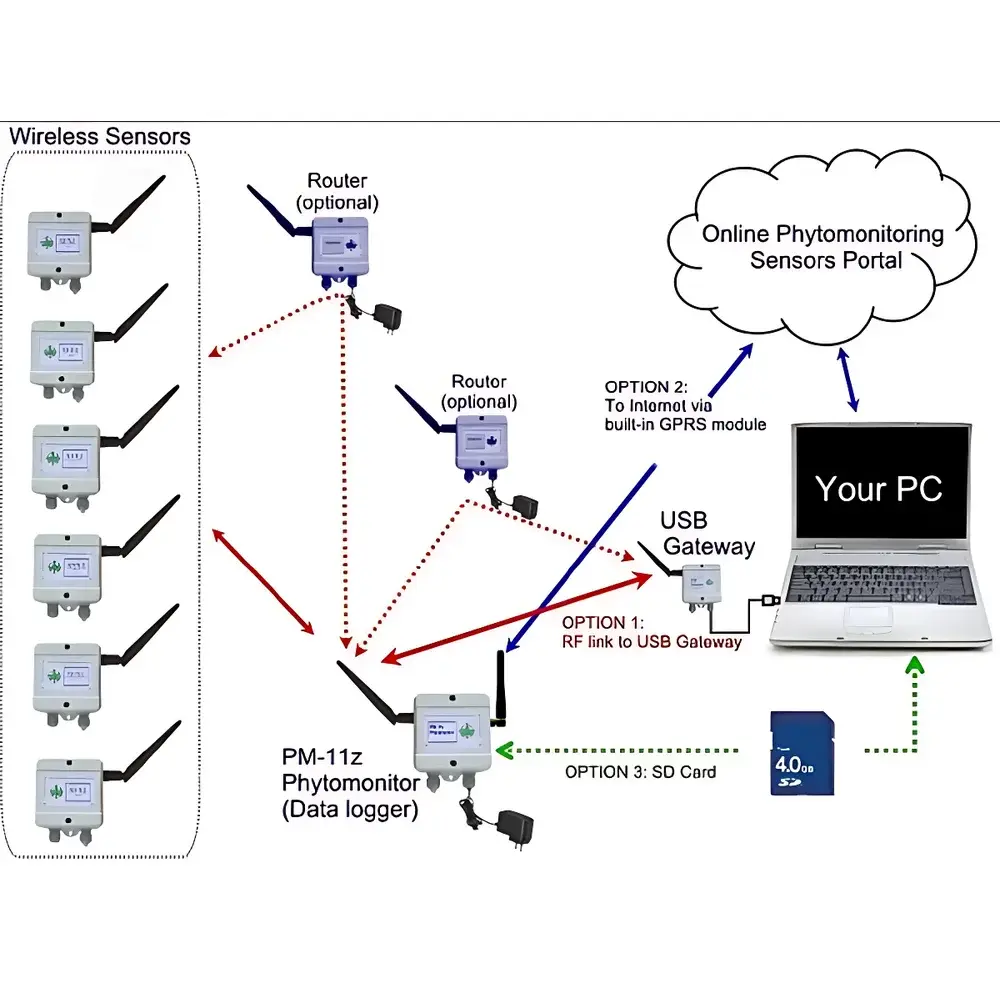
The PM-11z Plant Physiology & Ecology Monitoring System is a field-deployable, wireless data acquisition platform engineered for long-term, high-temporal-resolution monitoring of plant physiological responses and concurrent environmental drivers. It operates on a distributed sensor architecture grounded in low-power RF (2.4 GHz) communication, with optional GPRS-based remote data transmission—enabling continuous, unattended operation across remote or infrastructure-limited field sites. The system captures dynamic biophysical processes—including stem flow, leaf temperature, fruit expansion, canopy microclimate, and soil hydric-thermal-electrical properties—using calibrated, application-specific transducers. Its design aligns with ecological physiology research protocols requiring minimal disturbance, high reproducibility, and traceable measurement chains. Data integrity is maintained through onboard SD card logging, timestamped sensor metadata, and configurable sampling intervals (1 min to 24 h), supporting longitudinal studies compliant with FAO, IPCC, and ICRAF field methodology guidelines.
Key Features
- Modular wireless sensor network: Up to 15 standalone sensors per USB transmitter; scalable via RF repeater units for extended coverage (up to 4 km line-of-sight)
- Low-power operation: AA battery-powered sensors (3× AA per unit), delivering ~6 months of continuous operation at 15-min sampling intervals
- Dual-mode connectivity: Integrated 2.4 GHz RF module for local mesh networking + embedded GPRS modem (SIM card required) for cellular telemetry
- Onboard data resilience: PM-11z host unit includes internal SD card storage with automatic rollover and time-synchronized logging
- Solar-ready architecture: Compatible with external solar charging kits (panel, charge controller, deep-cycle battery) for multi-year deployments
- Configurable sampling logic: Sensor-specific trigger thresholds, burst logging, and event-driven acquisition supported via Windows-based configuration software
Sample Compatibility & Compliance
The PM-11z accommodates a broad spectrum of botanical morphologies and measurement scales—from herbaceous stems (5–25 mm diameter) to mature tree trunks (>60 mm), and from small fruits (7 mm) to large melons (160 mm). Sensor calibration follows ISO/IEC 17025 traceability principles where applicable; factory calibration certificates are supplied for all volumetric soil moisture (SMS-5z), combined soil parameter (SMTE-z), and radiation (PIR-1z, TIR-4z) modules. Environmental operating ranges meet IP67 ingress protection for outdoor deployment. The system supports GLP-aligned data governance: all logged entries include UTC timestamps, sensor IDs, firmware versions, and battery voltage diagnostics—enabling audit trails required under USDA ARS, EFSA, and EU Horizon research grant reporting frameworks.
Software & Data Management
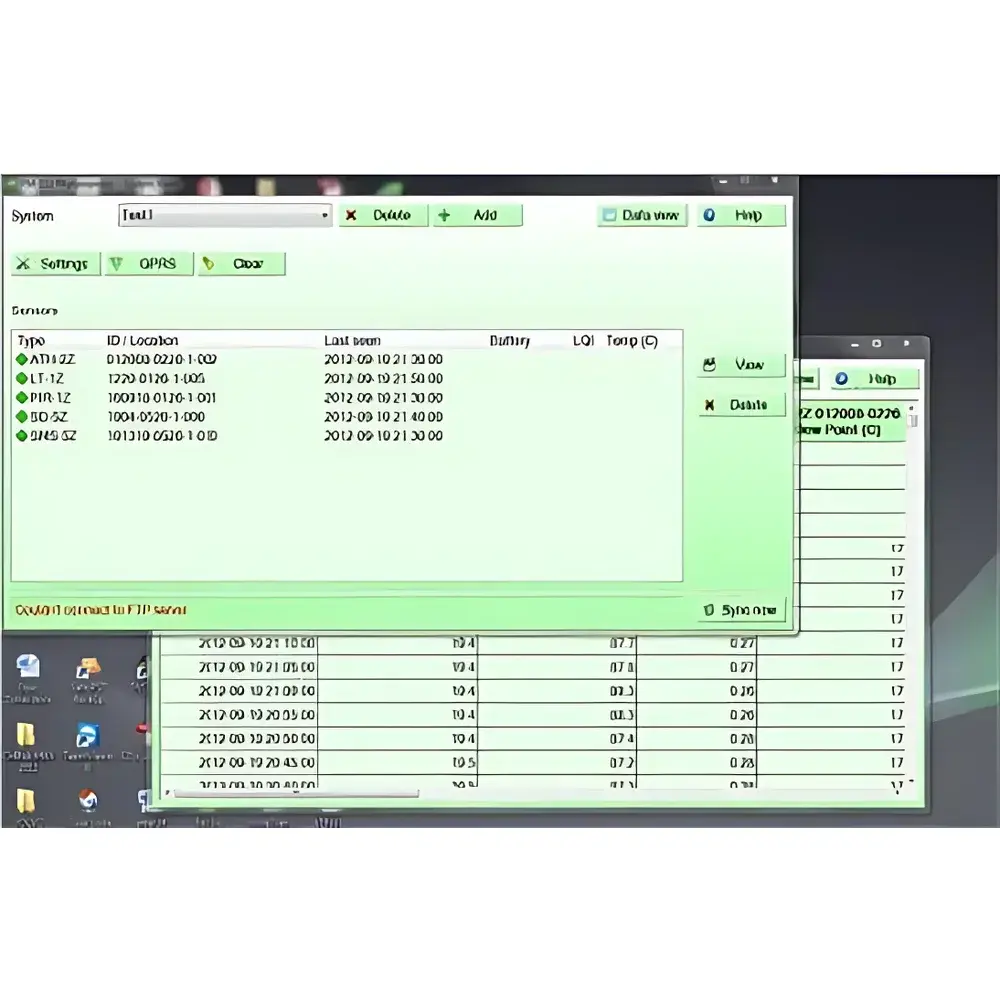
The proprietary Windows desktop application provides full system control, real-time sensor status visualization, and hierarchical data export. Users configure acquisition schedules, define alarm thresholds (e.g., stem shrinkage >0.1 mm/h), and manage firmware updates over USB or GPRS. Raw datasets export natively to CSV or Excel (.xlsx) with column headers adhering to CF Metadata Conventions v1.8. Time-series plots support overlay of multiple parameters (e.g., sap flow vs. PAR vs. VPD) with linear interpolation and gap-filling options. All exported files retain embedded metadata (sensor model, calibration date, location coordinates), facilitating integration into R, Python (Pandas), or MATLAB workflows. Audit logs record user actions (configuration changes, manual uploads, file exports) to satisfy 21 CFR Part 11 electronic record requirements when deployed in regulated agronomic trials.
Applications
- Plant water relations research: Continuous sap flow quantification using Granier-type thermal dissipation probes integrated via SD-5z/SD-6z/DE-1z sensors
- Climate-smart agriculture: Correlating diurnal stem growth dynamics with soil moisture depletion (SMS-5z), root-zone EC (SMTE-z), and atmospheric demand (ATH-2z/ATH-3z)
- Controlled-environment phenotyping: High-resolution fruit expansion kinetics (FI-Lz/FI-Mz/FI-Sz) under elevated CO₂ or heat-stress treatments
- Ecosystem flux modeling: Coupling leaf temperature (LT-1z/LT-IRz), canopy PAR (PIR-1z), and net radiation (TIR-4z) to parameterize Penman-Monteith and Jarvis-type stomatal conductance models
- Long-term ecological monitoring: Multi-sensor arrays deployed across elevation gradients or land-use transitions to track phenological shifts and drought resilience indicators
FAQ
What is the maximum number of sensors supported in a single network?
A base configuration supports up to 15 wireless sensors communicating directly with one USB transmitter. Adding an RF repeater extends capacity to 30+ sensors by relaying data through intermediate nodes.
Are calibration certificates provided with each sensor?
Yes—factory calibration reports (including reference standards used, uncertainty budgets, and date of verification) are supplied with all radiation, temperature, humidity, and soil parameter sensors.
Can the system operate without GPRS connectivity?
Absolutely. All sensors store data locally (up to 7,200 readings per unit); the USB transmitter retrieves historical data during periodic physical visits, eliminating dependency on cellular coverage.
Is the software compatible with macOS or Linux?
The native configuration and visualization software runs exclusively on Windows (10/11, 64-bit). However, exported CSV/Excel files are fully interoperable with cross-platform analysis tools.
How is sensor accuracy validated in-field?
Users may perform in-situ verification using NIST-traceable references—for example, comparing LT-1z output against calibrated infrared thermometers or validating SMS-5z readings against gravimetric soil moisture samples per ASTM D4959.




