
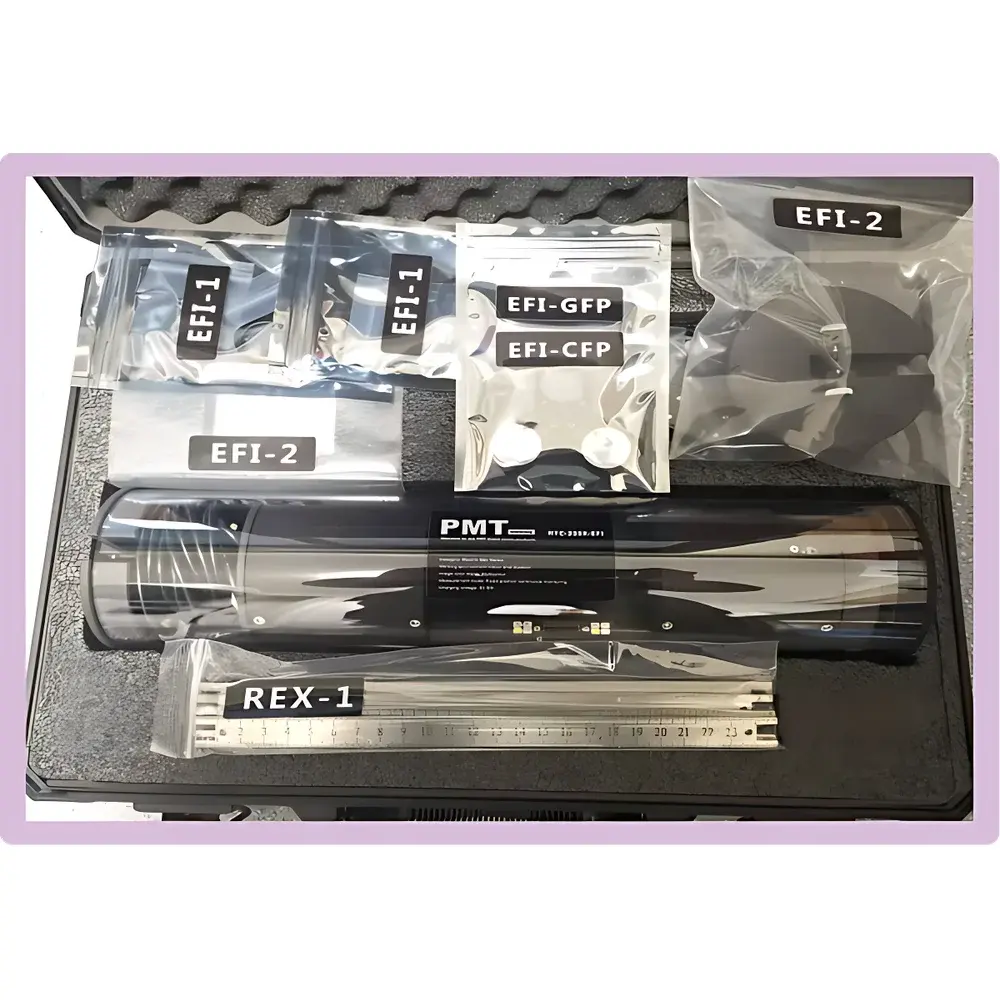
PM-Tech RTC-200X-EFI Mobile In-Situ Rhizosphere Fluorescence Imaging System (High-End Configuration)
| Brand | PM-Tech |
|---|---|
| Origin | Germany |
| Model | RTC-200X-EFI (High-End Configuration) |
| Camera | Dual 5-MP starlight-grade ultra-wide dynamic digital color cameras |
| Fluorescence Excitation Sources | Independently adjustable intensity for CFP, GFP, RFP, and YFP excitation |
| Light Control | Software-programmable dimming (≤1% intensity resolution |
| Illumination Modes | Automatic switching among white light, red light, green light, UV, and fluorescence-specific excitation |
| Operating Environment | −10 °C to +60 °C |
| Power Supply | USB-powered from laptop, external battery, or AC adapter |
| Image Color Mode | Full-color |
| Data Interface | USB 3.0 |
| Calibration Handle | 2-m tethered scale bar with engraved graduations for depth/rotation-controlled positioning |
| Data Storage | Local storage on host laptop or tablet |
| Imaging Modality | 定点 and time-series in-situ monitoring via minirhizotron tube insertion |
| Root Analysis Software | Pregizer, Topology, and Custom topological mapping modes |
| Morphometric Outputs | Horizontal/vertical biomass (mean, median, SD), root length estimation, distribution density profiles |
| Single-Root Metrics | Length, weighted mean width & angular orientation, width/angle SD, surface area, projected area |
| Directional Profile Analysis | Width, angle, surface area, projected area, and volume trends along root axis |
| Visualization | Line, bar, scatter, and area plots |
| Metadata Management | Timestamp, geotag, event annotation, and descriptive notes per image |
| Correction Tools | Region-of-interest boxing, zoom-assisted inspection, rubber-erase refinement, contamination masking, and adaptive noise suppression |
| Calibration | Semi-automatic XY-scale calibration with follow-zoom measurement aid |
| Language Support | English, Simplified Chinese, Traditional Chinese |
| Integrated Sensors | Onboard 12-bit temperature sensor (−50 °C to +85 °C) |
Overview
The PM-Tech RTC-200X-EFI is a field-deployable, in-situ rhizosphere imaging platform engineered for high-fidelity, non-destructive visualization and quantitative analysis of plant root systems within intact soil matrices. Unlike destructive excavation or static lab-based imaging, this system leverages minirhizotron methodology—inserting transparent acrylic tubes into the soil profile—to enable longitudinal observation of root architecture, phenology, and physiological status over time. Its dual-camera optical architecture supports simultaneous brightfield and modulated fluorescence imaging, permitting differentiation between viable and senescent roots via UV-induced autofluorescence and exogenous fluorophore tagging (CFP/GFP/RFP/YFP). The system’s core measurement principle relies on spatially resolved, spectrally selective excitation and emission capture under controlled illumination conditions, minimizing ambient interference through hardware-synchronized modulation and pseudo-color intensity mapping. Designed for ecological resilience studies, drought response profiling, nutrient uptake dynamics, and rhizosphere microbiome spatial mapping, the RTC-200X-EFI delivers traceable, repeatable data compliant with FAO and ISRIC soil monitoring frameworks.
Key Features
- Dual 5-MP starlight-grade CMOS sensors with ultra-wide dynamic range (120 dB), enabling high-contrast imaging under low-light rhizotron conditions without motion blur.
- Modulated fluorescence excitation engine supporting four discrete fluorophore channels (CFP: 433/475 nm; GFP: 470/525 nm; RFP: 550/600 nm; YFP: 500/540 nm), each with independently programmable irradiance (0–100%, 1% resolution).
- Fully software-controlled illumination sequencing—no mechanical dials—ensuring inter-experiment reproducibility and audit-ready parameter logging.
- Integrated environmental sensing: factory-calibrated 12-bit temperature probe (±0.2 °C accuracy) and capacitive water immersion detector triggering automatic shutdown to prevent electrical damage.
- USB 3.0 interface with real-time streaming capability; compatible with Windows 10/11, macOS 12+, and Linux kernel 5.10+ via vendor-provided SDK.
- 2-meter tethered calibration handle with dual-axis engraved scale (mm precision), allowing precise depth registration and rotational alignment relative to root growth direction.
Sample Compatibility & Compliance
The RTC-200X-EFI is validated for use with standard 60-mm-diameter minirhizotron tubes (supplied: ten 1-m acrylic tubes, ASTM D5103-compliant optical clarity). It accommodates root systems from herbaceous crops (e.g., maize, wheat, Arabidopsis), woody perennials (e.g., poplar, grapevine), and model legumes (e.g., Medicago truncatula). All optical components meet IEC 61000-6-3 EMC standards; UV sources comply with EN 62471 photobiological safety classification (Risk Group 1). Firmware and analysis software support ALCOA+ data integrity principles—full electronic audit trail, user authentication, and immutable raw image hashing. Export configurations adhere to ISO/IEC 17025:2017 clause 7.7 (data control) and are compatible with GLP-compliant laboratory information management systems (LIMS).
Software & Data Management
The bundled RhizoScan Suite comprises two modules: RhizoGrab (acquisition) and RhizoAnalyze (quantification). RhizoGrab provides real-time preview, exposure bracketing, batch timestamping, and georeferenced metadata embedding (WGS84). RhizoAnalyze implements three topological algorithms—Pregizer (skeleton-based branching), Topology (graph-theoretic node-edge modeling), and Custom (user-defined adjacency rules)—to reconstruct root networks from segmented binary masks. Color-space analysis employs both RHS (Red-Hue-Saturation) and UCL (Uniform Color Lab) transforms for robust discrimination of fluorescence intensity gradients across heterogeneous soil backgrounds. All measurements undergo XY-pixel calibration correction using the integrated scale bar; results export as CSV, HDF5, or MAT files with embedded units and uncertainty annotations. The software satisfies FDA 21 CFR Part 11 requirements for electronic records and signatures when deployed with validated IT infrastructure.
Applications
- Long-term root phenotyping under abiotic stress (drought, salinity, heavy metal exposure) with temporal resolution down to 24-hour intervals.
- Rhizosphere microbiome spatial profiling via fluorescent in situ hybridization (FISH) or reporter-strain imaging, correlating microbial hotspots with root exudation zones.
- Evaluation of mycorrhizal colonization patterns and arbuscule density using GFP-tagged fungal strains.
- Quantification of root turnover rates, mortality indices, and lateral root initiation frequency in crop breeding programs.
- Validation of root architectural models (e.g., CRootBox, OpenSimRoot) against empirically derived morphometric datasets.
- Soil structure-root interaction studies, including biopore formation, crack propagation, and aggregate stabilization metrics.
FAQ
What minirhizotron tube specifications are required for optimal imaging?
The system is calibrated for 60-mm outer diameter, 4-mm wall thickness acrylic tubes meeting ASTM D5103 optical transmission standards (≥92% at 400–700 nm). Custom tube lengths up to 2 m are supported with optional extension kits.
Can the system operate autonomously without a laptop in the field?
No—the RTC-200X-EFI requires continuous USB host connection for power delivery, real-time image streaming, and software control. Field deployment necessitates a ruggedized laptop or tablet with ≥8 GB RAM and SSD storage.
Is fluorescence quantification calibrated against reference standards?
Yes—each excitation channel includes NIST-traceable fluorescence reference slides (e.g., Chroma Technology FES-01 series) for daily intensity normalization. Software enforces linear response validation prior to acquisition.
How does the system handle soil particle interference during image segmentation?
RhizoAnalyze applies adaptive local thresholding combined with morphological filtering and spectral unmixing to suppress mineral reflectance artifacts. Users may define custom soil mask regions for iterative background subtraction.
Does the software support batch processing of time-series datasets?
Yes—time-lapse workflows allow automated alignment (feature-based SIFT registration), differential root growth mapping, and delta-parameter generation (e.g., Δlength, Δbiomass) across defined intervals.



