
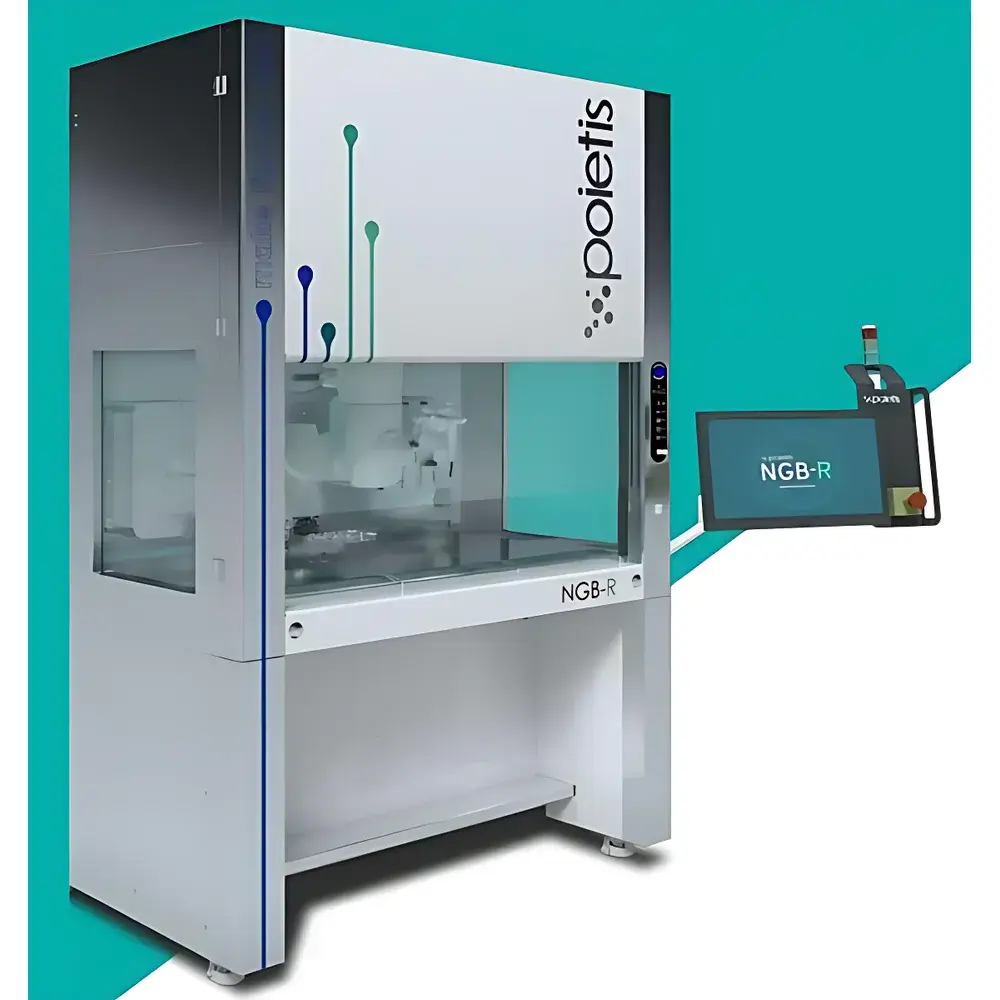
Poietis NGB-R 4D Biological Bioprinter
| Origin | France |
|---|---|
| Manufacturer Type | Authorized Distributor |
| Origin Category | Imported |
| Model | NGB-R |
| Price Range | USD 280,000 – 700,000 |
Overview
The Poietis NGB-R 4D Biological Bioprinter is an advanced, laser-assisted bioprinting platform engineered for high-precision, non-contact deposition of living cells and biomaterials. Unlike conventional extrusion-based or inkjet bioprinters, the NGB-R employs a proprietary digital light processing (DLP)-guided laser-induced forward transfer (LIFT) technique—enabling nozzle-free, picoliter-scale droplet ejection with minimal mechanical shear stress. This physical principle ensures exceptional cell viability (>95%) and sub-100 µm spatial resolution, critical for recapitulating native tissue microarchitecture. The “4D” designation reflects not only three-dimensional structural fidelity but also the temporal dimension: printed constructs are designed to evolve functionally over time—supporting dynamic processes such as cell migration, differentiation, and extracellular matrix remodeling under controlled culture conditions.
Key Features
- Laser-assisted bioprinting (LIFT) technology eliminating nozzle clogging and shear-induced cell damage
- Single-cell to multicellular droplet control: 1–100 cells per droplet at up to 10,000 droplets/second
- Picoliter-level dispensing accuracy: droplet volume down to 100 nL with positional reproducibility ≤ ±5 µm
- Dual-head configuration: supports both standard and temperature-regulated print heads (4–37 °C), compatible with thermosensitive hydrogels (e.g., GelMA, collagen, fibrin)
- Fiber resolution up to 100 µm; capable of generating aligned microfibrous scaffolds mimicking native muscle or neural tissue anisotropy
- Integrated environmental chamber with real-time CO₂, humidity, and temperature monitoring for on-platform post-printing maturation
Sample Compatibility & Compliance
The NGB-R accommodates a broad spectrum of bioinks—including cell-laden hydrogels (e.g., hyaluronic acid, alginate, decellularized extracellular matrix derivatives), acellular viscoelastic matrices, and hybrid synthetic-biopolymer formulations. Its non-contact architecture enables printing of highly viscous (up to 200 Pa·s) or shear-thinning materials without pre-shearing or dilution. The system complies with ISO 13485:2016 for medical device quality management systems and supports GLP-compliant documentation workflows. All hardware and firmware are designed to meet IEC 61000-6-2/6-4 electromagnetic compatibility standards and CE marking requirements for in vitro diagnostic (IVD) research instrumentation.
Software & Data Management
Controlled via Poietis’ proprietary BioCAD™ software suite, the NGB-R provides end-to-end digital workflow integration—from 2D/3D image segmentation (DICOM, TIFF, STL import) to voxel-based path planning and real-time print monitoring. The software includes audit-trail functionality compliant with FDA 21 CFR Part 11 for electronic records and signatures, supporting traceability of print parameters, cell source metadata, and environmental logs. Raw data export is available in HDF5 and CSV formats for downstream analysis in MATLAB, Python (NumPy, SciPy), or commercial biomechanical modeling platforms (e.g., COMSOL Multiphysics). Remote diagnostics and firmware updates are delivered through encrypted TLS-secured channels.
Applications
- Engineering of vascularized microtissues for drug metabolism and toxicity screening (aligned with OECD TG 497 and EMA CHMP guidelines)
- High-fidelity disease models: spatially patterned tumor-stroma interfaces, neurodegenerative organoids with laminated cortical layers
- Regenerative medicine scaffold development: patient-specific osteochondral grafts with zonal biochemical gradients
- Basic mechanobiology studies: controlled modulation of cell-cell and cell-matrix signaling via programmed micro-patterned co-cultures
- Bioprinted biosensors: embedded living reporter cells within hydrogel matrices for real-time metabolite detection
FAQ
What distinguishes laser-assisted bioprinting from extrusion-based methods?
Laser-induced forward transfer eliminates mechanical contact between print head and bioink, avoiding nozzle-induced shear stress and thermal degradation—critical for preserving primary cell functionality and genomic integrity.
Can the NGB-R print multiple cell types simultaneously?
Yes. The system supports multi-material, multi-nozzle (dual-head) operation with independent temperature and pressure control, enabling sequential or interlaced deposition of distinct cell populations and bioinks.
Is the NGB-R suitable for GMP-grade manufacturing?
While primarily validated for R&D and preclinical use, its design incorporates features required for future process validation—including full parameter logging, user-access controls, and change management protocols aligned with ISO 13485 and Annex 11.
What bioink viscosity range is supported?
From low-viscosity aqueous solutions (<1 mPa·s) to highly structured hydrogels (up to 200 Pa·s), including photocrosslinkable, enzymatically triggered, and thermoresponsive formulations.
Does Poietis provide application support and protocol development?
Yes. Authorized distributors offer on-site installation qualification (IQ), operational qualification (OQ), and application-specific method development services—including bioink formulation optimization and tissue maturation protocols.



