
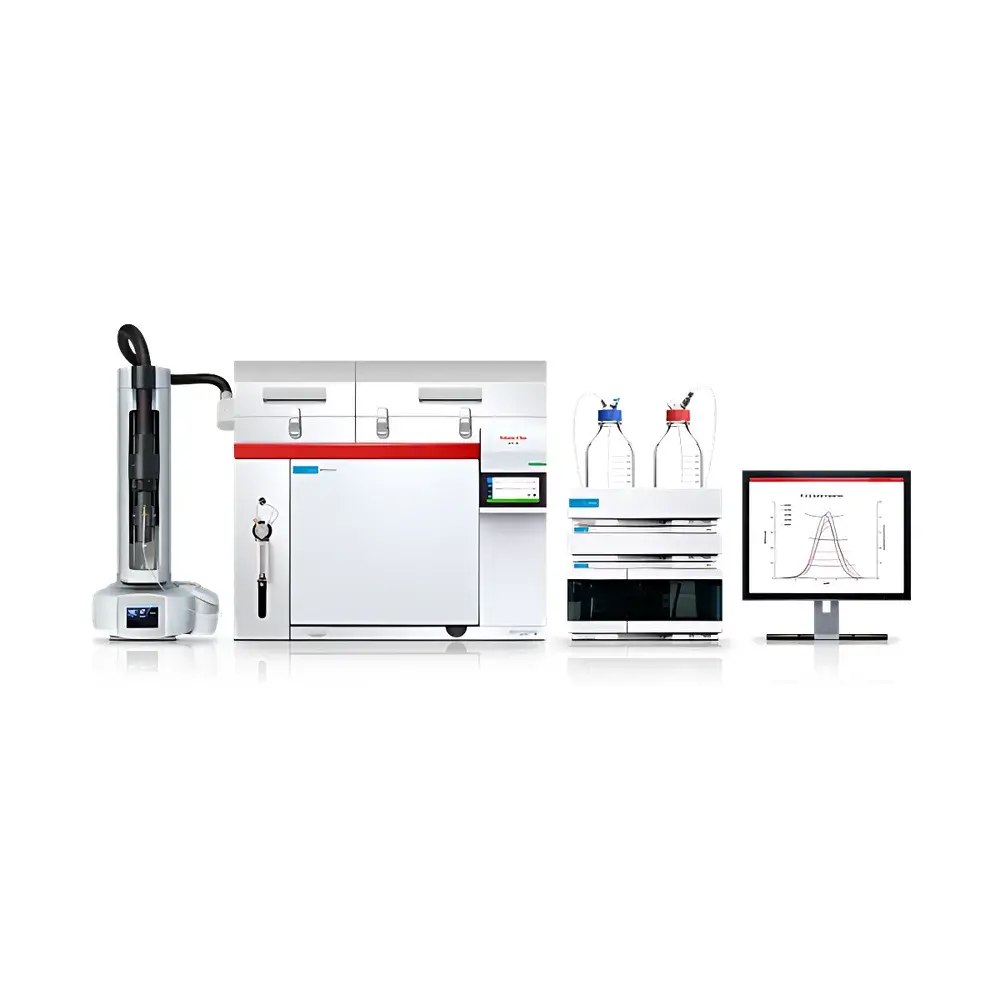
Polymer Char GPC-IR High-Temperature Gel Permeation Chromatograph
| Brand | Polymer Char |
|---|---|
| Origin | Spain |
| Model | GPC-IR |
| Instrument Type | High-Temperature GPC System |
| Pump Flow Range | 1 mL/min |
| Maximum System Pressure | 1000 psi |
| Column Oven Temperature Range | Up to 250 °C |
| Detector Configuration | IR4 or IR5 MCT Infrared Detector (C–H selective) |
| Optional Detectors | Four-Capillary Viscometer, Multi-Angle Light Scattering (MALS), Refractive Index (RI) |
| Automation | 42-position Autosampler with Integrated Sample Dissolution, Online Filtration & Backflush, Nitrogen Deoxygenation, Flow Marker Injection |
| Software | GPC-One (Multi-Detector Synchronization, Real-Time Data Acquisition, Mark–Houwink Analysis, Branching Quantification) |
Overview
The Polymer Char GPC-IR is a high-temperature gel permeation chromatography (HT-GPC) system engineered specifically for the comprehensive molecular characterization of polyolefins—including polyethylene (PE), polypropylene (PP), and ethylene–α-olefin copolymers—under rigorously controlled thermal and oxidative conditions. Unlike conventional ambient- or medium-temperature GPC platforms, the GPC-IR operates at column temperatures up to 250 °C using trichlorobenzene (TCB) or 1,2,4-trichlorobenzene as solvent, enabling full dissolution and stable elution of ultra-high-molecular-weight and highly crystalline polyolefins. Its core analytical capability rests on dual orthogonal detection: infrared absorption (via IR4 or IR5 MCT detector) provides concentration-sensitive, chemically selective quantification of C–H bonds, while optional viscometric and light-scattering detectors deliver absolute molar mass, intrinsic viscosity, and branching architecture data. The system implements Couette-flow-based separation mechanics coupled with precise temperature zoning, minimizing thermal history variability and suppressing shear- and oxidation-induced degradation during dissolution and elution.
Key Features
- Automated 42-position sample handling with integrated dissolution: users weigh solid polymer only; solvent addition, heating, agitation, and online filtration occur unattended under programmable thermal staging (ambient → high-temp zone transfer).
- Dual-zone thermal management: independent column oven (up to 250 °C) and detector/valve compartment minimize thermal cycling during maintenance—extending column lifetime and improving retention time stability.
- IR4 or IR5 MCT infrared detector optimized for C–H stretching band (≈2920 cm⁻¹ and ≈2850 cm⁻¹): baseline drift <0.001 mAU/h; detection limit for CH₃/1000C <1 for HDPE; signal-to-noise ratio ≥60 at 0.125 mg/mL PE in TCB.
- Nitrogen purging module integrated into autosampler and solvent delivery path to suppress oxidative degradation during high-temperature dissolution and analysis.
- Optional flow marker injection system for automated system validation: marker peak appearance confirms complete elution and validates run completion without manual intervention.
- Modular detector compatibility: supports simultaneous RI, viscometry (four-capillary bridge), and MALS—enabling Mark–Houwink plot generation, long-chain branching (LCB) quantification via LCB index (g′), and short-chain branching (SCB) determination via CH₃/1000C calibration.
Sample Compatibility & Compliance
The GPC-IR is validated for analysis of polyolefin resins used in pipe-grade HDPE, rotational molding compounds, metallocene-catalyzed LLDPE, and reactor-grade PP copolymers. It complies with ASTM D6474 (Standard Test Method for Determination of Molecular Weight Distribution of Polyolefins by High-Temperature Gel Permeation Chromatography), ISO 16014-4 (Plastics — Determination of Average Molecular Parameters of Polymers by Size-Exclusion Chromatography — Part 4: Detection by Infrared Spectrometry), and aligns with USP <621> and FDA 21 CFR Part 11 requirements when deployed with GPC-One software configured for audit trail, electronic signatures, and role-based access control. All fluidic pathways are constructed from high-purity stainless steel and PEEK, resistant to TCB at elevated temperatures and compatible with GLP/GMP laboratory environments.
Software & Data Management
GPC-One is a dedicated, Windows-based acquisition and processing platform designed exclusively for multi-detector HT-GPC workflows. It synchronizes real-time signals from IR, RI, viscometer, and MALS detectors with sub-millisecond timestamp resolution. Built-in algorithms perform automatic baseline correction, peak integration, universal calibration (using polystyrene standards), and SCB-specific calibration against reference materials traceable to NIST SRM 1475a. The software generates Mark–Houwink plots, calculates g′ values (ratio of intrinsic viscosity of sample vs. linear reference at same molar mass), and applies SCB correction to isolate LCB contribution. Data files adhere to AIA (.cdf) format for long-term archival and third-party interoperability. Remote monitoring and diagnostic capabilities enable secure SSH-based troubleshooting and firmware updates without physical access.
Applications
- Quantitative short-chain branching (SCB) analysis of HDPE pipe resins: direct CH₃/1000C determination without cryogenic FTIR, eliminating liquid nitrogen dependency and operator variability.
- Differentiation of bimodal HDPE distributions: resolving low-MW and high-MW fractions while simultaneously quantifying SCB content per elution slice.
- Long-chain branching characterization in LLDPE and metallocene PE: combining IR-derived SCB data with viscometric g′ to decouple branching contributions and improve rheological model fidelity.
- Stability assessment of polymer batches under accelerated thermal stress: monitoring molar mass shift and branching profile changes after controlled melt aging.
- QC/QA release testing in polyolefin manufacturing: fully automated, walk-away operation supports ≤30 min/sample throughput with <1.5% RSD in Mw across replicate injections at 0.125–2.0 mg/mL concentrations.
FAQ
What solvents are compatible with the GPC-IR system?
Trichlorobenzene (TCB) is the primary solvent; o-dichlorobenzene (ODCB) may be used with appropriate column and detector validation. All solvent lines are pressure-rated to 1000 psi and temperature-rated to 250 °C.
Can the IR5 MCT detector quantify SCB in ethylene–butene copolymers?
Yes—the IR5’s spectral resolution and low-noise MCT sensor enable selective detection of butyl branch C–H modes at 2960 cm⁻¹, calibrated against certified copolymer standards.
Is column calibration required for absolute molar mass determination?
Universal calibration using narrow-distribution PS standards is standard; absolute molar mass is obtained via MALS coupling, eliminating reliance on column calibration curves.
How does the system prevent thermal degradation during dissolution?
Through staged thermal transfer (samples remain at ambient until programmed entry into heated zone), nitrogen-purged dissolution vials, and controlled orbital shaking—minimizing both thermal soak time and mechanical shear.
Does GPC-One support 21 CFR Part 11 compliance out-of-the-box?
Yes—when installed with validated configuration (audit trail enabled, electronic signature workflow, user access tiers), it meets ALCOA+ data integrity principles and supports regulatory submission-ready reporting.




