
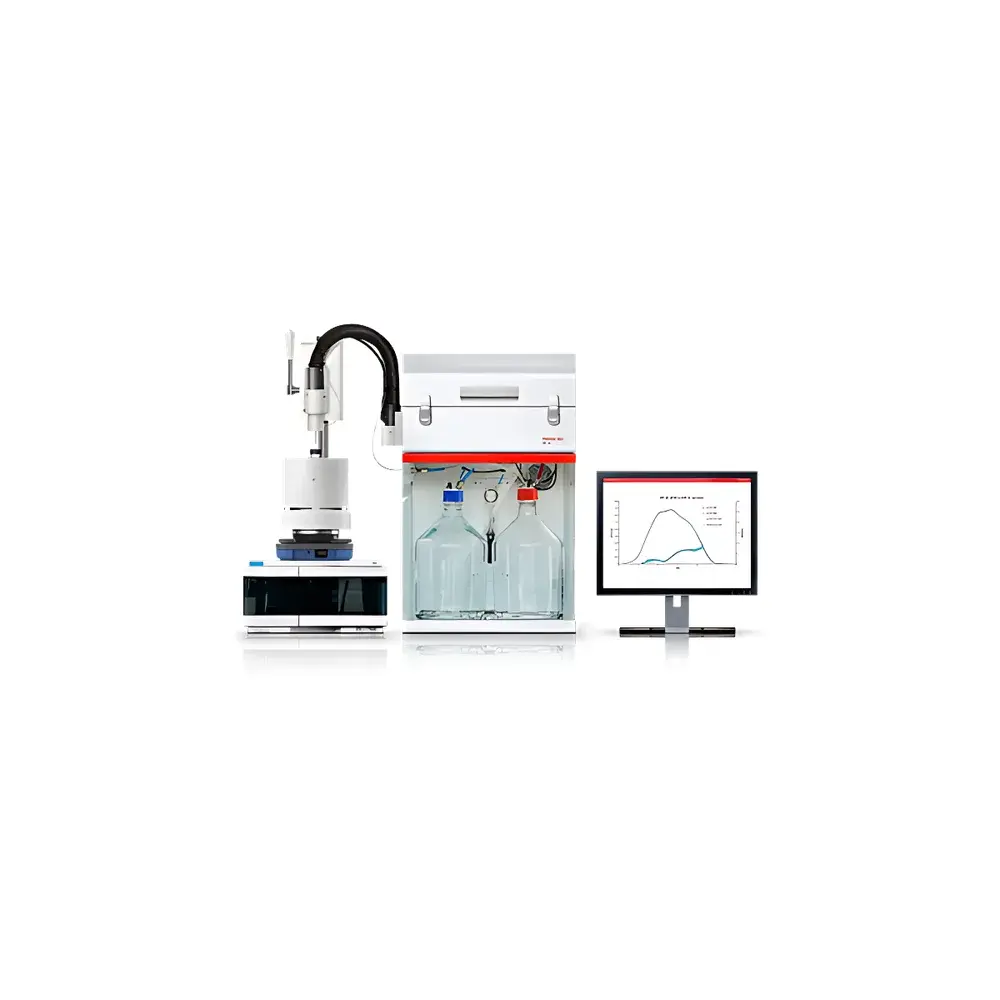
Polymer Char GPC-QC High-Temperature Gel Permeation Chromatography System for Rapid Quality Control
| Brand | Polymer Char |
|---|---|
| Origin | Spain |
| Model | GPC-QC |
| Operating Temperature Range | 140–160 °C |
| Analysis Time per Sample (incl. dissolution) | ≤30 min |
| Detection | IR5 Selective Infrared Detector (C–H stretch, 3.42 µm) |
| Concentration Sensitivity | 0.125 mg/mL (S/N ≥60) |
| Optional Detectors | Dual Capillary Viscometer (IV), IR4 |
| Column Configuration | Pre-packed High-Throughput GPC Columns (macroporous crosslinked polystyrene/divinylbenzene, calibrated for polyolefins) |
| Software Compliance | Audit-trail enabled, 21 CFR Part 11–ready data handling |
| Sample Throughput | Up to 24 samples unattended |
| Dimensions | Benchtop (W × D × H: 750 × 600 × 550 mm) |
Overview
The Polymer Char GPC-QC is a purpose-built, high-temperature gel permeation chromatography (HT-GPC) system engineered exclusively for real-time molecular weight distribution (MWD) analysis in polyolefin manufacturing environments. Unlike conventional research-grade GPC platforms, the GPC-QC operates on a robust, simplified workflow grounded in Couette-flow dissolution and high-temperature steric exclusion chromatography (140–160 °C in 1,2,4-trichlorobenzene). It delivers full MWD profiles—including Mn, Mw, Mz, dispersity (Đ), intrinsic viscosity ([η]), and short-chain branching (SCB) content—within 30 minutes per sample, including automated dissolution. Its design targets ISO 16014-4, ASTM D6474, and ASTM D5296 compliance while meeting GLP/GMP operational requirements for in-process quality control laboratories.
Key Features
- Benchtop footprint with fully automated sample handling: single-step weighing initiates dissolution, filtration, injection, separation, and detection without manual intervention
- Integrated IR5 selective infrared detector tuned to C–H asymmetric stretch (3.42 µm), delivering exceptional specificity for polyolefin backbone quantification and eliminating solvent or additive interference
- Dedicated high-temperature dissolution module with programmable heating ramp (up to 160 °C) and inert gas purging to prevent thermal degradation of UHMWPE and LLDPE
- Optimized column set featuring macroporous, low-backpressure packing (mean pore diameter >10⁵ Å) to accommodate ultra-high-molecular-weight polyethylenes (UHMWPE) up to 10⁷ g/mol without clogging
- Optional dual-capillary differential viscometer for simultaneous intrinsic viscosity and branching ratio calculation (g′/g″)
- Pre-calibrated polymer standards traceable to NIST SRM 1475a and Polymer Char’s proprietary polyethylene reference materials
- Embedded method validation tools: system suitability checks (peak symmetry, resolution between PS standards), carryover assessment, and baseline drift monitoring
Sample Compatibility & Compliance
The GPC-QC is validated for polyolefin matrices including HDPE, LDPE, LLDPE, PP homopolymers and copolymers, ethylene–octene elastomers, and UHMWPE. It accepts raw reactor powder, extruded pellets, and solution-cast films after minimal pretreatment (drying under vacuum at 60 °C). All hardware components contacting solvents or samples are constructed from high-purity stainless steel and PEEK, ensuring compatibility with aggressive chlorinated solvents at elevated temperatures. The system supports IQ/OQ documentation packages aligned with ISO/IEC 17025 and meets essential requirements for FDA-regulated environments: electronic signatures, audit trails, user role-based access control, and data integrity safeguards per ALCOA+ principles.
Software & Data Management
GPC-QC is operated via Polymer Char’s QC-Analyzer software—a dedicated platform built on Microsoft .NET Framework with native support for 21 CFR Part 11 compliance. The interface provides real-time chromatogram visualization, automatic peak integration using second-derivative algorithms, and batch processing for trend analysis across production lots. All raw data (IR5 absorbance vs. time, viscometer voltage output, pressure logs) are stored in encrypted, tamper-evident .qcd files. Reporting modules generate PDF certificates compliant with internal QA templates or external customer specifications—including summary tables with confidence intervals (n = 2 injections per sample, RSD <1.8% for Mw in UHMWPE at 0.125 mg/mL).
Applications
- Rapid grade verification during plant start-up and transition batches
- In-line monitoring of multi-zone loop or gas-phase reactors to track MWD shifts correlated with catalyst activity or hydrogen concentration
- Microstructure characterization of tubular LDPE: quantifying long-chain branching (LCB) via co-injection with viscometry and universal calibration
- QC release testing for medical-grade polyethylene (ISO 5832-2) and cable insulation resins (IEC 60811-503)
- Supporting Design of Experiments (DoE) in pilot plants by enabling same-day feedback loops between process parameters and polymer architecture
FAQ
What polyolefin molecular weight ranges does the GPC-QC reliably characterize?
The system is optimized for Mw from 10⁴ to >10⁷ g/mol, with validated performance for UHMWPE down to 0.125 mg/mL concentration using IR5 detection.
Can the GPC-QC be integrated into an existing LIMS or MES environment?
Yes—via standardized OPC UA and CSV export protocols; full API documentation is provided for custom middleware integration.
Is column calibration required before each analysis run?
No—factory-installed columns include permanent calibration curves referenced to primary PE standards; periodic verification (every 200 runs) is recommended using narrow-distribution controls.
How is solvent safety managed at 160 °C?
The instrument incorporates redundant temperature fuses, sealed solvent reservoirs with positive-pressure inert gas blanket, and automatic shutdown if vapor pressure exceeds 4.5 bar absolute.
Does the system support regulatory submission-ready reports?
Yes—reports include full metadata (instrument ID, analyst ID, timestamp, environmental conditions), raw signal traces, integration parameters, and statistical summaries—all digitally signed and archived with immutable audit trail.







