
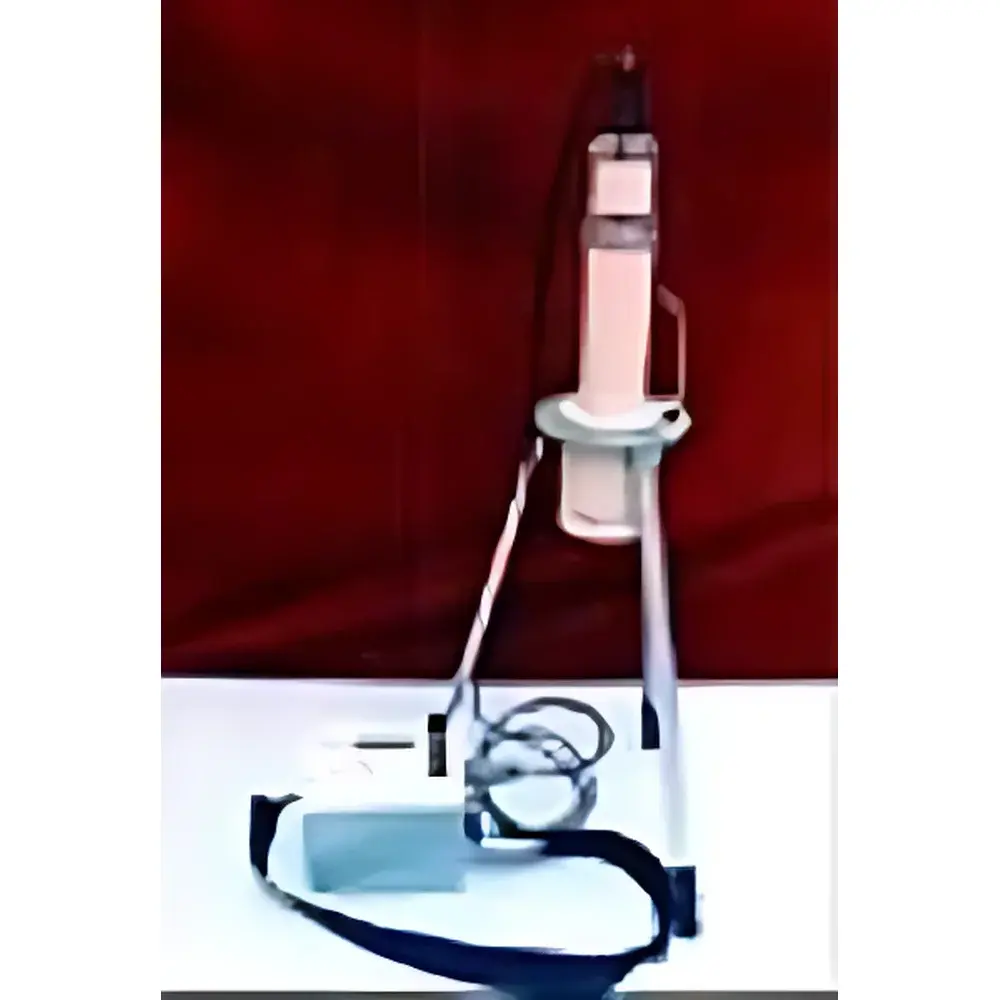
Portable X-γ Dose Rate Meter
| Origin | Beijing |
|---|---|
| Manufacturer Type | Distributor |
| Origin Category | Domestic |
| Quotation | Upon Request |
| Instrument Type | Dosimeter / Dose Rate Meter |
| Measurement Range | 0–100 μGy·h⁻¹ |
| Angular Response (¹³⁷Cs) | 0°–120° (±25%), 90°–180° (±35%) |
| Energy Response | 50 keV–3 MeV (±20%) |
| Cosmic Ray Response (vs. RSS-111 reference ionization chamber) | ±15% |
| Dose Rate Accuracy vs. Theoretical Calculation | ±10% |
| Drift After 8-h Continuous Operation at Room Temperature | ≤±7% |
| Total Error (−10°C to +40°C) | ≤±30% |
| Operating Temperature | −10°C to +40°C |
| Relative Humidity | ≤90% at +30°C ±2°C |
| Power Supply | Six No. 1 dry cells |
| Console Dimensions | 180 mm × 113 mm × 155 mm |
| Probe Dimensions | 210 mm × 120 mm × 45 mm |
| Console Weight | ~2 kg |
Overview
The Portable X-γ Dose Rate Meter is a field-deployable radiation survey instrument engineered for precise measurement of ambient air kerma rate (expressed as absorbed dose rate in air, μGy·h⁻¹) from external X-ray and gamma-ray sources. It operates on the principle of ionization detection—utilizing a pressurized or compensated ionization chamber (as specified per design configuration) to convert incident photon energy into measurable electrical current, which is then linearly correlated to dose rate via calibrated amplification and digital signal processing. Designed for routine environmental monitoring, regulatory compliance verification, and occupational health & safety assessments, this meter meets the functional requirements of ISO 4037-3 (Calibration of area and personal dosimeters for use in photon and beta radiation fields), IEC 60846-1:2014 (Radiation protection instrumentation – Ambient and/or directional dose equivalent (rate) meters and/or monitors for beta, X and gamma radiation), and supports alignment with national radiation protection guidelines (e.g., GBZ 128–2019 in China, NCRP Report No. 160 in the U.S.). Its compact form factor and battery-powered architecture enable real-time, walk-through surveys in diverse operational contexts—from nuclear medicine departments to construction material screening facilities.
Key Features
- Wide dynamic measurement range of 0–100 μGy·h⁻¹, suitable for both background-level environmental monitoring and elevated occupational exposure scenarios.
- Optimized angular response: ≤±25% deviation over 0°–120° and ≤±35% over 90°–180° relative to normal incidence for 137Cs (662 keV), ensuring reliable readings under non-perpendicular irradiation geometries typical in field deployment.
- Broad energy response across 50 keV–3 MeV (≤±20% deviation), validated against standard gamma-ray reference sources; cosmic ray contribution characterized to ±15% relative to RSS-111 high-pressure ionization chamber reference data.
- Stable long-term performance: ≤±7% additional error after eight hours of continuous operation at ambient temperature (20–25°C), supporting extended-shift radiation safety patrols.
- Rugged mechanical design with ergonomic console housing (180 × 113 × 155 mm) and detachable probe (210 × 120 × 45 mm), enabling flexible positioning during surface or airborne contamination mapping.
- Low-power operation powered by six standard No. 1 dry cells, delivering >30 hours of typical field use without recharging or replacement.
- Environmental resilience: Fully functional within −10°C to +40°C ambient temperature and up to 90% relative humidity at +30°C ±2°C—meeting IP54-equivalent ingress protection for dust and splash resistance.
Sample Compatibility & Compliance
This instrument is validated for direct measurement of X- and γ-ray fields emitted from sealed radioactive sources (e.g., 137Cs, 60Co), medical X-ray equipment (diagnostic and therapeutic), nuclear medicine isotopes (including 131I), industrial radiography systems, and naturally occurring radioactive materials (NORM) in building materials (e.g., granite, concrete, fly ash). It complies with metrological traceability requirements for field instruments under ISO/IEC 17025-accredited calibration protocols. While not inherently compliant with FDA 21 CFR Part 11 for electronic records, its analog-digital hybrid architecture allows integration into GLP/GMP-aligned workflows when paired with auditable manual logging or externally timestamped data capture. Calibration certificates are issued traceable to national primary standards (e.g., NIM, CNIM) and include uncertainty budgets per GUM (JCGM 100:2008).
Software & Data Management
The meter operates in standalone mode with real-time LCD display and audible dose-rate alerts. Optional infrared or RS-232 interface modules (sold separately) support periodic data export to PC-based analysis software for trend visualization, report generation (PDF/CSV), and archival per ALARA documentation requirements. Firmware supports user-configurable alarm thresholds, auto-zeroing routines, and battery-status diagnostics. All stored measurement logs retain timestamps, operator ID fields (via manual entry), and environmental condition tags—facilitating audit readiness under IAEA Safety Standards Series No. GS-R-3 and EU Council Directive 2013/59/Euratom.
Applications
- Environmental radiation baseline surveys and post-incident monitoring (e.g., near NPP perimeters, waste disposal sites).
- Radioactive material screening in construction aggregates, ceramics, and recycled industrial byproducts.
- Occupational dose rate assessment in radiology suites, radiotherapy bunkers, and industrial radiography work zones.
- Verification of shielding integrity in nuclear medicine laboratories handling 131I, 99mTc, or 18F.
- Regulatory compliance checks for licensees operating under national radiation protection legislation.
- Educational use in health physics training programs requiring hands-on detector characterization exercises.
FAQ
Is this instrument suitable for personal dosimetry?
No—it is an area dose rate meter designed for environmental and workplace ambient measurements, not for individual dose assessment. Personal dosimeters (e.g., TLDs or OSL badges) must be used for legal dose-of-record purposes.
Does it require annual recalibration?
Yes. Per ISO/IEC 17025 and national regulatory guidance, recalibration is recommended at least once per year—or after any physical shock, repair, or suspected performance drift—to maintain metrological validity.
Can it distinguish between X-ray and gamma-ray spectra?
No. It provides total photon dose rate without spectral discrimination. Energy-compensated response ensures accuracy across mixed fields but does not enable source identification or nuclide-specific quantification.
What is the typical calibration uncertainty?
When calibrated against a national standard reference field (e.g., 137Cs at 662 keV), expanded uncertainty (k = 2) is typically ≤±4.5% for the 0.1–10 μGy·h⁻¹ range and ≤±6.0% across the full 0–100 μGy·h⁻¹ span.
Is firmware upgrade supported in the field?
Firmware updates require connection to a dedicated service terminal and authorized access credentials; end users cannot perform upgrades independently. Contact the distributor for scheduled maintenance windows and version release notes.
Related Products







