
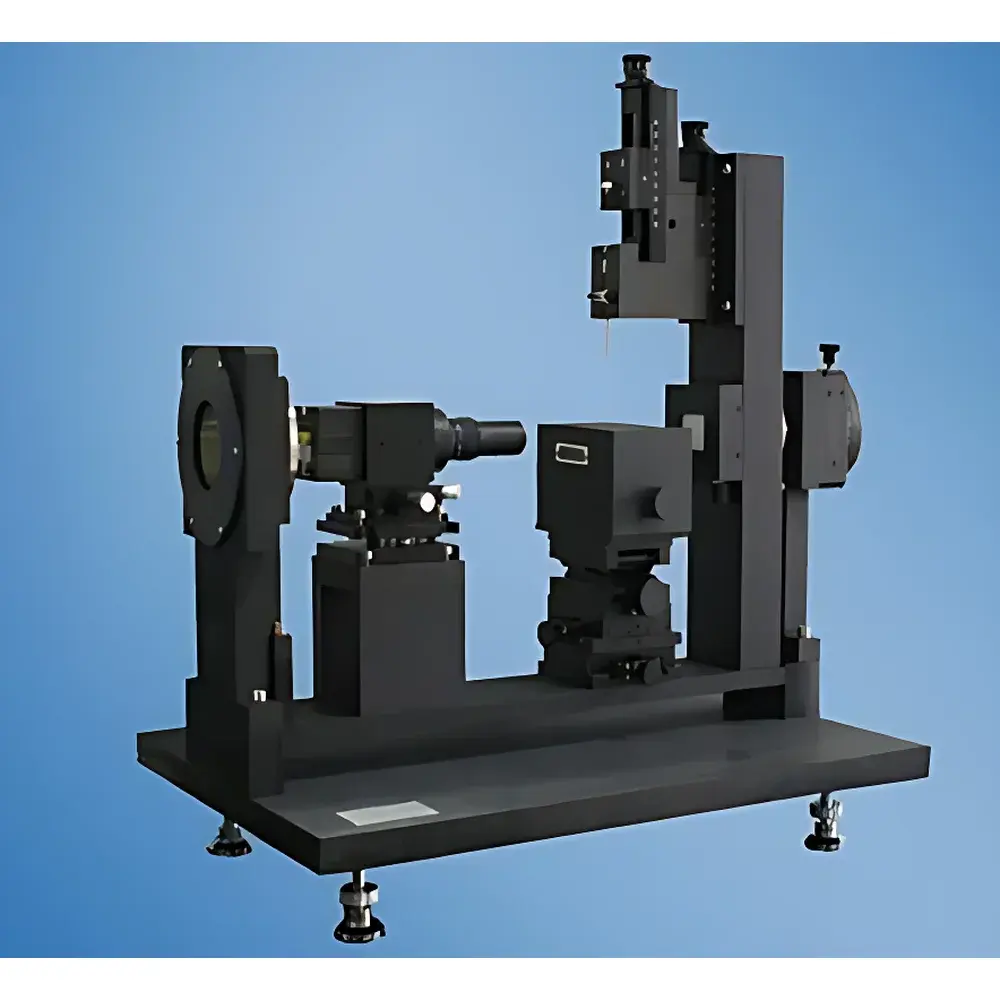
PowerView JC2000D4M Dynamic High-Temperature Automated Contact Angle Goniometer
| Origin | Beijing, China |
|---|---|
| Manufacturer Type | Authorized Distributor |
| Origin Category | Domestic (China) |
| Model | JC2000D4M |
| Price Range | USD 7,000–14,000 |
| Instrument Class | Dynamic Contact Angle Analyzer |
| Form Factor | Benchtop Laboratory System |
| Contact Angle Range | 0–180° |
| Contact Angle Accuracy | ±0.1° |
| Roll-Off Angle Resolution | 0.2° |
| Sample Stage Dimensions | 100 × 100 mm |
| Optical Magnification | 0.7–5× (55–320 pixels/mm) |
| Surface/Interfacial Tension Range | 0–1000 mN/m |
Overview
The PowerView JC2000D4M Dynamic High-Temperature Automated Contact Angle Goniometer is an engineered precision instrument designed for quantitative characterization of solid–liquid–vapor interfacial interactions under controlled thermal conditions. Based on the sessile drop, pendant drop, captive bubble, and tilting plate methods, it employs high-resolution optical imaging coupled with advanced geometric contour analysis to determine contact angle hysteresis, advancing/receding angles, roll-off behavior, and dynamic wetting kinetics. Its integrated heating stage supports temperature-controlled measurements from ambient up to 400 °C — enabling investigation of thermally responsive surfaces, polymer melt wettability, high-temperature catalytic substrates, and molten salt or metal interface behavior. The system conforms to foundational principles outlined in ASTM D7334 (Standard Practice for Surface Wettability of Coated Surfaces), ISO 19403-2 (Contact Angle Measurement by Optical Methods), and complements GLP-compliant workflows through audit-trail-capable software logging.
Key Features
- High-temperature heated sample stage (ambient to 400 °C) with ±0.1 °C thermal stability and programmable ramp profiles
- Motorized XYZ manual positioning system: ±50 mm XY travel (0.1 mm resolution), 45 mm Z travel (0.01 mm resolution), and full 360° rotational platform (0.2° angular resolution)
- Dual-mode fluid dispensing: Precision syringe pump with interchangeable calibrated tips (5 μL, 10 μL, 50 μL, 100 μL, and disposable 1 mL cartridges) and PTFE-coated needles for low-adhesion delivery
- Optical subsystem featuring industrial-grade continuous zoom lens (0.7–5× magnification), 25 fps CCD camera (640 × 780 resolution, 0.0005 lux sensitivity), and adjustable cold LED backlight with acrylic diffuser for glare-free silhouette imaging
- Multi-algorithm contact angle analysis engine supporting six validated methods: tangent-based height measurement, five-point polynomial fitting, protractor-based manual annotation, Wilhelmy plate approximation, pendant drop shape fitting (Young–Laplace equation), and captive bubble inversion
- Surface energy modeling suite with nine established theoretical models (e.g., Owens–Wendt, Fowkes, Wu harmonic mean, van Oss–Chaudhury–Good) applicable to both low-energy polymers and high-energy ceramics/metals
Sample Compatibility & Compliance
The JC2000D4M accommodates diverse physical forms including rigid solids (films, wafers, ceramics), flexible substrates (fibers, textiles, membranes), compressed powders, and patterned microstructures. Its 100 × 100 mm stage — with a central 40 × 60 mm heated zone — ensures uniform thermal distribution across standard coupon sizes. The system supports ISO 27448 (photocatalytic activity assessment), ASTM D5725 (coating wettability), and USP guidelines for analytical instrument qualification when configured with user-defined SOPs and electronic signature-enabled reporting. All firmware and software modules are structured to support 21 CFR Part 11 readiness, including secure user authentication, immutable audit trails, and version-controlled method storage.
Software & Data Management
PowerView Analysis Suite v5.2 provides fully automated image acquisition, real-time contact angle calculation, and batch processing for time-series or multi-location experiments. It enables synchronized video capture (AVI export), frame-by-frame manual correction, left/right asymmetry quantification, and hysteresis loop generation. Surface tension values are derived via pendant drop shape analysis using numerical solutions of the Young–Laplace equation. All results — including fitted curves, contact angle histograms, surface energy component breakdowns, and CMC determinations — are exportable to Excel-compatible CSV or PDF reports. Database functions include encrypted backup, compression archiving, metadata tagging (operator, date, temperature, solvent ID), and direct overlay of numerical results onto annotated images for publication-ready documentation.
Applications
This goniometer serves critical R&D and QC functions across multiple regulated and industrial domains: evaluation of anti-fouling coatings on biomedical devices (ISO 10993-5); optimization of inkjet print head nozzle wettability; characterization of hydrophobic/hydrophilic textile finishes; screening of catalyst support wettability in fuel cell membrane electrode assemblies; thermal stability assessment of encapsulant resins in photovoltaic modules; surface energy mapping of plasma-treated polymer films; and interfacial analysis of molten solder alloys on PCB substrates. Academic users apply it to nanomaterial functionalization studies — particularly in evaluating silane coupling agent efficacy on silica nanoparticles or graphene oxide dispersion stability.
FAQ
What temperature range does the heated stage support?
The integrated Peltier-assisted heating platform operates from ambient temperature up to 400 °C, with closed-loop PID control ensuring ±0.1 °C thermal accuracy and repeatability.
Can the system measure contact angles on fibrous or porous samples?
Yes — the combination of high-magnification optics, adjustable illumination geometry, and multi-method analysis allows robust measurement on non-planar, textured, or absorbent surfaces, including single fibers and nonwovens, provided appropriate droplet volume and deposition control are applied.
Is the software compliant with FDA 21 CFR Part 11 requirements?
While the base software includes electronic logbooks, user access controls, and audit trail generation, formal Part 11 compliance requires site-specific validation protocols, including IQ/OQ/PQ documentation, which are supported through optional validation packages and on-site qualification assistance.
Does the instrument support interfacial tension measurement for liquid–liquid systems?
Yes — using the pendant drop method with dual-phase immiscible liquids (e.g., oil–water), the system calculates interfacial tension within the same 0–1000 mN/m range, leveraging the same Young–Laplace curve-fitting algorithm.
What calibration standards are recommended for routine verification?
Certified contact angle reference slides (e.g., Krüss KRUSS-CA-STD series) with known static angles (e.g., 35°, 65°, 110°) are recommended for daily performance checks; thermal calibration is verified using NIST-traceable RTD probes placed directly on the stage surface.



