
PPLN Crystal – Custom-Designed Periodically Poled Lithium Niobate Device
| Brand | HCP (Longcai Technology) |
|---|---|
| Origin | Taiwan |
| Manufacturer Type | Authorized Distributor |
| Model | PPLN-Custom |
| Pricing | USD 2,800 (FOB Taiwan) |
| Substrate | MgO-doped LiNbO₃ |
| Poling Period Range | 2.5–35 µm |
| Maximum Crystal Length | 80 mm |
| Maximum Aperture Width | 40 mm |
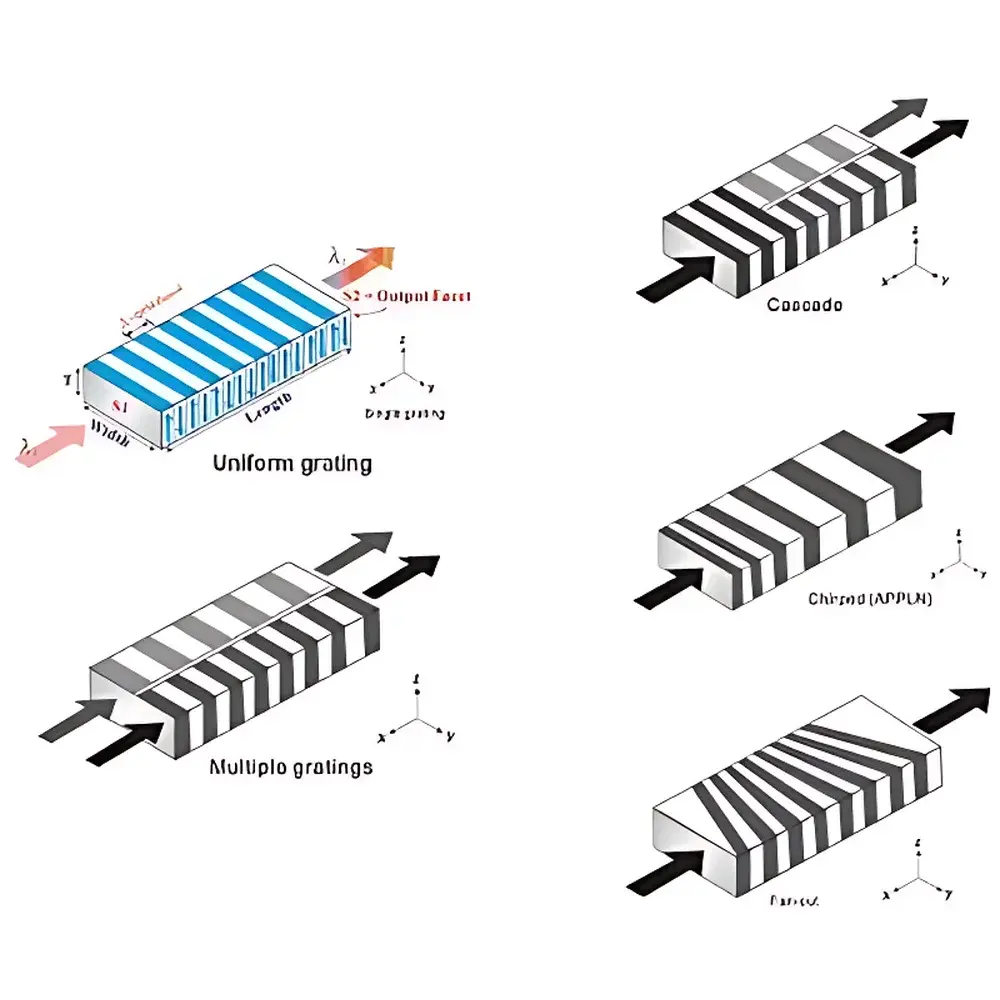
| QPM Configurations | Multi-period, Chirped, Fan-out, Step-chirped, and Radially Symmetric Gratings |
| Coating Options | AR/HR @ 532/780/1064/1550 nm |
| Mounting Options | Chip-on-Carrier (COC), Kinematic Mount, Fiber-Pigtailed Module Integration |
Overview
Custom-designed Periodically Poled Lithium Niobate (PPLN) crystals are nonlinear optical components engineered for precise quasi-phase-matching (QPM) in second-harmonic generation (SHG), optical parametric oscillation (OPO), difference-frequency generation (DFG), and electro-optic modulation applications. Unlike off-the-shelf PPLN wafers, this service delivers fully tailored ferroelectric domain structures—fabricated via high-resolution electric-field poling—optimized for specific wavelength conversion targets, pulse duration regimes (fs to CW), beam geometry, and thermal stability requirements. The core substrate is congruent or MgO-doped lithium niobate, selected for enhanced photorefractive resistance and broad transparency from 350 nm to 5.2 µm. Each custom crystal undergoes rigorous domain uniformity verification using piezoresponse force microscopy (PFM) and SHG microscopy, ensuring >98% grating duty-cycle fidelity across the full aperture.
Key Features
- Fully configurable QPM grating architecture—including multi-period, chirped, fan-out, step-chirped, and radially symmetric designs—to support broadband tunability, group-velocity matching, or spectral narrowing.
- Extended physical dimensions: up to 80 mm crystal length and 40 mm aperture width, enabling higher effective nonlinear interaction length and improved power handling for high-energy pulsed systems.
- Sub-micron poling period control (2.5–35 µm range) with ±0.5% period accuracy, verified by X-ray diffraction and SHG mapping.
- AR/HR dielectric coatings optimized for key laser wavelengths (e.g., 532 nm pump + 1064 nm signal/idler; 780 nm + 1550 nm telecom bands), deposited via ion-beam sputtering for 500 MW/cm² (10 ns, 1064 nm).
- Flexible integration options: bare chip, chip-on-carrier (COC) with thermal-electric cooler (TEC) interface, kinematic mount with angular adjustment (±2°), or fiber-pigtailed module with PM-fiber coupling and integrated temperature stabilization.
- Compliance with ISO 10110-7 (surface quality), ISO 14997 (laser damage threshold testing), and IEC 61290-4 (nonlinear optical device characterization).
Sample Compatibility & Compliance
This custom PPLN platform supports integration with Ti:sapphire, Yb-fiber, Nd:YAG, and semiconductor disk lasers operating in CW, Q-switched, or mode-locked regimes. Crystals are qualified per MIL-STD-883H (method 2010.10) for thermal cycling (−40°C to +85°C, 100 cycles) and mechanical shock (1,500 g, 0.5 ms). All fabricated devices include full traceability documentation: wafer lot ID, poling mask design file hash, coating spectral data, and SHG efficiency calibration report at reference conditions (e.g., 1064 nm → 532 nm, 1 W input, 25°C). Design files and test records are archived for GLP-compliant audit trails upon request.
Software & Data Management
HCP provides a proprietary QPM design suite (PPLN-Designer v3.2) for pre-fabrication simulation—supporting coupled-wave modeling, thermal phase-matching analysis, and walk-off compensation optimization. Exportable outputs include MATLAB-compatible .mat files, Gerber-format poling mask layouts, and JSON-encoded fabrication parameters. Raw metrology data (PFM amplitude/phase maps, SHG intensity profiles) are delivered in HDF5 format with embedded metadata compliant with FAIR principles (Findable, Accessible, Interoperable, Reusable). For regulated environments, optional 21 CFR Part 11–compliant electronic signatures and audit logs are available through validated instrument control software (HCP-OptiControl Suite v4.1).
Applications
- Ultrafast laser systems: Chirped QPM gratings for octave-spanning OPOs and dispersion-compensated DFG sources in attosecond science.
- Quantum photonics: Fan-out PPLN chips for wavelength-multiplexed SPDC photon-pair generation with deterministic spectral engineering.
- Mid-IR spectroscopy: Multi-stage PPLN-based DFG modules targeting 3–5 µm atmospheric windows with <1 cm⁻¹ linewidth control.
- Industrial sensing: Compact, TEC-stabilized SHG modules for fiber-laser-based gas detection (e.g., CH₄ at 1653 nm → 826.5 nm).
- Defense & aerospace: Radiation-hardened, shock-mounted PPLN OPOs for airborne LIDAR and countermeasure systems requiring SWaP-C optimization.
FAQ
What minimum lead time is required for a custom PPLN design cycle?
Standard lead time is 12–14 weeks from finalized mask design approval, inclusive of substrate preparation, domain poling, coating, metrology, and packaging. Expedited options (8-week delivery) are available with priority scheduling surcharge.
Can you fabricate PPLN with non-planar domain geometries (e.g., curved or 3D poled structures)?
Yes—curved QPM gratings on convex/concave substrates are supported for intracavity enhancement and aberration-corrected nonlinear conversion; 3D domain engineering remains under R&D collaboration with academic partners.
Do you provide temperature-tuning curves and Sellmeier coefficients for custom-doped MgO:LN substrates?
Yes—each batch includes experimentally measured temperature-dependent phase-matching curves (±0.1°C resolution) and substrate-specific Sellmeier coefficients fitted to 0.4–5.2 µm spectral range.
Is post-fabrication re-poling or domain erasure possible?
No—ferroelectric domains in LiNbO₃ are stable above Curie temperature (1140°C); however, localized domain rewriting via micro-electrode poling is feasible for limited-area corrections under cleanroom conditions.
Are RoHS and REACH compliance certifications available?
Yes—all materials, coatings, and packaging meet EU Directive 2011/65/EU (RoHS2) and Regulation (EC) No 1907/2006 (REACH), with full SVHC screening reports provided upon order confirmation.





