
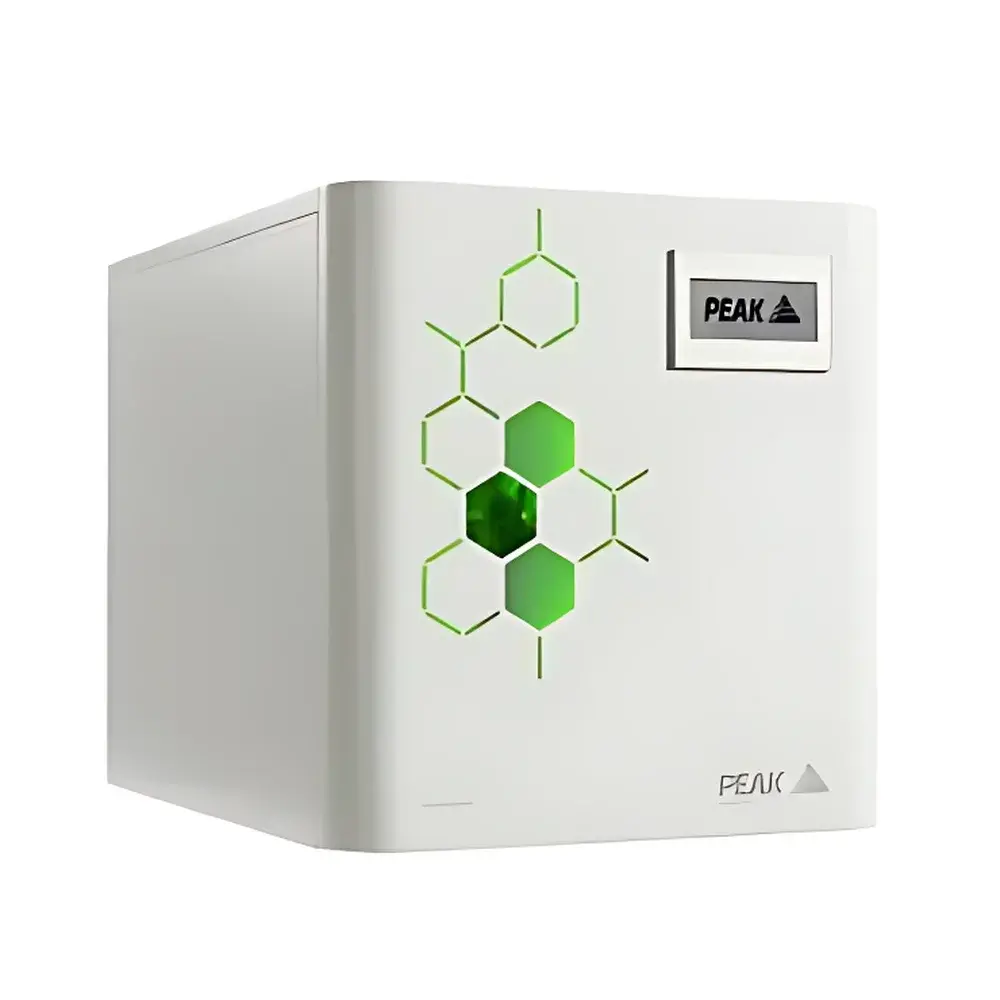
Precision Hydrogen Trace 250 by PEAK Scientific
| Brand | PEAK |
|---|---|
| Origin | United Kingdom |
| Manufacturer Type | Original Equipment Manufacturer (OEM) |
| Import Status | Imported |
| Model | Precision Hydrogen Trace 250 |
| Hydrogen Generation Principle | Pure Water Electrolysis via Proton Exchange Membrane (PEM) |
| Output Flow Rate | 250 cm³/min |
| Output Pressure | 100 psi (6.9 bar) |
| Hydrogen Purity | 99.9999% (6.0 N) |
| Maximum Power Consumption | 600 W |
Overview
The Precision Hydrogen Trace 250 is a laboratory-grade hydrogen generator engineered specifically for demanding analytical and materials science applications—including chemical vapor deposition (CVD), gas chromatography (GC), and as fuel gas for flame ionization detectors (FID) and flame photometric detectors (FPD). Built upon a robust proton exchange membrane (PEM) electrolysis platform, it produces ultra-high-purity hydrogen (99.9999%) directly from deionized water—eliminating reliance on compressed gas cylinders and associated handling, storage, and regulatory compliance burdens. Unlike alkaline electrolyzers, PEM-based systems operate at ambient temperature and pressure, deliver rapid start-up response, and maintain stable output across variable demand. The integrated pressure regulation and dual-stage purification—comprising pressure swing adsorption (PSA) and molecular sieve drying—ensure consistent removal of residual moisture and trace contaminants to meet stringent requirements for carrier and fuel gas in trace-level analysis.
Key Features
- Proton exchange membrane (PEM) electrolysis technology for safe, efficient, and scalable hydrogen generation from deionized water
- Continuous output flow up to 250 cm³/min at regulated pressure of 100 psi (6.9 bar), suitable for single or multiple instrument supply
- Ultra-high purity hydrogen (99.9999%, <1 ppm O₂, <1 ppm H₂O, <0.1 ppm total hydrocarbons) validated per ISO 8573-1 Class 1:1:1
- Onboard leak detection system with automatic shutdown upon anomaly detection—compliant with IEC 61000-6-4 electromagnetic compatibility standards
- Modular, space-saving footprint (W × D × H: 320 × 450 × 520 mm) designed for benchtop integration in controlled laboratory environments
- Intelligent power management: dynamic load adjustment ensures energy consumption remains ≤600 W even at peak output
- Self-contained DI water recirculation loop with auto-refill interface; only periodic replacement of the deionization cartridge required
- Three-year limited warranty on the PEM electrolyzer stack—reflecting long-term reliability validation under continuous operation
Sample Compatibility & Compliance
The Precision Hydrogen Trace 250 is compatible with all major CVD reactor platforms requiring high-purity reducing or carrier gas, including low-pressure (LPCVD), atmospheric-pressure (APCVD), and plasma-enhanced (PECVD) configurations. It meets essential safety and quality benchmarks for analytical laboratories: CE marking per Machinery Directive 2006/42/EC and Pressure Equipment Directive 2014/68/EU; conformity with UL 61010-1 for electrical safety; and alignment with GLP/GMP documentation requirements through optional audit-ready event logging. When deployed in GC systems, its output satisfies USP , ASTM D7217, and ISO/IEC 17025 traceability expectations for carrier gas integrity. Optional hydrogen leak sensors (H₂-LD100) may be installed inside GC oven compartments for real-time monitoring per OSHA 1910.103 and NFPA 55 guidelines.
Software & Data Management
The generator operates autonomously without external PC control but supports optional RS-232 or Ethernet connectivity for integration into centralized lab infrastructure. Firmware includes configurable alarm thresholds (e.g., low water level, pressure deviation >±5 psi, purity drift >0.0001%), with timestamped event logs stored onboard for ≥30 days. Audit trail functionality complies with FDA 21 CFR Part 11 when paired with validated LIMS or ELN platforms. Remote diagnostics and predictive maintenance alerts are accessible via PEAK’s proprietary CloudConnect portal—enabling proactive service scheduling and firmware updates without onsite intervention.
Applications
- Chemical vapor deposition (CVD) processes requiring ultra-dry, oxygen-free hydrogen as precursor carrier or reduction agent
- Gas chromatography systems utilizing hydrogen as both carrier gas (for faster analysis and improved resolution) and detector fuel (FID, FPD)
- Surface science instrumentation such as XPS and AES where background contamination must be minimized
- Hydrogenation reaction monitoring in catalysis labs using in-situ FTIR or Raman
- Calibration gas blending systems requiring certified traceable hydrogen reference streams
- Research-scale fuel cell testing where consistent stoichiometric H₂ supply is critical
FAQ
What is the maximum number of CVD tools that can be supplied by one Precision Hydrogen Trace 250 unit?
Up to three standard low-flow CVD reactors (≤80 cm³/min each) may be served simultaneously, provided piping layout maintains pressure drop <5 psi and dew point remains below −70 °C.
Does the system require external cooling or ventilation?
No active cooling is needed; the unit is air-cooled and rated for continuous operation in ambient lab conditions (15–30 °C, <80% RH non-condensing).
How often must the deionization cartridge be replaced?
Typical service interval is every 6–12 months depending on feed water quality and daily runtime; the system displays a maintenance countdown and alerts 72 hours prior to expiry.
Can this generator be used for GC carrier gas in EPA Method 8260-compliant analysis?
Yes—its certified purity, pressure stability, and documented traceability satisfy method requirements for volatile organic compound (VOC) analysis when operated within specified environmental parameters.
Is remote monitoring supported out-of-the-box?
Basic status indicators (ready, fault, maintenance due) are available via front-panel LED; full telemetry requires optional Ethernet module and CloudConnect subscription.



